Protests, boycott cast shadow on Pakistan-administered Kashmir election
 03 August 2026
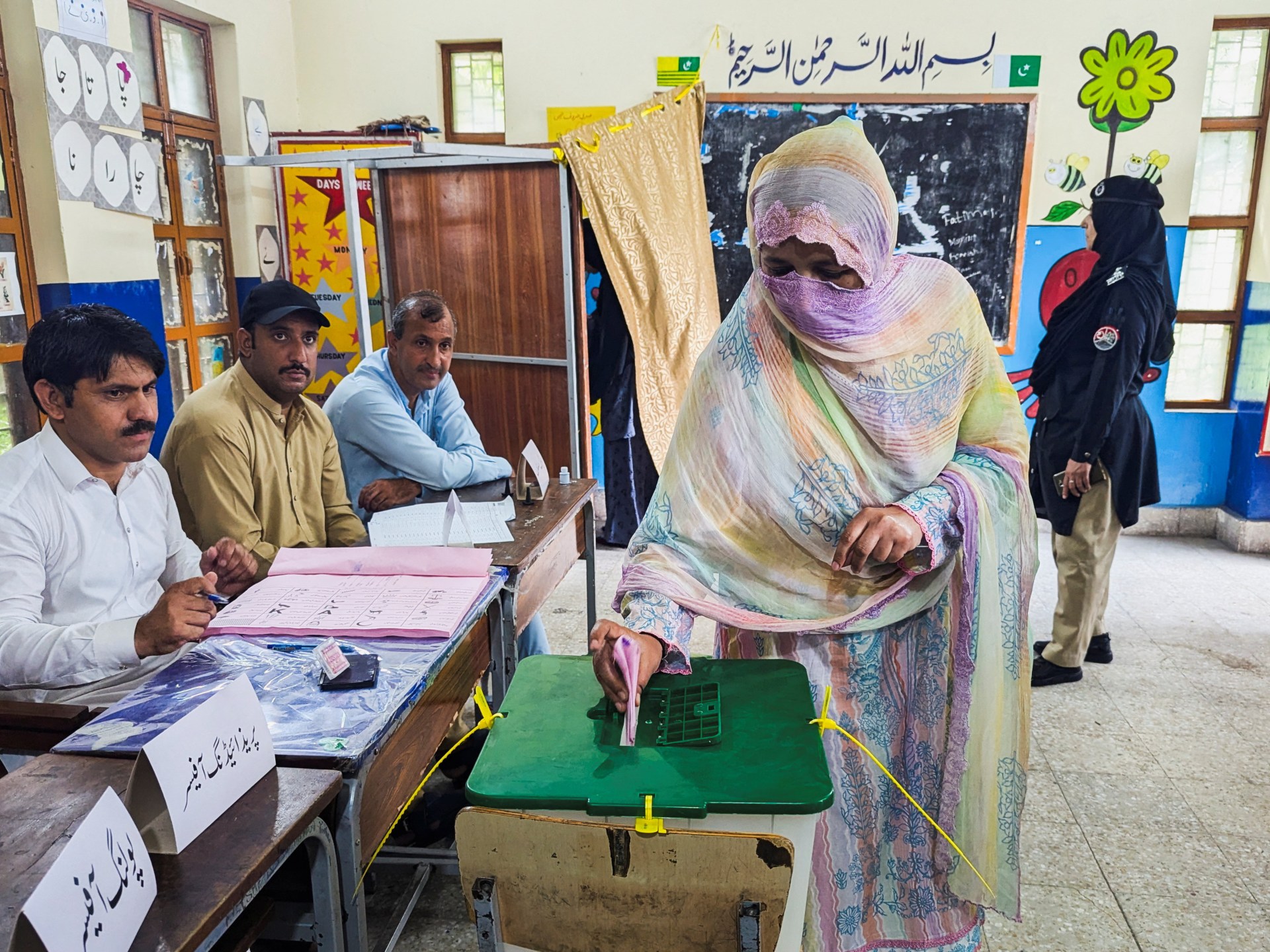

Islamabad, Pakistan – By the time polling stations opened in Muzaffarabad, the capital of Pakistan-administered Kashmir, the city had already witnessed two days of shutdowns and empty streets.
For a city meant to be voting on Sunday, it looked remarkably like one that had already decided not to.
- list 1 of 4Pakistan-administered Kashmir elections and protests – all you need to know
- list 2 of 4Pakistan’s Kashmir votes: Why the election hinges on 12 disputed seats
- list 3 of 4‘Collapsed’: Roadblocks, internet blackout leave Pakistani Kashmir in limbo
- list 4 of 4Can Pakistan-administered Kashmir’s election overcome a violent summer?
end of list
The unrest dates back to June 5 when authorities banned the Jammu Kashmir Joint Awami Action Committee (JAAC), a local pressure group, for holding demonstrations over rising prices and governance.
The JAAC protests soon evolved into a campaign demanding the abolition of 12 seats in the regional Legislative Assembly reserved for displaced Kashmiris living elsewhere in Pakistan.

As the JAAC protests intensified, Pakistani authorities launched a crackdown on its leaders. Meanwhile, weeks of marches, negotiations and crackdowns forced the Election Commission to split the voting into three phases.
The Mirpur division voted on July 27, followed by the Muzaffarabad division and the 12 refugee constituencies on Sunday. The Poonch division, the JAAC’s stronghold and the site of its deadliest clashes with authorities, is to vote last on August 10.
An intermittent internet shutdown stretching beyond 50 days has disrupted campaigning and made reporting from the region increasingly difficult.
Eight weeks of unrest
The second phase of voting began at 8am (03:00 GMT) on Sunday under heavy security. Paramilitary personnel and police were deployed across Muzaffarabad.
Markets, banks and petrol stations had been closed since Friday, and public transport was suspended as deadly protests spread.
Advertisement
Residents and rights groups said the death toll has surpassed 50, including at least seven law enforcement personnel. The government has not shared an official death toll.
The JAAC said more than 60 civilians have been killed since June. Its leaders are not contesting the election, and the group has called for a boycott of the vote.
In one of Muzaffarabad’s main squares, groups of young men gathered to denounce the election and criticise the political establishment.
“We have no issue with Pakistan or its armed forces,” a man in his late 20s told Al Jazeera on condition of anonymity, fearing reprisals from the authorities. “We came out for our rights, and we are being shot at directly.”
Ahmer Gilani, 31, told Al Jazeera he had boycotted the vote in protest against the government’s crackdown on JAAC supporters “with absolutely no hint of an apology”.
“The way the government targeted protesters, … it just made me very disillusioned,” he said. “No government should shoot its own people.”

Liaqat Ali Malik, inspector general of police in Azad Jammu and Kashmir, rejected allegations that his force was responsible for civilian deaths and accused sections of the media of sympathising with the JAAC protesters.
“I have lost seven of my men. More than 200 of my officers have been injured in the last few weeks, but nobody wants to highlight the use of weapons by violent elements,” Malik told Al Jazeera on Monday.
He also alleged that JAAC supporters repeatedly tried to disrupt polling.
“At some places, groups of young men tried to even snatch polling material both in the morning and later in the evening after the polling period ended,” he said.
‘Under shadow of gun’
For many Muzaffarabad residents, the election was less about candidates or manifestos than a verdict on a political class they believe has exploited them for decades.
“We do not want to bring these politicians back to power by voting for them,” a resident in Muzaffarabad told Al Jazeera while declining to give his name. “People are dying and being injured while fighting for our rights.”
A first-time voter said she changed her mind about exercising her right after the deaths in Rawalakot, Mirpur and Kotli towns in recent weeks. “Where were they when people were dying?” she asked of the candidates canvassing for votes.
Another resident, who had also never voted before, was equally dismissive.
“These politicians exploit every vote they get for their own interests. This time, voting for them would have been like voting for your own killer,” he said, requesting anonymity.
Advertisement
“They are holding elections under the shadow of the gun only to gain power, and they can go to any extent for power and financial interests.”
Not everyone, however, stayed away.
Yasir Josh, a 28-year-old, said he voted for the Pakistan People’s Party (PPP), the region’s governing party, “because PMLN wants to form a government with a two-thirds majority and commit tyranny”. The PMLN refers to Prime Minister Shehbaz Sharif’s Pakistan Muslim League-Nawaz party.

Voting was cancelled in two constituencies due to heavy rain and landslides. Some residents claimed JAAC protesters cut off access routes. Repolling is scheduled for Tuesday.
Al Jazeera contacted several JAAC leaders for comment but was unable to reach them.
Meanwhile, the PPP said one of its workers, Syed Mushtaq Shah, was killed in an attack by PMLN supporters on Sunday. The PMLN rejected the allegation, saying Shah suffered a cardiac arrest after a scuffle.
Despite the JAAC’s boycott call, election officials claimed a turnout of nearly 50 percent, more than the 46 percent figure recorded in the first phase, but still less than the more than 60 percent recorded in the 2021 and 2016 elections.
“This election, in current circumstances, was a massive challenge, and I am very grateful to God that we have successfully delivered two phases so far,” Chief Election Commissioner Ghulam Mustafa Mughal told Al Jazeera.
Mughal said the governing PMLN won 14 of the 18 seats whose results had been declared so far while the PPP won the other four.
The PPP also alleged widespread rigging, a charge Mughal rejected, arguing that the ruling party’s losses proved the process was fair.
Attention now shifts to the Poonch division, a JAAC stronghold.
The area is expected to see more demonstrations leading up to August 10 with marches to Muzaffarabad planned in the next 48 hours.
Additional reporting by Farhan Tariq in Muzaffarabad
Related News

How much disaster aid will the US provide to Venezuela?
Top IRS lawyer to resign post amid disagreements with Trump administration
Iran war live: Tehran warns of ‘decisive’ response to any US ‘aggression’