
Plaskett and Potter Win Democratic Primary as Turnout Reaches 47.75 Percent
 01 August 2026
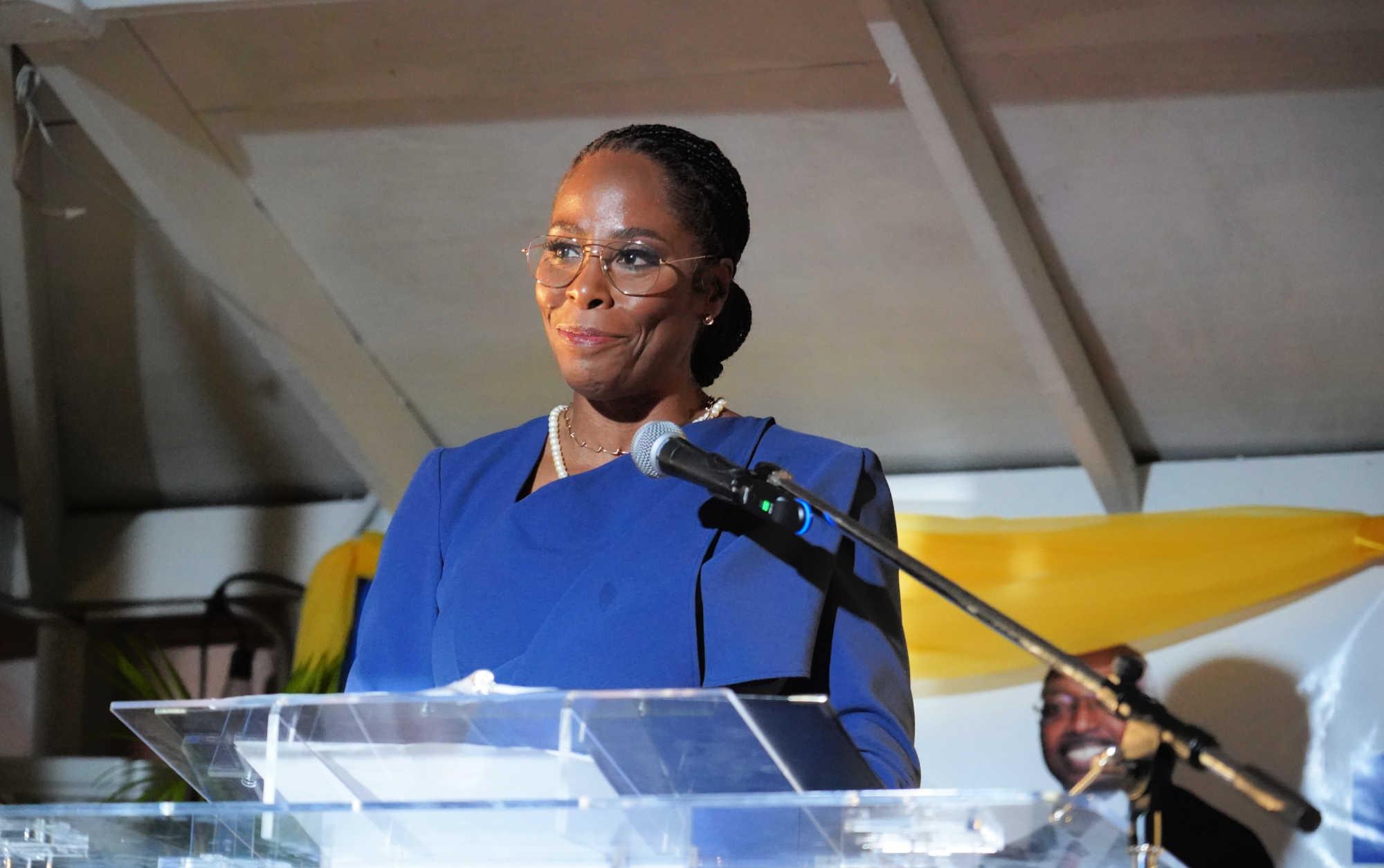

ST. CROIX — With turnout reaching 47.75 percent and nearly 10,000 voters casting ballots, Delegate to Congress Stacey E. Plaskett and Senate President Milton E. Potter won the Democratic primary for governor and lieutenant governor Saturday, defeating two rival tickets after a campaign centered on whether the territory’s unprecedented federal resources were producing measurable results at home.
An unofficial territorial election summary released at 8:46 p.m. showed Plaskett and Potter receiving 4,493 votes, or 46.99 percent of the 9,561 votes cast in the gubernatorial contest.
Lieutenant Governor Tregenza Roach and Senator Novelle E. Francis Jr. finished second with 3,054 votes, or 31.94 percent, while former senator Donna Frett-Gregory and Rodney Moorehead placed third with 1,975 votes, or 20.66 percent. Another 39 votes were cast for write-in candidates.
Plaskett and Potter led their nearest opponents by 1,439 votes, a margin of just over 15 percentage points, giving the ticket a commanding plurality in the three-way contest.
The results remain unofficial. The Elections System’s amended calendar schedules certification of the primary election results for August 11. Plaskett and Potter are now positioned to represent the Democratic Party in the November 3 general election.
The election summary reported 9,991 ballots cast territorywide, including 17 blank ballots. The final unofficial count was 2,878 ballots higher than the 7,113 recorded when early voting ended Wednesday. Early voters alone represented 34 percent of the territory’s active registered Democrats, with 3,461 ballots cast on St. Croix, 3,444 on St. Thomas and 208 on St. John.
The participation level represented a sharp increase over the 2022 Democratic primary, when 7,064 ballots were cast and turnout stood at 20.36 percent. Saturday’s unofficial count was 2,927 ballots higher than four years ago, while the turnout rate more than doubled, even as the territory’s Democratic registration base declined substantially.
Plaskett and Potter’s victory closed a political season that became a sustained argument over three competing approaches to governing the Virgin Islands: the federal relationships and urgency offered by Plaskett, the executive experience and continuity presented by Roach, and the local financial and management discipline emphasized by Frett-Gregory.
Plaskett formally launched her campaign in Frederiksted on April 18, pairing her bid for Government House with Potter, a sitting senator and the president of the 36th Legislature.
From the beginning, she argued that the territory had gained access to enormous federal resources but had not converted those opportunities into reliable electricity, modern hospitals, completed schools, affordable housing or a sufficiently rapid disaster recovery.
Her campaign presented the central question as one of execution: whether a leader with established federal relationships could compel the local government to move projects faster, coordinate agencies more effectively and produce visible improvements in residents’ daily lives.
At her campaign launch, Plaskett proposed developing two nationally accredited hospitals within six years, recruiting additional medical professionals and building a local healthcare workforce. She also placed senior care and mental-health facilities among her priorities.
Her education platform included expanded early-literacy and after-school programs, stronger mathematics and reading performance, incentives to recruit and retain teachers, and additional technical and trade opportunities for students.
On WAPA, Plaskett called for greater transparency surrounding the territory’s energy-reconstruction plans. During the campaign, she proposed batteries at electrical substations as an immediate reliability measure, followed by microgrids, renewable-energy development and a longer-term restructuring of power generation.
Potter supplied the ticket with extensive local government and legislative experience and sought to connect Plaskett’s federal record with the everyday responsibilities of territorial administration.
During the lieutenant governor debates, he argued that the territory’s banking, insurance and government systems were not working adequately for ordinary residents. He proposed greater banking competition, additional training and staffing for financial regulators, stronger employee development and more accountability within the Office of the Lieutenant Governor.
Potter also proposed convening a banking summit involving existing financial institutions, prospective entrants and consumers. He said additional competition could expand the financial products available to Virgin Islanders and pressure institutions already operating locally to improve their services.
Potter, Francis and Moorehead ultimately agreed on one significant transparency measure: producing public, island-by-island lending results showing how financial institutions were serving residents of St. Croix, St. Thomas and St. John.
Roach and Francis entered the race asking voters to value experience, institutional knowledge and the work already underway within the Bryan-Roach administration.
Roach pointed to modernization within the Office of the Lieutenant Governor, the Street Addressing Initiative, free tuition at the University of the Virgin Islands, composite-pole installation, underground utility work and economic-development plans for the South Shore of St. Croix.
Francis emphasized his legislative, public-safety and government-management background and argued that the ticket could begin governing without an extended learning period. Together, they presented more than six decades of public service as an advantage in managing the next phase of disaster recovery and government operations.
Frett-Gregory and Moorehead offered a different alternative, presenting themselves as a management-focused team capable of replacing government announcements and political explanations with disciplined execution.
Frett-Gregory relied on more than three decades of experience in public finance, education, the executive branch and the Legislature. She emphasized government accountability, healthcare access, workforce development and measurable performance.
Moorehead focused on property appraisals, staffing, insurance access, digitization and faster delivery of services within the Office of the Lieutenant Governor. Their campaign argued that longstanding government problems would not be solved by federal relationships or continuity alone, but through stronger local management and direct responsibility for results.
Those differences were tested repeatedly during the debate season.
At the first major gubernatorial debate, Plaskett, Roach and Frett-Gregory clashed over who should be held responsible for the territory’s unresolved problems and whose experience was best suited to fixing them.
Plaskett argued that federal funding and opportunities had not been effectively managed locally. Roach defended the administration’s record and asked voters to distinguish between his statutory responsibilities as lieutenant governor and the powers exercised by the governor. Frett-Gregory maintained that effective leaders must accept responsibility during both successful and difficult periods.
Their disagreement extended across WAPA, healthcare, education, insurance, housing, workforce development, crime, tourism, federal funding and the territory’s declining population.
The V.I. Consortium-WTJX gubernatorial debate later subjected the candidates to nearly two hours of questioning on corruption, WAPA, healthcare, economic development, crime, the cost of living and government performance.
Plaskett and Roach were questioned about their responses to the convictions of former Police Commissioner Ray Martinez and former cabinet members Jenifer O’Neal and Calvert White.
Plaskett proposed stronger ethics rules governing members of future administrations. Roach called for increased staffing at the Office of the Inspector General and recurring ethics and conflict-of-interest training. Frett-Gregory proposed fully funding the inspector general and establishing a public corruption hotline.
The candidates also offered different first-100-day approaches to WAPA. Roach proposed an immediate forensic audit. Plaskett said she would examine whether the territory’s energy conditions justified a state-of-emergency response while pursuing assistance for lower-income ratepayers. Frett-Gregory proposed moving rapidly toward a private partnership involving WAPA’s revenue-generation operations.
Plaskett also entered the final stretch after facing sustained questions about her past association with Jeffrey Epstein and whether her adversarial history with President Donald Trump could complicate the territory’s relationship with the federal government.
Roach, meanwhile, was challenged to explain how he could campaign on the Bryan administration’s accomplishments while distancing himself from its failures. Frett-Gregory was pressed to show how her legislative, financial and administrative experience would translate into faster executive action from Government House.
By the closing days, the contest had become less about whether the Virgin Islands faced serious problems — all three tickets agreed that it did — and more about which combination of experience voters believed could produce change.
Plaskett and Potter argued that federal relationships, legislative knowledge and a greater sense of urgency were needed to move the territory forward. Roach and Francis asked voters to preserve experience and continue projects already underway. Frett-Gregory and Moorehead argued for a locally grounded management overhaul.
Saturday’s outcome suggests that a plurality of Democratic voters accepted Plaskett and Potter’s argument that the territory needed a stronger connection between the resources available in Washington and the execution taking place within the Virgin Islands government.
Plaskett entered election week with support from the U.S. Virgin Islands Area Labor Federation, a coalition representing approximately 4,000 workers. The federation said its selection followed a straw poll, online member voting, candidate interviews and a review of debate performances.
Former Vice President Kamala Harris also endorsed Plaskett during the campaign’s closing week, highlighting her leadership and Potter’s experience in territorial government.
The primary victory now moves Plaskett from a contest among three Democratic tickets into a broader general-election campaign involving independent candidates and voters who did not participate in Saturday’s primary.
It also places Plaskett within reach of a historic result. A victory in November would make her the first woman elected governor of the U.S. Virgin Islands.
Plaskett and Potter’s immediate political challenge will be to unite Democrats who supported Roach-Francis and Frett-Gregory-Moorehead while demonstrating that the policies presented during the primary can be converted into realistic timelines and measurable outcomes.
They must also broaden their campaign beyond the Democratic electorate and make their case to independent voters concerned about WAPA, healthcare, schools, disaster recovery, public safety, government corruption, housing and the cost of living.
The general election is scheduled for November 3.
Related News

OCR Says Cannabis Cultivation Could Begin Within Weeks, With Dispensaries Opening Before Y...
Man Found Dead After Shooting at Croixville Apartments on St. Croix

Man Charged With Burglary After Police Say He Was Found Naked in Teenager’s Bedroom at F...