Early evidence in massive Belize River fish kill points to farm runoff after flooding
BELMOPAN, Wed. Aug. 12, 2026
The Department of the Environment (DOE) says it is still working to determine the exact cause of the unusual, large‑scale fish kill reported in the Belize River Valley on August 3, but early evidence suggests that the event may have been triggered by heavy runoff from both the Santander Sugar Group and a 380-acre Mennonite-operated rice farm previously unknown to the department. The runoff followed the July 11 localized flood that dumped between 8 and 10 inches of rainfall in a few hours, inundating portions of Belmopan like never before.
Chief Environmental Officer Anthony Mai told Amandala that fish kills have occurred in the Belize River before, but “this is the first time that it happened at this magnitude.”
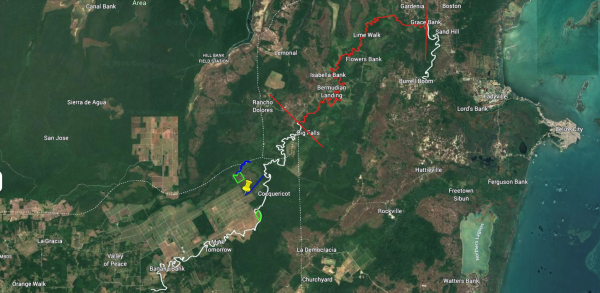
The affected stretch spanned 17.5 miles, from St. Paul’s Bank to Grace Bank, with water quality only improving near Burrell Boom.
Three possible causes and what has been ruled out
Mai explained that the DOE typically investigates three possible triggers: disease, toxic/chemical contamination, or a sudden drop in water quality caused by high organic loads that reduce dissolved oxygen levels. After consulting local experts, he said the DOE is now largely confident that the event was not caused by a disease, since multiple species, including fish, turtles, and crocodiles, were affected. Mai said a disease would normally impact only one species.
A necropsy conducted by Dr. Abel Carrias found that the fish died from hypoxia, or dangerously low oxygen levels consistent with heavy organic matter entering the water and triggering an algae bloom.
Chemical testing continues, but early signs point elsewhere
Mai said DOE teams collected water, sediment, and fish tissue samples from ten sites, including Santander’s effluent ponds and drainage network, as well as the nearby rice farm. These samples are undergoing chemical analysis, but so far, there is no strong indication of a toxic spill.
He pointed to the results of the necropsy, and said chemical poisoning typically results in discoloured or damaged internal organs and heavier bleeding, none of which were observed.
DOE hopes to complete all chemical testing by the end of this week.
Satellite imagery shows major runoff from two farms after July 11 flood
One of the strongest leads comes from satellite imagery captured before the fish kill. Mai said the images show significant flooding in agricultural areas including Santander and the large rice field north of its operations.
The DOE believes this flooding caused large volumes of organic debris and nutrients to wash into the Belize River, triggering algae blooms and oxygen depletion. “We have satellite imagery to show that the area was significantly flooded,” Mai said.
Santander reported that the northeast portion of its cane fields became flooded and was rendered inaccessible. Satellite imagery shows the rice farm was fully inundated, with water receding by July 23.
The imagery captured on July 23 shows discoloration emerging from Labouring Creek, corresponding with the date when the water receded from the rice farm. On August 2, discoloration was seen coming from Santander’s discharge outlet. The fish kill was first reported on August 3.
Water quality monitoring also showed elevated chlorophyll-A, which indicates an algae bloom.

Santander cooperating; rice farm lacked environmental clearance
Mai emphasized that Santander has been fully cooperative, opening its facilities and records to investigators. “They actually called us and said ‘our doors are open, our books are open’,” he stated. He said additional data is being collected to determine how Santander’s operation contributed to what has been taking place in the river.
However, the DOE discovered that the nearby rice farm, which is responsible for a large portion of the runoff, does not appear to have environmental clearance. The department is verifying land ownership; and once that is done, he says, the owner will be held accountable for carrying out such activity without environmental clearance.
As for Santander, Mai says DOE’s legal counsel is consulting with the Attorney General’s office on possible next steps.
Water quality improving; advisory remains in effect
Despite the severity of the event, Mai said the water quality has begun to improve, and the river is expected to recover “hopefully within the next few weeks.” Belize Water Services Ltd. (BWSL) reported improvements at its Double Run water treatment facility as of Friday, August 7, with significant improvement by August 10. However, Mai cautioned residents to remain vigilant. He noted that the eutrophication (proliferation of algae) will travel downstream and eventually reach the sea, and DOE will therefore maintain its monitoring.
The DOE’s August 7th advisory remains in effect. The public is urged not to consume fish or use untreated river water for drinking, cooking, livestock, or pets until conditions return to normal. This advisory does not apply to potable water supplied by BWSL.
Mai said the DOE will issue updates if new concerns arise, and intends to hold a public meeting with affected communities once findings are finalized.
Recommendations to prevent a repeat
For now, Mai said they have broad recommendations that will be refined as more information comes in. He highlighted the need for a watershed management plan for the Belize River, and consultations with all farms in the area to implement measures to prevent or mitigate future events.
Rice farms typically maintain shallow water across fields for most of the growing season as part of pest management. At harvest, the water is discharged, in this case, into Labouring Creek, which flows into the Belize River.
East of Santander, Mai says there are additional rice and soy fields.
An all-local group of experts conducted the investigation
Mai shared that the DOE used a new approach for this investigation, assembling two teams of local experts. Some 15 partner agencies assisted. For the river monitoring, there was participation from area representative Hon. Marconi Leal, Jr., the Ministry of Health, the University of Belize (UB), Belize Water Services, the Coastal Zone Management Authority and Institute, and the Fisheries Department. UB also assisted with chemical analysis and data interpretation, BWSL with water quality data, the Forest Department with remote sensing data (satellite imagery), and the Belize Agricultural Health Authority (BAHA) with the chemical analysis of water and fish tissue. Additionally, the Pesticides Control Board inspected Santander for pesticide use and determined if aerial spraying was done in the area before the event. The Met Service assisted with climatic data; and the National Hydrological Service with hydrological data, river flow and discharge data. The Sugar Industry Research and Development Institute conducted sediment analysis.
The Ministry of Infrastructure Development inspected Santander’s discharge canal and was on standby to close it if necessary.
Mai praised the country’s growing capacity to conduct such investigations. UB is using GC-MS equipment for chemical analysis, which he described as highly accurate.

(AMANDALA Ed. Note: AWikipedia description of GCMS: “Gas chromatography–mass spectrometry (GC–MS) is an analytical method that combines the features of gas-chromatography and mass spectrometry to identify different substances within a test sample … it can identify trace elements in materials that were previously thought to have disintegrated beyond identification.”)
Related News
VIPD Warns of St. Croix Burglary and Home Invasion Spike After Nine Break-Ins Reported in ...
Belize City electrician dies on Caye Caulker
Journalist-Led Debate Series Begins Sunday as WTJX and Consortium Question 2026 Primary Ca...