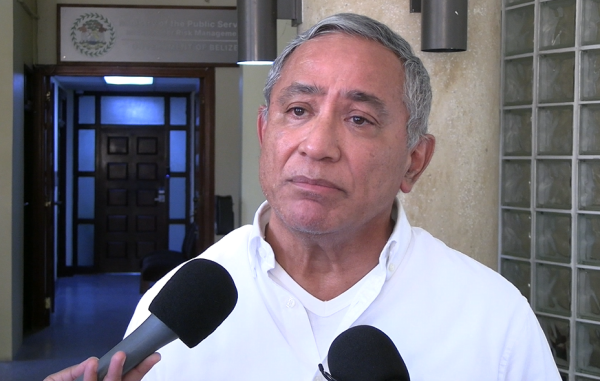
Belize chairs CCAD pro tempore
By William Ysaguirre (Freelance Writer)
BELIZE CITY, Thurs. Aug. 13, 2026
Belize assumed the presidency of the Central American Commission for the Environment and Development (CCAD) of the Central American Integration System (SICA) at the 75th meeting of the CCAD Council of Ministers at the Best Western Biltmore Plaza Hotel in Belize City on Thursday, August 13. Minister of Sustainable Development, Climate Change and Solid Waste Management Hon. Orlando Habet took command to chair the Council for the next 6 months.

Minister Habet congratulated the outgoing president, Vice Minister Anna Emilia Pimentel Rodriguez of the Dominican Republic and her government for their “leadership and stewardship during their presidency.”
“Belize takes up this responsibility with a firm commitment to build upon the work already advanced. Regional progress requires continuity; it requires sustained political commitment; and above all, it requires implementation,” Habet affirmed. “The challenges before us are increasingly interconnected. Climate change does not recognize borders, neither do drought, marine pollution, biodiversity loss, forest degradation or sargassum. Their consequences reach directly into our economies and communities, affecting water security, food production, fisheries, tourism, infrastructure and livelihoods. This is precisely why CCAD remains so important. It gives our countries a mechanism to confront challenges collectively, where national action alone is not enough.”
“We will consider ongoing regional work on the dry corridor, biodiversity, climate transparency, marine resources, forests, and sargassum; as well as important initiatives concerning regional environmental policy, financing, and climate mobility. But our measure of success … must be whether those decisions translate into meaningful action in our countries and for our people,” Habet avowed.
In the main business of the day, Habet presented Belize’s priorities for its pro tempore presidency in greater detail, which Belize’s CCAD liaison officer Carlos Moreno translated for the benefit of our Central American neighbors.
Habet outlined 8 priority areas: (1) To strengthen water resource management with an emphasis on drought management, using nature-based solutions and inclusive water governance; (2) to conserve and restore regional biodiversity through sustainable management and financing in compliance with the Kunming-Montreal Global Biodiversity Framework; and (3) to align the Meso-American Environmental Sustainability Strategy (EMSA) with the Regional Environmental Strategy Framework (ERAM). (4) Another priority is Climate Change and Integrated Risk management, with emphasis on an evidence-based framework to address loss and damage; (5) and to manage sargassum within the “2026-2028 Roadmap for addressing sargassum and its impacts in the SICA region”, proposing a draft resolution for a regional sargassum project. (6) To institute a sustainable, circular economy for waste management in the SICA region, to guarantee environmental resilience, and protect regional health. (7) To ensure safe and sustainable chemical and pesticides management, considering their life cycles, to minimize risk to human health and the environment; (8) and last but not least, to protect wildlife by safeguarding the long term viability of the jaguar population, ensuring vital ecological corridors, and to maintain the habitat integrity of regional ecosystems. Habet proposes to protect the region’s “extraordinary natural wealth”, which “is also highly vulnerable to environmental and climatic shocks.”
For her part, his predecessor Minister Pimentel cited the advances in her term as CCAD chair: strengthening regional cooperation in environmental protection, such as the CAM project to protect large marine ecosystems; coordinated solutions in sargassum handling and use, and promoting climate resilience through ecosystem-based adaptation, transparency in climate action and regional coordination against desertification (REDD). This included the creation of an Environmental Think Tank, the development of a CCAD communication strategy, and the actualization of the Regional Environmental Strategy Framework (ERAM). Along with the formulation of a SICA regional health strategy, she saw these achievements as the SICA members’ shared commitment to work together for a more resilient and sustainable region, prepared for all present and future environmental challenges.

CCAD Executive Secretary Marisol Castillo Collado reported on what was accomplished over the past 6 months, which included the Dry Corridor – the drought-prone western seaboard from Mexico to Panama, the launch of the marine environmental quality (CAM) Project, the Regional Climate Action (ICAT) Transparency Hub, the sub-regional Biodiversity Conservation Centre, and the Maritime Resources Project (KfW MARFUND). She also reported on the UMBRELLA-UNCCD projects, participation at the Conference of Parties on Climate Change (COP) meetings and the Sargassum Exchange.
Related News
"There's Trouble in Paradise": HUD Secretary Escalates Rhetoric Against VIHFA as White Hou...
Bryan Calls July 21 Special Session on Revised Southland Horse Racing Agreement
MoHW launches Human Resource for Health Policy & Strategic Plan