
SSB plans major contributions reform
 22 April 2026

If approved, some contributors will pay more while others will pay less
BELIZE CITY, Mon. Apr. 20, 2026
The Social Security Board (SSB) is nearing the end of a three-month consultation process on major reforms that would reshape how contributions are calculated and how low-income workers are protected. The proposed changes flow from the SSB’s strategic plan 2025-2029, that includes scheme modernization and fund sustainability.
The two changes under consideration focus on the model used to calculate contributions and the contribution floor, which sets the minimum insurable earnings level at which workers begin paying contributions. SSB stresses that there is no proposal to change the overall contribution rate of 10%, which is split between employee and employer, with employers continuing to pay the larger share.
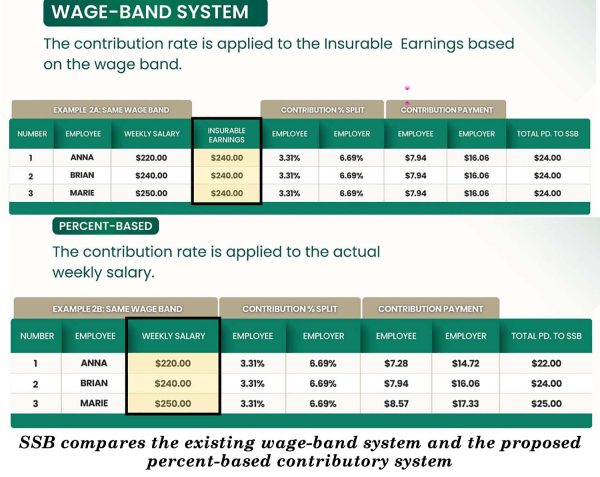
The first proposal is to replace the fixed wage-band system – that has been in use since the scheme’s inception in 1981 – with a percentage-based model which SSB CEO Jerome Palma says more accurately reflects contributors’ real earnings.
Speaking at an April 16 consultation with union members, Palma said that reform is overdue 45 years later. “In 1981, there were no call centers … The investment market in 1981 is distinctly different than what it is today. Technology has overcame and moved forward … We have to recognize now where the scheme needs to change to become more modern and adapt to the situations of today,” he told attendees.
Palma noted that Belize is one of only four countries still using the wage-band structure, which groups workers earning different salaries within a specified range into the same band, and requires them to each pay the same contribution amount.
Under the proposed model now used in over 100 countries, contributions would be calculated as 10% of one’s actual weekly salary, up to the existing $520 ceiling in insurable earnings which will remain unchanged. As a result, workers earning $520 or more weekly will not see an increase in their contributions. Palma argued that the new model would create greater administrative and payroll efficiency, noting that it is far easier for employers to calculate and for workers to understand.
Meanwhile, some contributors would end up paying more because their actual salary currently falls above the midpoint of their wage band. The CEO explained that someone earning $250 per week is actually contributing as if they earn $240. On the other hand, some contributors would pay less under the new model because their real salary is below the midpoint of their current band, meaning that they are presently contributing more than their actual earnings reflect.

The second proposal is to raise the contribution floor – currently set at $55 in insurable earnings for anyone earning under $70 per week – to $130 by eliminating the two lowest insurable earnings bands of $55 and $90. This means contributors in those bands would now pay contributions at the $130 level. According to Palma, 6,006 contributors or 4.72% of the total 127,324 active insured persons, would be affected if the change is approved. SSB notes that workers earning less than $70 per week contribute just $1.03, and Palma argues that “pension for the lowest wage bands are significantly subsidized by higher earners, leading to financial strain on the Fund.” The last increase in the contribution floor was implemented in 2001.
Using an example of a part-time worker earning $69 weekly, Palma explained that under the current contribution floor, contributions on her behalf are calculated as 10% of $55 – a total of $5.50 weekly. Based on the sum of her contributions, she would qualify for a pension ranging between $16.50 to $33 weekly. Palma noted that under the existing floor, one in nine retirees receives the minimum pension of $47 per week, which he described as “just not adequate.”
Under the proposed increase to a $130 contribution floor, contributions on her behalf would rise to 10% of $130 or $13 weekly. Her pension entitlement would then fall between $39 and $78 weekly, – and based on the statutory minimum pension, she would receive no less than $47 weekly. The SSB maintains that contributing more leads to increased benefits across the board, including sickness benefits.
Also worth noting is that contributors who receive annual salary increases will also begin seeing increased Social Security deductions, since contributions will now move in direct proportion to actual salary earnings.
Asked whether the SSB expects to collect more money overall due to the proposed changes, Palma said the total intake should remain roughly the same, as increases for some contributors are expected to be offset by decreases for others.
Also of note is that the SSB is seeking feedback on how the 10% contribution rate should be split between employee and employer, taking into consideration that low-income workers cannot absorb large increases, and that employers currently shoulder a greater share at the lowest bands.
The stakeholder consultation sessions continue with insured workers on Tuesday, April 21 in San Pedro, on April 28 in Punta Gorda and April 30 in Placencia.
Related News

Trump’s Final Iran Deadline Nears as Tehran Pushes Back and the Global Cost Shock Worsens
Virgin Islands American Job Center to Host Career Training Expo Linking Residents to Free ...
New Poll Shows Vialet Ahead in Governor Race as Voters Put Economy, Healthcare First