
“Let my people go!”
 02 September 2026

NGC reaffirms ancestral land rights after official response from Honduras
By Adele Ramos (Freelance Writer)
DANGRIGA, Thurs. Aug. 20, 2026
The concerns of the National Garifuna Council of Belize (NGC) over reports from the Garifuna community of Honduras claiming violations of Indigenous land rights, have not been quelled, despite an official response this week from the Government of Honduras, through the Embassy of Honduras in Belize.
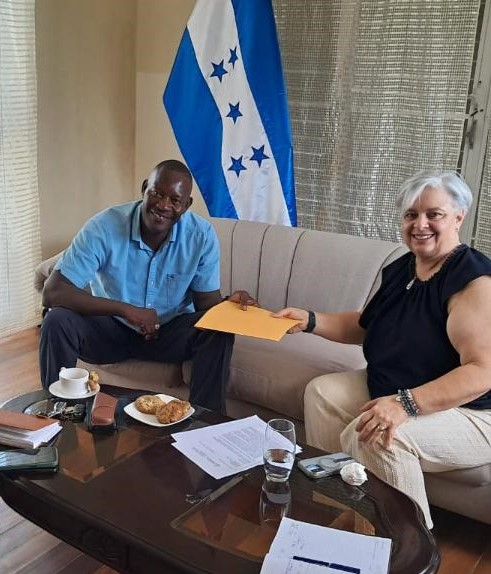
NGC President, Alex Nolberto, met with Her Excellency Carmen Scarleth Ayón Neda, on Wednesday, 19 August 2026, at the Embassy in Belize City, where the parties discussed the matter—but still without resolution, since 5 Garinagu remain in detention in Honduras on allegations that they have been involved in organized crimes. The official position claims that the removal of the Garinagu from their lands in July was “a preventive eviction.”
The Ambassador’s letter stated that, “The local Prosecutor’s Office of Tela filed criminal charges for the offense of aggravated usurpation against Sara Acosta, Hirvin René López, Onil Rigoberto Fernández, Carlos Enrique Fernández, and Deinor Osman Mejía, to the detriment of Empresa Promociones y Turismo S.A. de C.V., and ordered a preventive eviction. The case file was referred by the Court of First Instance of Tela to the National Criminal Court with jurisdiction over Organized Crime, Environment, and Corruption.”
Nolberto says that the response “doesn’t do much …,” and he asserts that, notwithstanding claims that members of the Garifuna community had sold lands to others outside the community, such sale of communal, ancestral spaces are invalid, especially where the Government claims that it has passed laws to protect those spaces.
“I don’t know who dropped the ball,” Nolberto added.
Although the public protests over Garifuna land rights issues in neighboring Honduras have subsided since hitting a crescendo in July 2026, the five Garinagu remain in detention as fervent legal opposition is being waged to affirm what community leaders contend are protected Indigenous lands.
The United Nations Declaration on the Rights of Indigenous Peoples (UNDRIP) passed by the General Assembly on 13 September 2007 reaffirms Indigenous land rights. This international declaration also covers the Garifuna people, who are Indigenous to our region.
Article 26 of the Declaration says, “Indigenous peoples have the right to the lands, territories and resources which they have traditionally owned, occupied or otherwise used or acquired.”
It recognizes the urgent need to respect and promote the inherent rights of Indigenous peoples.
Article 8 specifically implores States to “provide effective mechanisms for prevention of, and redress for: Any action which has the aim or effect of dispossessing them of their lands, territories or resources.”
Article 10 goes on to declares that: “Indigenous peoples shall not be forcibly removed from their lands or territories. No relocation shall take place without the free, prior and informed consent of the Indigenous peoples concerned and after agreement on just and fair compensation and, where possible, with the option of return.”
In the article titled “Our cross-border solidarity with Garifuna!” and published in the Sunday, July 19th, 2026, edition of the Amandala newspaper, we outlined the essence of the NGC’s letter to the Ambassador of Honduras to Belize. The letter dated 13 July 2026 called on the Government of Honduras to respect and fully implement the judgments of the Inter-American Court of Human Rights concerning Garifuna ancestral lands; to ensure that all law enforcement and security personnel act in accordance with national and international human rights standards, exercising restraint and protecting the safety and dignity of community members; to guarantee meaningful dialogue with the affected Garifuna communities and their legitimate representatives regarding any matters affecting their ancestral territories; and to take immediate steps to safeguard the cultural heritage, livelihoods, and territorial rights of the Garifuna people, recognizing that their lands are inseparable from their identity, history, and survival as a distinct people.
When we reached out to the Ambassador a few days later, she indicated to us that the correspondence was sent to the President of Honduras Nasry Asfura. She, furthermore, expressed her belief that the Government of Honduras was doing everything in its power to resolve the problem.
Her 19 August 2026 reply to the NGC states: “Through the High-Level Intersectoral Commission (Executive Decree PCM No. 03- 2024), the Government has implemented land registry protection measures, including more than 300 registration refusals, in order to safeguard ancestral territories. Likewise, Legislative Decree No. 107-2026 reaffirms the protection of ancestral territories from dispossession and the right to prior, free, and informed consultation, while the National Protection System strengthens, with a culturally sensitive approach, the prevention of risks faced by human rights defenders.”
It added that, “Regarding the use of public force, the State guarantees that operations carried out by the National Police and the Armed Forces are strictly governed by the principles of legality, necessity, graduality, and proportionality. Within this framework, ethnic affiliation shall never constitute grounds for differential or stigmatizing treatment.”
The response concludes by saying: “The Government of Honduras will continue promoting interinstitutional consultation and coordination mechanisms, as well as direct dialogue with the affected communities, with the aim of consolidating peace, justice, the protection of cultural heritage, and the full rule of law in ancestral territories.”
We asked the NGC what its next steps will be, given the official response from Honduras. Nolberto said that they will continue to render support to the Garifuna community in Honduras, and they plan to engage at the level of the Organization of American States and the United Nations while also seeking legal support from the Garifuna Diaspora.
He also informed us that he had hinted to Belize Prime Minister, Hon. John Briceño, who he also wrote in July regarding the conflicts in Honduras, that the matter needs to be addressed. The NGC has called on Prime Minister Briceño to formally engage the Government of Honduras through diplomatic channels to express concern regarding the treatment of the Garifuna communities in San Juan and other affected areas.
Prime Minister Briceño told Amandala when we sought comment that, “Our government has always supported the Garifuna people, and we will do all we can to continue to support them.”
Nolberto reiterated his concern today that the Government still has not given an official response. However, he informed us that the Prime Minister is due to travel to Honduras in a few days, and he urged that the matter should be raised with the President of Honduras.
We’ve also received information that the Ambassador of Honduras to Belize plans to travel to her home country soon, and she is also amenable to addressing the matter further with officials on that trip.
President of the NGC Peini (Punta Gorda) branch, Therese Aleman, told Amandala that she remains in regular contact with members of the Garifuna community in Honduras. She said the legal battle continues and latest indications were that some progress was being made with negotiating the release of at least some of the detainees. She said that they will continue to stand in solidarity with the Garifuna community in Honduras as they continue to assert their Indigenous rights. In a public statement today, Organización Fraternal Negra Hondureña (OFRANEH), led by Coordinator – Miriam Miranda, continued to call for the court to dismiss the cases against the 5 Garinagu accused of organized crimes amid the Indigenous land dispute.
Related News
UVI Files Show-Cause Response, Prepares for Sept. 24 Accreditation Visit; Teach-Out Plan R...
FEMA Places USVI Recovery Under Enhanced Compliance Review; Bryan Says No New Funding Rest...
Link Up Lounge to Host ‘The Brand Lab’ on St. Croix, Blending Branding Insight With Li...