How Silicon Valley became central to Israel’s war on Palestinians
 26 November 2026

The Israeli military’s reported use of Amazon’s cloud infrastructure to upload millions of images of Palestinians has been cited by activists as further evidence of the deep entrenchment of Western, and principally US, technology in Israel’s military and economic ecosystem.
According to rights groups and analysts interviewed by Al Jazeera, the trade in the technology and expertise that Israel relies on to monitor, track and kill Palestinians in the occupied West Bank and Gaza involves many of the United States’s leading technology companies, including Google, Palantir, and Microsoft. And, as Al Jazeera reported earlier this year, some of that technology has also been exported to Western governments that are publicly critical of Israel and its actions.
Recommended Stories
list of 4 items
- list 1 of 4What are the world’s biggest AI companies and how much are they worth?
- list 2 of 4How HSBC’s Islamic fund invested millions in Israeli war-linked firms
- list 3 of 4Palantir harvests battlefield data that Ukraine pays for ‘with blood’
- list 4 of 4‘Second home’: Why Israel is celebrating Jensen Huang’s return to Nvidia
end of list
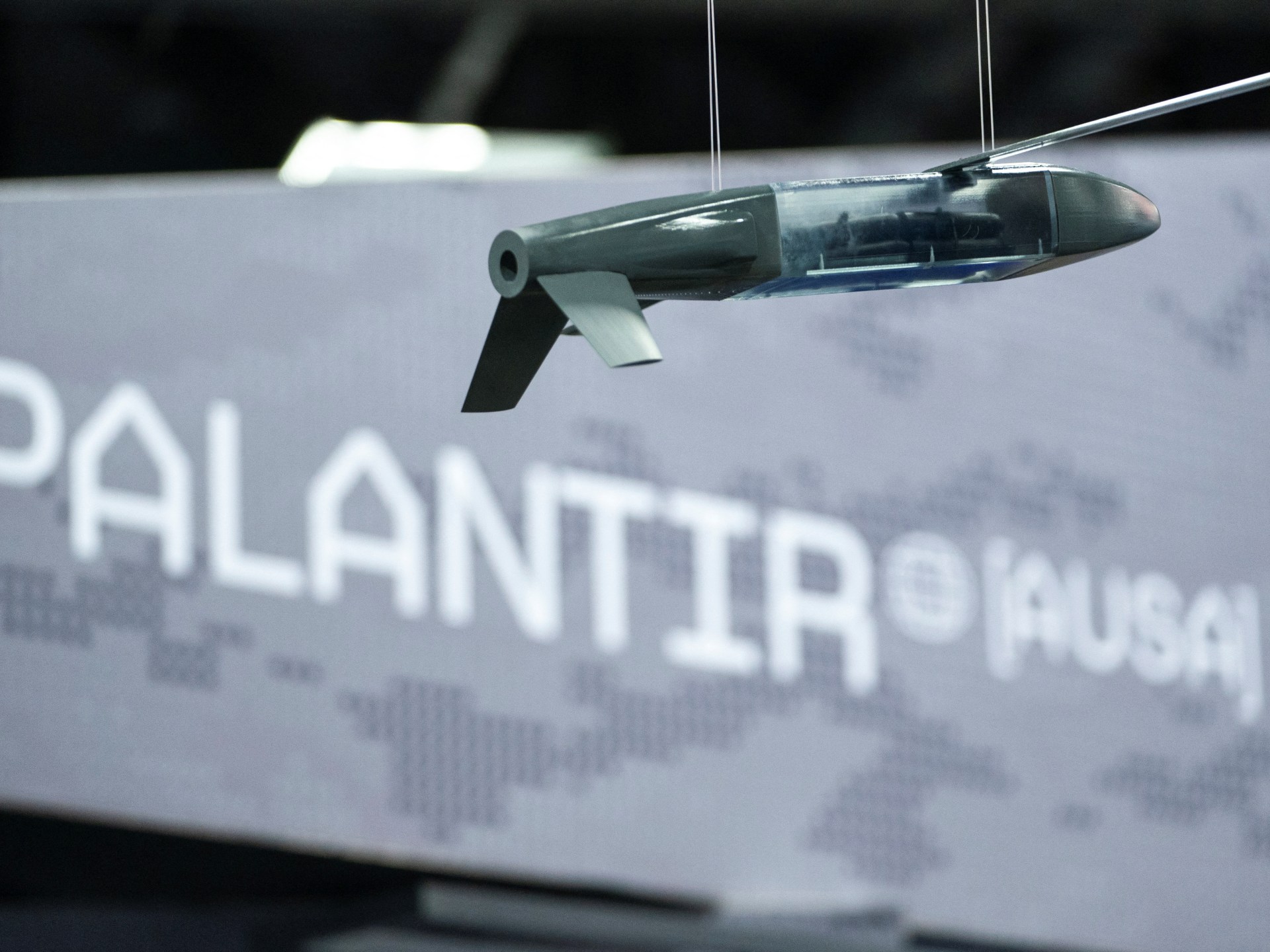
In January 2024, the US tech giant Palantir agreed to a strategic partnership with Israel’s Ministry of Defence for “war-related missions”, while Microsoft’s Azure cloud computing platform was reported to have been used to store vast archives of intercepted Palestinian phone calls that sources said helped guide deadly air strikes.
Google and Amazon, meanwhile, provide the Israeli military with advanced facial recognition and artificial intelligence capacity as part of the $1.2bn Project Nimbus.
And the US chipmaker Nvidia has become so central to the Israeli economy that economists have credited its tax payments with helping to reduce the country’s fiscal deficit.
“It’s everywhere,” Jalal Abukhater of the digital and social rights group 7amleh, describing the surveillance Palestinians live under every day. “If you’re in East Jerusalem or Hebron, you’re being photographed. When I go to the running track, my picture is taken countless times at checkpoints or by roadside cameras. The 3.5 million images uploaded to Amazon are nothing. Everyone is photographed all the time, and it’s all getting fed into these systems that we don’t know about and for reasons they don’t explain.”
Advertisement
Silicon Valley goes to war
The rightward shift in Silicon Valley over recent years has been accompanied by more overt support for Israel.
Palantir, in particular, has been unapologetic in its support for the country throughout its genocidal war on Gaza. In July 2025, UN special rapporteur Francesca Albanese found “reasonable grounds” to believe the company had provided predictive policing technology and an AI platform to Israeli forces, adding that, had proper due diligence been undertaken, technology firms such as Palantir would have divested from Israel “long ago”.
In January 2024, the Business and Human Rights Resource Centre, which tracks corporate conduct, logged numerous allegations that Palantir technology had been used in Israeli attacks on Gaza. Palantir has denied abetting war crimes, and has denied developing the Israeli military’s Lavender and Gospel AI-assisted targeting systems.
However, Open Intel, which tracks corporate involvement in the war, says Palantir’s software is linked to the Israeli military’s integration of intercepted communications, satellite imagery and other data to help compile military targeting lists.
Project Nimbus has also emerged as a key plank of US technology’s support for Israeli operations in the West Bank and Gaza. According to Albanese’s report, Amazon and Google stepped in when Israel’s own cloud and AI infrastructure became overloaded following the beginning of Israel’s genocidal war on Gaza.
And OpenAI’s models have also reportedly found their way into the Israeli military’s operations, with access provided through Microsoft’s Azure platform.
Leaked documents published in January 2025 showed that the military began buying access to OpenAI’s GPT-4 in August 2023, with its use of the model increasing 20-fold following the start of the genocidal Gaza war.

Military intelligence to Big Tech
Analysts have also pointed to the connections between the US’s foremost tech giants and the Israeli military, specifically, members of its cyberwarfare 8200 Unit. In 2025, Drop Site News reported that a database of current and former members of the Israeli military intelligence showed about 1,400 working at US tech firms, some 900 of them from Unit 8200, including roughly 250 at Microsoft and others at Nvidia, Meta, Google, Intel and Apple.
The overlap in personnel raises questions about potential conflicts of interest. That is particularly relevant in the case of Microsoft, where it has been reported that there was concern at a senior level that some employees in Israel had not been transparent about how Unit 8200 was using its technology.
Advertisement
The Guardian reported earlier this year that a Microsoft inquiry looked into how some Israel-based employees “had felt conflicting loyalties” to the company and the Israeli military.
Paul Biggar, one of the founders of Tech for Palestine, said that Israeli military personnel are embedded across US tech companies.
“Often, members of Unit 8200 are hired at senior levels and, as is often the case, they will hire people with similar technology and intelligence backgrounds to create a culture tied to their original unit,” Biggar said.
“You have to remember these guys are spies,” he continued, “So the number one thing they want to do is bring in more people from Unit 8200 to increase their influence. Including for example acquiring Israeli companies into US Big Tech”
Beyond the $1.2bn value of the Project Nimbus contract awarded to Google and Amazon, hard figures for the extent of the trade between Israel and US tech are hard to come by.
Irrespective of the sums of money, the Israeli military heft and US technology have combined to create one of the most surveilled populations on the planet.
“I’ve been lucky, but when people closer to me told me of having been pulled in [by the security services] they’ve been presented with a heat map of their entire lives,” Abukhater said, “Through a mixture of telephone tracking and constant surveillance, they’re shown where they’ve been and how long they spent there.
“We don’t even know half of it. When Microsoft’s role was exposed [in 2025], they revealed 200 million hours of audio recordings on a server in the Netherlands. That’s just one. Who else knows what they have and what these companies are processing?”
A Microsoft spokesperson told Al Jazeera: “Microsoft conducted an investigation into the alleged use of our technologies for the mass surveillance of civilians by the Israeli Ministry of Defence. In June, we published a final report summarising the investigation and outlining steps we are taking to strengthen our governance and oversight.”
“This included establishing a process where any employee can anonymously report concerns about practices that may violate the company’s policies regarding the development and deployment of our technology through our Microsoft Integrity Portal,” the spokesperson added.
A spokesperson for Amazon Web Services told Al Jazeera: “We respect the privacy of our customers, and we do not discuss our relationship without their consent, or have visibility into their workloads. Customers regularly visit our offices for briefings and meetings with our teams, and any suggestion that these visits are anything other than routine customer engagement is wrong and unsubstantiated.”
A spokesperson for OpenAI told Al Jazeera: “OpenAI does not have any contracts with Israeli military or intelligence entities. We do not control which entities Microsoft contracts with through Azure. At OpenAI, we have a rigorous process for assessing whether a proposed deployment of our technology to any national security entity aligns with our National Security Principles.”
Advertisement
Palantir, Google, Nvidia, and the Israeli military did not respond to Al Jazeera’s requests for comment.
Related News

Russian court jails rights lawyer for 12 years on treason charge

LIVE: FAA issues nationwide ground stop after communications outage in US
Is Iran plotting a ‘dirty bomb’ attack in the US? What we know