
MoHW launches Human Resource for Health Policy & Strategic Plan
 29 June 2026

By William Ysaguirre (Freelance Writer)
BELIZE CITY, Thurs. June 25, 2026
Belize’s health system is under attack, like all small island developing states (SIDS), from wealthy, developed countries offering better pay to lure away doctors and nurses; and the Ministry of Health and Wellness (MoHW) is fighting back with a new human resource policy, offering competitive remuneration and working conditions in an effort to retain every health worker it has at present, and to recruit new ones.
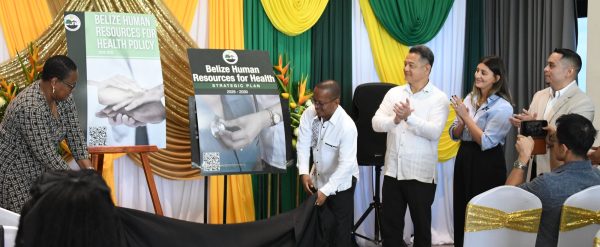
Minister of Health Hon. Kevin Bernard launched the Belize Human Resources for Health Policy and Strategic Plan 2026-30 in partnership with the Pan American Health Organization (PAHO), and the support of the Inter-American Development Bank (IDB) and the Republic of China on Taiwan, at the Grand Resort in Belize City on Thursday morning, June 25.
In his address to the gathering, Minister Bernard declared, “The Human Resources for Health Policy and Strategic plan provides a framework to face challenges while preparing Belize for future needs. The policy is built around 4 priority actions that reflect the areas where Belize must continue to strengthen its health workforce. These include strengthening governance and regulatory frameworks, improving recruitment and deployment, expanding education and training opportunities, and enhancing the attraction, motivation, and retention of health professionals.”
He continued by assessing the current situation. “We have made significant progress in developing our health workforce; we know there is still work to be done. Currently, Belize has approximately 612 physicians and 983 nurses, and we do remain below the World Health Organization (WHO) recommended threshold. We recognize that strengthening the health workforce is not only about increasing numbers, but it’s also about ensuring that the health workforce is equitably distributed across the country, that communities have access to the services that they need, and with the right mix of skills and specialties to meet the evolving health needs of population,” Bernard cited.
He then listed some of the initiatives of his ministry to address the shortcomings. “We have introduced a series of retention measures aimed at supporting our nursing workforce and improving workforce stability. These measures include increases in remuneration and a number of allowances to support our health workers; and while no single intervention will solve the issue, these investments send an important message. We value our health workers and we are committed to supporting [them]. We have also strengthened scholarship and non-compliance mechanisms to help ensure that individuals who benefit from public investment in their training return to serve the Belizean people. These efforts form part of a broader strategy to strengthen the recruitment and retention of the workforce, through planning, education, and professional development,” Bernard explained.
The minister also took the opportunity to express his commitment and gratitude to partners in the healthcare system. “As Minister of Health and Wellness, I remain committed to ensuring that our health work force remains at the center of our efforts, as we continue strengthening the health system. The future of healthcare in Belize depends on the people who deliver every single day. To all who have worked, thank you for your service. To our partners, thank you for your commitment and continued support,” he said.
Belize’s health system was tested during those difficult years of the COVID-19 pandemic, he acknowledged. “Our physicians, nurses, allied health professionals, laboratory staff community health workers, public health professional practitioners, and support personnel carried an enormous responsibility. They worked [long] hours, adapted quickly to changing circumstances, and continued providing care under significant pressure. Their efforts helped our country navigate one of the most challenging periods in recent history,” he recalled.
“Countries must strengthen work force governance, mapping, planning, and forecasting; improve education, training and support of professional teams; and create better conditions to attract, retain and protect health workers. They are valuable resources without whom the health system would crumble,” warned PAHO representative, Dr. Karen Lewis-Bell. “Belize faces important challenges in this area, many of which are shared across the Caribbean,” she continued. “These include the inadequate number to population ratio and the distribution of health workers, especially in rural and under-served areas. The need to align education and training with primary healthcare-based model, the need for optimizing the skills mix of the health team, and the need to strengthen retention in a context marked by ongoing external migration of qualified personnel.”
She then shared a note of caution. “At the same time, we must recognize that retention is not only about remuneration; it is also about working conditions, career development, quality improvement, and supportive supervision. Health workers must be able to perform their duties effectively and efficiently in safe, respectful and enabling environments with the right resources,” Lewis-Bell concluded.
“For the IDB, supporting the health sector is crucial, as it is embedded in the central pillar of our country’s strategy with Belize. It reflects our commitment to working with the country to strengthen the systems that improve people’s lives,” pledged Camilo Pecha, representative of the Inter-American Development Bank.
There remains much room for improvement, Dr. Andrei Chell – Director of Health Policy Research And Planning, acknowledged. Belize’s 612 doctors and 983 nurses represents a ratio of 14.7 physicians and 23.5 nurses per 10,000 of population; while WHO recommends the threshold minimum should be 44.5 physicians, nurses and midwives per 10,000 population. He noted that the policy and strategic plan had been 2 years in the making, as work on it began in 2024. The success of the plan depends on sustained leadership, coordinated action and strong partnerships. Much more than offering better pay, it aims to create pathways for health workers to advance in their careers through education and mentoring, to create working conditions that induce healthcare workers to want to stay. Health planner Shayna Makin outlined how the Strategic Plan would work.
Related News
Justice on trial!!

DOJ’s One-Person Public Corruption Unit Investigating Up to 10 Cases; Criminal Filings C...

Governor’s Office Publishes 105-Entry Abandoned Vehicle List; Owners Given 72 Hours to Act