Who is the Indian guru Venezuelan acting President Delcy Rodriguez follows?
 04 June 2026
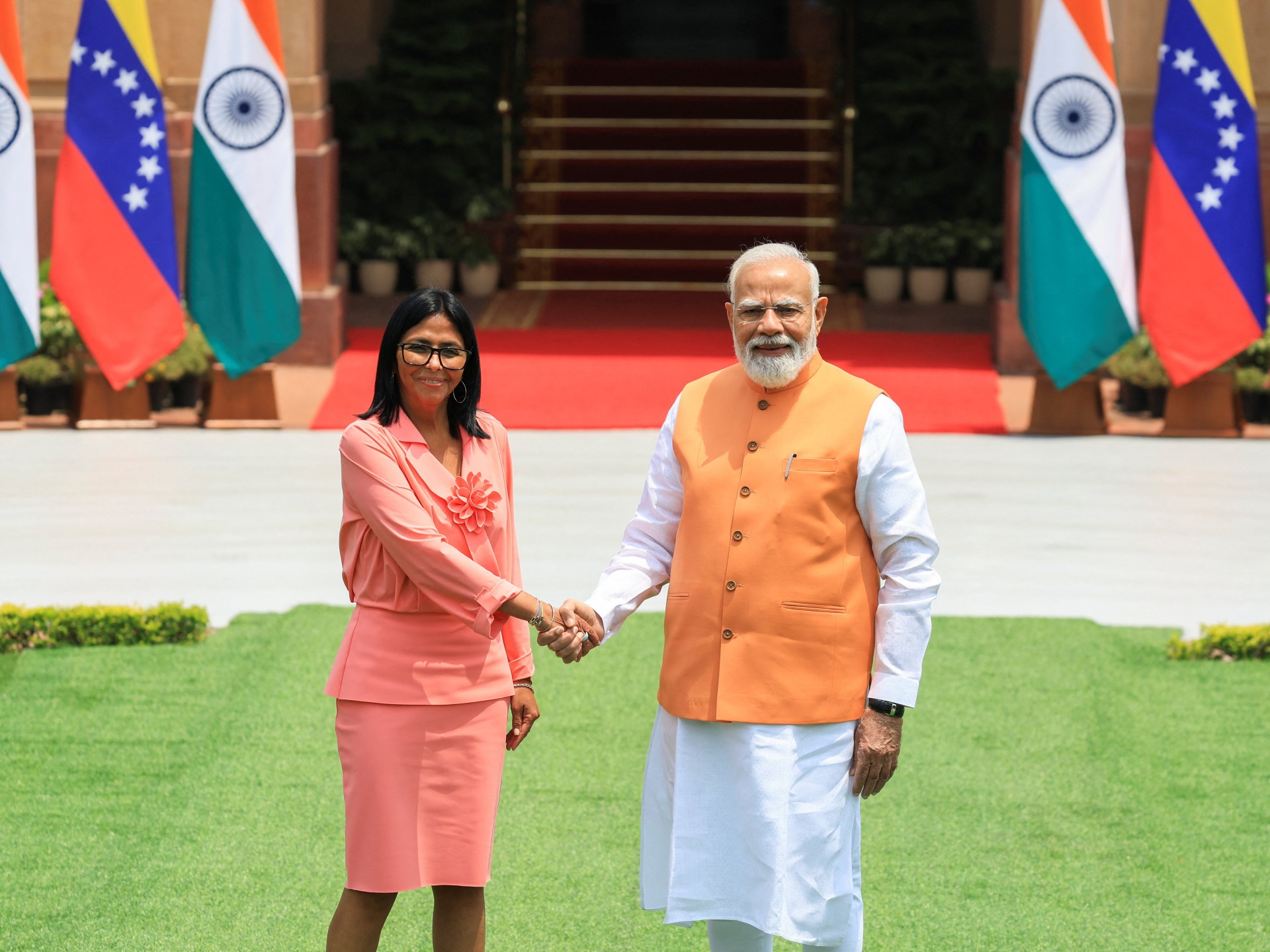

Delcy Rodriguez is in India for the first time since she became Venezuela’s interim president after democratically elected President Nicolas Maduro was abducted by the US military in January.
Energy cooperation, including the supply of Venezuelan oil to India, tops the agenda during her five-day trip, as leaders in New Delhi look to diversify energy imports amid supply disruptions in the wake of the US-Israel war on Iran.
- list 1 of 3Venezuela’s Delcy Rodriguez heads to The Hague for land dispute case
- list 2 of 3US raises threat of military action against Cuba
- list 3 of 3Can Venezuelan oil save India amid the Hormuz energy crisis?
end of list
But diplomacy is not her only focus. Rodriquez, who is a follower of Indian guru Sathya Sai Baba, is expected to visit his birthplace in Puttaparthi in the Indian state of Andhra Pradesh. Rodriquez’s predecessor, Maduro, was also a devotee of Sathya Sai Baba.
So, who is Sathya Sai Baba and why are Rodriquez and other Venezuelan politicians connected to him?
Here’s what we know:
Who is Sathya Sai Baba?
Born Sathyanarayana Raju in November 1926 in the village of Puttaparthi, Sai Baba was an Indian self-styled ‘godman’ and spiritual leader who had a global following and whose teachings on unity, peace and spirituality transcended religion.
He was spiritually inclined from a young age. In 1940, at the age of 14, he said he was the reincarnation of Shirdi Sai Baba – an Indian saint, who was born in the late 19th century and followed by millions.
Sathya Sai Baba advocated for “peace, love and nonviolence” to the world. As a part of his religious mission, he encouraged people to “Love All, Serve All”.
Sathya Sai Baba became popular in India and worldwide in the 1970s and 1980s and was known to materialise objects such as rings and sacred ash. He is also believed to have performed healings and resurrections. While scientists have accused him of faking those activities, his followers have defended his miraculous skills.
Advertisement
Besides the average Indian, his followers included famous Indian cricketers such as Sachin Tendulkar, Bollywood actors including Amitabh Bachchan, as well as prominent business and political leaders.
In 2002, Britain’s parliament noted that Sathya Sai Baba had been sexually abusing the male children of devotees, and called on the foreign secretary at the time to raise the issue with Indian officials.
In 2004, the BBC produced a documentary titled The Secret Swami which investigated a case of alleged sexual abuse. In November 2006, the Guardian newspaper reported that the US State Department had issued travel advisories warning of “inappropriate sexual behaviour by a prominent local religious leader”, which officials later told the publication was a reference to Sai Baba. But he was never charged with the crime.
After his death in April 2011, suitcases containing cash and gold were found in his personal lodgings which led to fraud allegations. But officials from his Sri Sathya Sai Central Trust told local media that Sai Baba did not have any property of his own, and that income tax was always regularly paid.

What is Rodriquez’s connection with Sai Baba?
Rodriquez has been a devotee of Sathya Sai Baba for years and has regularly visited Puttaparthi – the last time was in 2024.
“Many times, when I was in danger, I felt Baba with me, my family and also with my country,” she said. “He is always with us, teaching us … and showing a path for peace and love,” she said in an interview with the Sri Sathya Sai Trust’s official media channel.
When she became interim president earlier this year, during her first media briefing, she conveyed Sai Baba’s teachings to Venezuelans and said: “A new moment where coexistence, mutual respect and recognition of others allow for the construction and building of a new spirituality”.
According to Indian media, a 2005 photo shows Maduro and his wife Cilia Flores, seated at the feet of Sai Baba. Maduro also reportedly had a photograph of Sai Baba in his office.
According to the Associated Press, when Sai Baba died, Maduro declared a national day of mourning in Venezuela and called the spiritual leader “a being of light” and a “beacon of unconditional love, selfless service and truth”.
In 1974, Sai Baba’s organisation opened a centre in Caracas, which runs a “Human Values School” and imparts the guru’s teachings.
Advertisement
What’s on Rodriguez’s agenda?
The interim president’s visit coincides with India increasing Venezuelan oil imports.
At an estimated 303 billion barrels of oil – about 17 percent of known global oil resources – the South American nation holds the world’s largest reserves, larger than Saudi Arabia and the US, though years of US sanctions and government mismanagement crippled production.
Venezuela emerged as India’s third-largest crude oil supplier this month, as the war on Iran and the closure of the Strait of Hormuz has forced countries to scramble for alternative energy sources.
Nearly half of India’s crude oil imports are normally shipped from Gulf producers through the strait, along with large volumes of liquefied natural gas and petroleum gas. But the narrow shipping channel has been under effective Iranian blockade since March 2.
India has also been buying more Russian oil amid the global energy crisis after Washington allowed a waiver. But before the Iran war began, Indian Prime Minister Narendra Modi promised the US that it would stop buying Russian oil and buy more crude from the US and Venezuela instead.
Indian companies have also had longstanding ties with Venezuela’s oil sector. Indian state-owned firms, led by ONGC Videsh, entered Venezuela in 2008, seeking access to heavy crude reserves.
By 2010, Indian consortia had secured stakes in major projects, including Carabobo-1 in the Orinoco Oil Belt, while in 2012, India overtook China as the largest Asian importer of Venezuelan crude. Before US sanctions intensified in 2019, Venezuela was among India’s biggest oil suppliers.

But sanctions imposed by Washington on PDVSA, the state-run oil company, forced Indian refiners and traders to sharply reduce purchases. The US sanctions were imposed after former Venezuelan President Hugo Chavez nationalised the oil sector in the 2000s, impacting US oil corporations.
That changed after Rodriquez took power after Maduro, Chavez’s successor, was abducted in January and taken to the US. Her government has since signed a new oil supply agreement with the US, allowing a limited number of companies to buy Venezuelan crude directly from PDVSA.
Venezuelan oil is particularly well-suited to the refinery run by Indian oil major Reliance Industries, it is one of the few facilities in the world capable of processing ultra-heavy crude efficiently.
But only a small number of Indian refineries are equipped to process the heavy, sulphur-rich oil that is extracted in Venezuela.
Despite that, Venezuela has supplied India with about 417,000 barrels per day (bpd) so far this month, up from 283,000 bpd in April, according to Kpler data. There had been no Venezuelan shipments to India during the previous nine months under the socialist government led by President Maduro.
Advertisement
As India’s total crude imports have risen this month to almost five million bpd amid the global oil supply crisis, Rodriguez will now be hoping to secure a deal that could pave the way for the surge in oil exports to continue.
Rurendra Tandon, secretary in the foreign ministry said that discussions between India and Venezuelan officials “focussed on forging an energy partnership”.
“They [Venezuela] see India as a stable demander for many years to come. Therefore there exists a perfect complementarity for India and Venezuela to work in the energy sector, both upstream as well as downstream,” he said on Thursday.
“The discussions also went into broadening the economic partnership to other areas…huge opportunities in areas like mining, animal husbandry, transportation, agricultural equipment and pharmaceuticals.”

Related News
Political commentators Cenk, Piker say UK bars them over Israel remarks
China’s Xi praises ‘unbreakable’ Pakistan ties as Sharif visits Beijing
Former assistant to TV star Matthew Perry sentenced to 41 months in prison