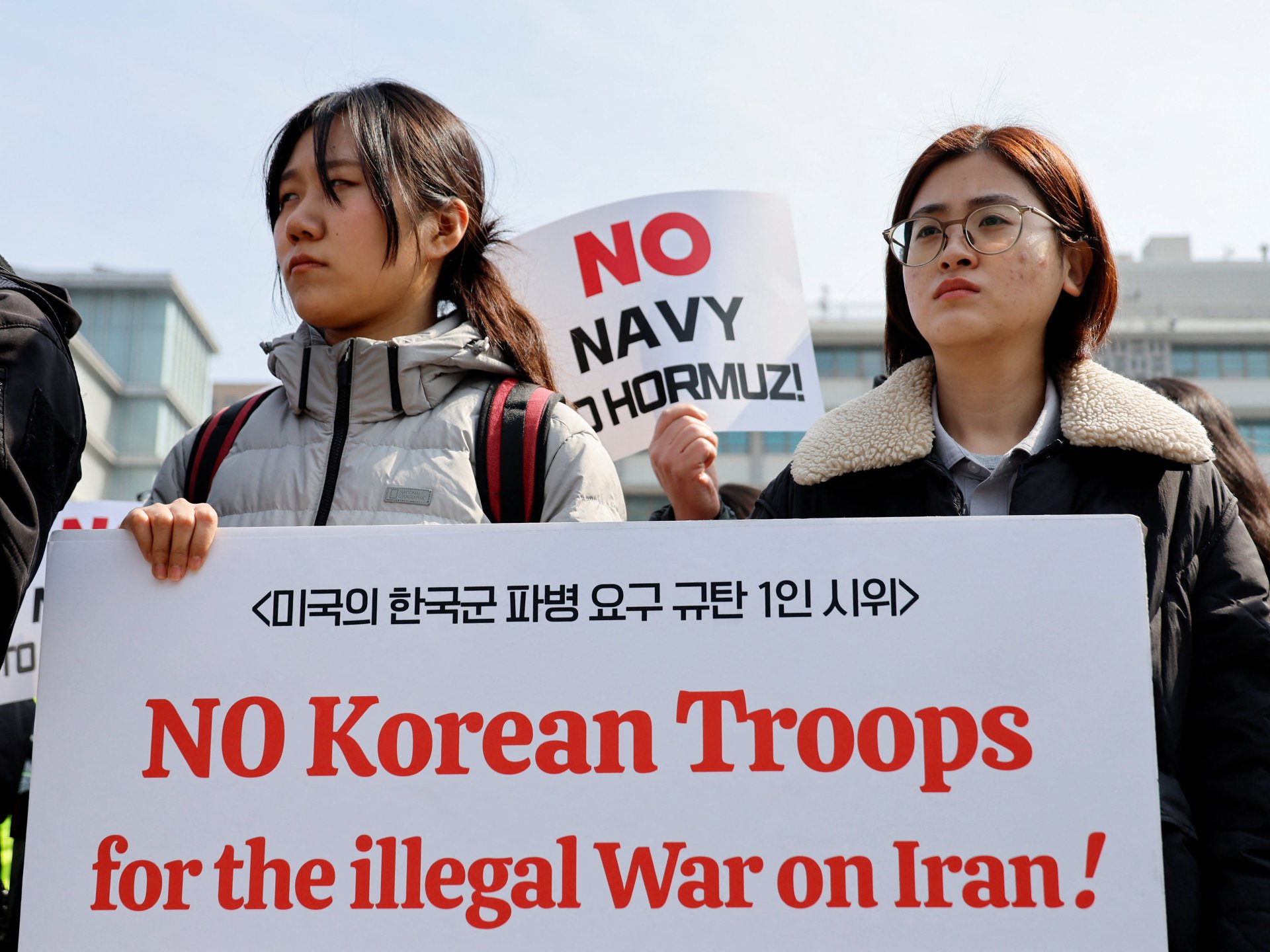
What is Trump hoping to achieve at APEC meeting in China?
 17 November 2026
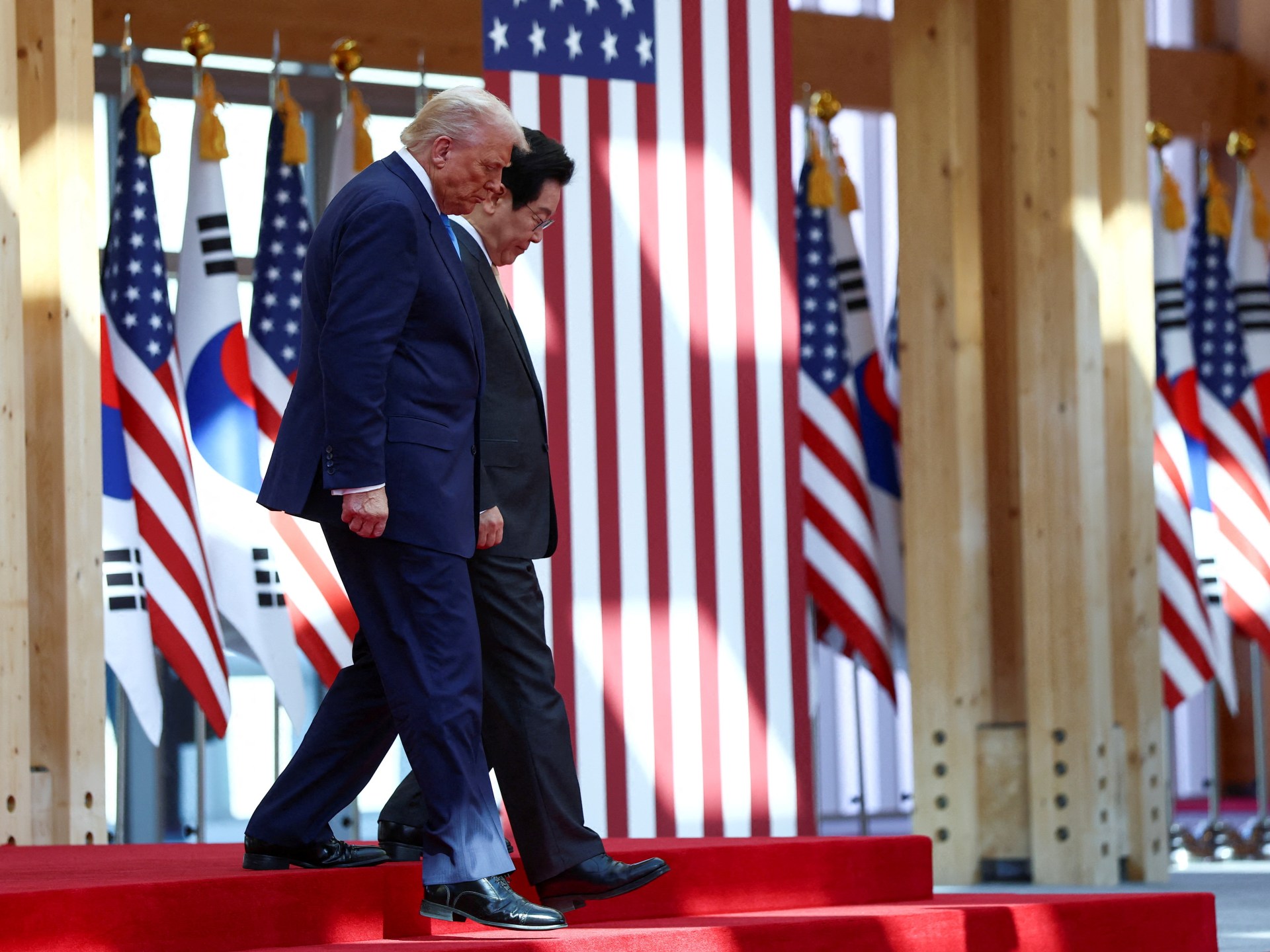

United States President Donald Trump will attend the Asia-Pacific Economic Cooperation (APEC) summit in Shenzhen, China, this week, where he is expected to meet with Chinese President Xi Jinping and hold a three-way meeting with Xi and Russian President Vladimir Putin.
A Trump-Xi meeting on the sidelines of the economic summit, which includes 21 Pacific Rim member economies, would be the third time the two superpower leaders have met this year.
- list 1 of 3What could Chinese intelligence have learned from Nvidia CEO’s affair?
- list 2 of 3US envoys and Putin agree to continue Russia-Ukraine peace talks
- list 3 of 3China says US ‘fabricating’ Nvidia spy claims to justify tech ‘blockade’
end of list
The prior meetings – with Xi hosting Trump in Beijing in May and Trump hosting Xi at the White House in September – were heavy on ceremonial pomp, as both leaders sought to portray a sense of stability in the consequential relationship, but light on meaningful breakthroughs.
Experts predicted a similar approach in Shenzhen, as topics of AI regulation, trade and the self-ruling island of Taiwan will again loom large.
The summit comes just days after Democrats won commanding control of both chambers of the US Congress, a shift that will likely serve as a major check on the US president in his final two years in office. Beijing, meanwhile, is increasingly looking beyond the Trump era to see what comes next.
“Trump will work to strengthen his rapport with Xi, but the meeting is unlikely to produce any substantive breakthroughs,” Ali Wyne, a senior research and advocacy adviser on US-China relations at Crisis Group, said.
As for Russia, Putin’s foreign policy adviser Yury Ushakov told reporters on Monday that “the significance and symbolism” of the meetings between the three superpower leaders “are hard to overestimate”.
Advertisement
Progress on AI?
Neither side has yet released a formal agenda for an expected Trump-Xi meeting, although the White House announced plans for the two countries to support each other at APEC and at the G20 summit in Florida in December.
“The two countries agreed to build a constructive relationship of strategic stability on the basis of respect, fairness, and reciprocity,” according to a White House statement.
As in previous meetings, AI regulation is set to loom large. Both the US and China, as industry leaders, have faced pressure to jointly agree to safeguards on the transformative technology.
In September, both sides pledged to set up a mechanism to quickly communicate AI-related incidents and to hold a dialogue on emerging risks.
Still, the Trump administration has repeatedly downplayed the need to integrate developmental guardrails. Following the White House meeting, Trump said the US would “not be putting on brakes” on the AI industry.
Speaking at a National Committee on US-China Relations event last week, US Treasury Secretary Scott Bessent said both sides “expect to exchange best practices for evaluating and testing advanced models before their release, and for keeping human judgment firmly in command of this technology”.
“As we do so, we should harbour no illusions about the differences between the United States and China,” he said. “And our approach to every challenge, likewise, will not always converge.”
The Nvidia scandal
The recent resignation of Nvidia CEO Jensen Huang, which followed revelations that he had an affair with an alleged Chinese spy, will also loom large over any Trump-Xi meeting, even if it is not directly addressed.
Huang’s close relationship with Trump, including accompanying the US president to Beijing during his May visit, and his ties to alleged spy Alice Huang have renewed questions about the influence he exerted over the US government as he pushed to ease restrictions on the sale of advanced AI chips to Beijing.
Trump administration Commerce Secretary Howard Lutnick has faced particular scrutiny, including from prominent members of the Republican Party, over his reportedly lax enforcement of export controls related to China.
“Trump will be under enormous pressure from Congress and members of his own administration to raise the scandal and warn Xi that their relationship could suffer if Trump concludes that Xi has been deploying Huang and other prominent business executives to sabotage US artificial intelligence efforts,” according to Crisis Group’s Wyne.
Advertisement
Still, some experts expect it to have little bearing on his interaction with his Chinese counterpart.
Gabriel Wildau, managing director at the advisory firm Teneo, told Al Jazeera last week that Trump “shows no sign that he intends to disrupt the current US-China rapprochement”.
The Reuters news agency reported on Friday that US officials said Trump is not expected to raise the issue of Alice Huang with Xi.
China has denied Alice Huang was working as a spy on its behalf.
Taiwan
Trump has already bucked longstanding US policy on Taiwan during his recent meeting with Xi.
Following the Beijing summit in May, Trump told reporters he had discussed US arms sales to the self-governing island, which Beijing claims as its own, “in great detail” with the Chinese president.
The US has provided arms to Taiwan since 1979 as mandated under the Taiwan Relations Act. But under the 1982 Six Assurances document, Washington has not consulted with China on such sales.
In a subsequent Fox News interview, Trump also referred to Taiwan as a “very good negotiating chip” with China. He has since held up approval of a $14bn arms package earmarked for the island.
The language “invites Beijing to expect something in return for each future approval”, Bonnie Glaser and Noah Munk of The German Marshall Fund of the United States (GMF) wrote in a recent analysis.
“The more successful that bargaining appears, the more Beijing will press it, and the more it will treat the next notification as a concession from Washington rather than a routine measure under the Taiwan Relations Act,” they wrote.
For its part, the White House has defended the delay, citing limited production capacity, particularly amid the US-Israel war with Iran, as well as the delicate nature of the US-China trade truce.
Democratic control of Congress, and general bipartisan support for Taiwan, could see pressure increase on the issue in Trump’s final two years in office.
“Today, the results of the midterm elections are on balance favourable for Taiwan,” Robert Sutter, a professor of international affairs at George Washington University, wrote recently for the ThinkChina publication.
Taiwan, a member of APEC, will be represented at the summit by Acer Group founder Stan Shih.
Trade breakthroughs?
US-China trade relations took a nosedive at the start of Trump’s second term, with the US president initially launching 10 percent tariffs on China for allegedly failing to crack down on the trade of fentanyl precursors.
By April, additional US tariffs on Chinese goods had reached 145 percent, while China’s retaliatory tariffs on US goods reached 125 percent.
Agreements to bring down the temperature faltered until Trump and Xi agreed to a yearlong truce in Busan, South Korea, in October of last year. The deal was extended through January 10, 2027, following Xi’s White House visit in September.
A particular issue has been US access to China’s rare earth minerals, which was severely restricted. Still, a recent analysis by the Center for Strategic and International Studies (CSIS) found that US imports of China’s rare earth minerals during the first 11 months of the agreement remained 75 percent lower than prior to the escalation.
“The recurring challenge is the persistent gap between China’s diplomatic commitments and actual export volumes,” the analysts wrote. “Despite successive agreements in Switzerland, London, and South Korea intended to restore supplies, shipments of controlled rare earth materials to the United States remain approximately 75 percent below pre-restriction levels.”
Advertisement
US agricultural exports were also hard hit during the trade war, an issue for farmers that resonated during the midterm elections. In recent meetings, China has agreed to buy 25 million metric tonnes of US soya beans, as well as what the White House has described as $17bn per year in US agricultural products in 2026, 2027, and 2028.
Those purchases have also lagged behind the commitments.
A Putin-Xi-Trump meeting
The most significant outcome of this year’s APEC summit may be the three-way meeting between Trump, Xi and Putin.
Such a meeting would likely be seen as a massive boon for Putin.
“By sitting down with the leaders of the world’s two most powerful countries in a trilateral format, Putin will be recognised as a major player on the world stage rather than a pariah,” Ryan Hass, a China expert at the Brookings Institution, wrote in a recent analysis.
Xi, in turn, would “bask in the glow of China serving as the convener and agenda-setter for how China, Russia, and the United States will relate to each other”.
The benefit for Trump, who the White House says will focus on denuclearisation efforts, remains less clear, according to experts.
“A trilateral meeting would showcase the extent to which both Trump and Putin seek to curry favour with Xi,” Crisis Group’s Wyne said.
“It would also further unnerve US allies and partners that fear Trump’s openness to an informal ‘G2’ or ‘G3’ arrangement,” he said, referring to a global realignment that bypasses other world powers.
Related News

CDC reports more than 5,000 measles cases, highest number in 35 years

Portugal cancels more than 300 flights, shuts schools due to Storm Charles
Polls open in closely contested US midterm elections 2026