What happened during Witkoff and Kushner’s latest meeting with Putin
 21 October 2026
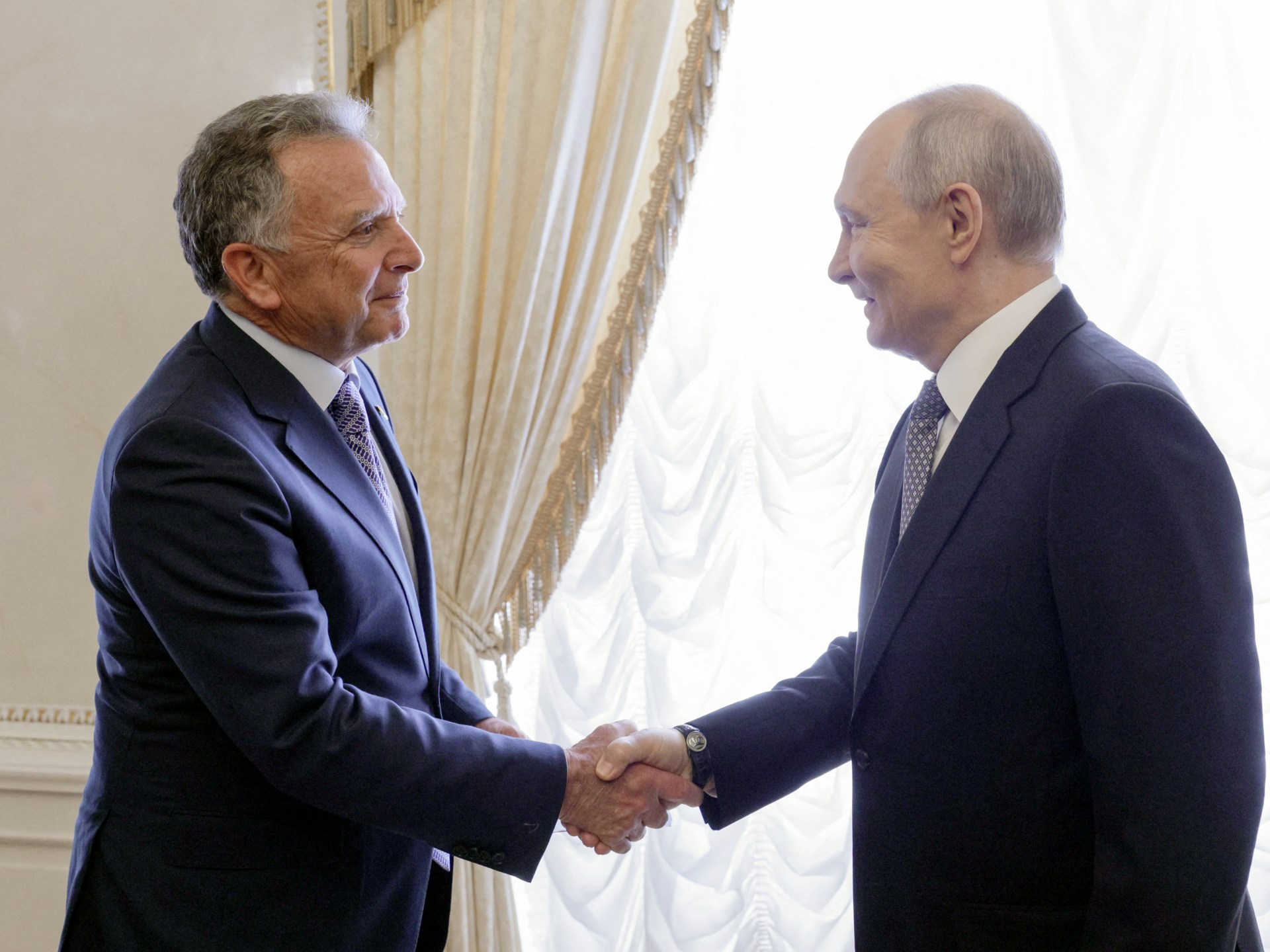

United States special envoys Steve Witkoff and Jared Kushner have wrapped up their latest meeting with Russian President Vladimir Putin with the release of a retired American teacher from Russian custody.
On Wednesday, Witkoff visited with Putin at the Constantine Palace in Saint Petersburg, while Kushner attended virtually.
- list 1 of 3Putin and Zelenskyy back three-way US peace talks on Ukraine
- list 2 of 3US envoy Witkoff calls Russia’s Putin a ‘humanitarian’
- list 3 of 3Russia to send first diesel tanker to the US amid Trump deal
end of list
The two special envoys have taken a leading role in conflict negotiations under US President Donald Trump. Their last meeting with Putin came during a trip to Moscow in September.
The latest talks come as the Trump administration intensifies its efforts to secure a peace deal to end Russia’s nearly five-year-long war against Ukraine. The war began when Russia launched a full-scale invasion of the Eastern European country in February 2022.
But there are growing concerns in Kyiv that the Trump administration is backing away from its support of Ukraine.
Trump has fostered warm relations with Putin, and critics fear that he may be willing to yield to Russian demands to reach an agreement that would end Europe’s bloodiest conflict since World War II.
Here’s what took place during the meeting:

Putin agrees to resume peace talks with Ukraine and US
The Russian president agreed on Wednesday to resume US-mediated peace negotiations with Ukraine for the first time in months.
A US official told Al Jazeera that Witkoff and Kushner proposed a “trilateral meeting at the technical level” that would focus on guaranteeing the security of Ukraine and Russia once the war had ended. The Ukrainians accepted the meeting when they met with the Americans on Tuesday in Oslo, Norway.
Advertisement
The last US-mediated peace talks took place in February, just days before the US and Israel launched their war against Iran.
The Kremlin, according to the Reuters news agency, said the new talks with Ukraine and the US may take place in Abu Dhabi and could start as soon as next month.
Russia frees retired US teacher
Wednesday’s meeting began with a goodwill gesture from Russia: the release of Stephen Hubbard, a retired American teacher who has been held in Russia for more than four years.
Hubbard, 74, was arrested in 2022 and sentenced to more than six years in a Russian prison after he was accused of being a Ukrainian mercenary. The US has argued the former teacher was wrongfully detained.

Trump, who made a direct appeal to Putin for Hubbard’s release, posted on social media Wednesday that Russia did not ask for a prisoner swap “out of respect for” him.
A US official said Trump spoke with Hubbard by phone and reiterated his “unwavering commitment” to bringing home all Americans who are wrongfully detained abroad.
Hubbard is headed back to the US where he will be reunited with his family.
Putin called a ‘humanitarian’
Witkoff has faced growing criticism after calling Putin a “humanitarian” for his decision to release Hubbard.
“You talk so much about my president, President Trump, being a humanitarian,” Witkoff said to Putin during Wednesday’s meeting. “You are a humanitarian also, sir, and I salute that. I commend you.”
That praise for the Russian president sparked bipartisan backlash from US lawmakers and human rights activists, who pointed to accusations of severe human rights abuses under Putin’s leadership.
“WTF, Steve?” US Senator Thom Tillis replied in astonishment on social media. Tillis, a member of Trump’s Republican Party, continued by writing that Witkoff should look up the definition of “humanitarian”.
“What an embarrassing and outrageous thing to say,” he said. “You should go back to Ukraine and ask the families of the children Putin has kidnapped and murdered whether they agree your friend Putin is a ‘humanitarian’.”
Tillis’s Senate colleague, Republican John Cornyn, echoed those thoughts.
“Putin is stone cold killer,” he wrote in response to Witkoff’s remarks.
US Senator Mark Kelly, who serves on the US Senate Intelligence and Armed Services Committees, also blasted Witkoff, calling Putin a “war criminal”.
Advertisement
“In what world is Putin a ‘humanitarian?’ He’s assassinated political rivals and journalists, bombed hospitals, and started a war that has intentionally killed tens of thousands of innocent people, including women and children,” Kelly, a Democrat from Arizona, said.
But members of the Trump administration defended Witkoff amid the outrage. During a visit to his home state of Ohio, Vice President JD Vance argued that Witkoff had “a job to get done”. He indicated that complimenting Putin likely aided the negotiations.
“I agree with Steve Witkoff saying something nice to a person who just released an American hostage,” Vance told reporters.
At a White House event on Wednesday, Trump said Witkoff’s characterisation of Putin was a “good saying” for “that particular purpose”: to release Hubbard.
“But I wouldn’t say anything one way or the other,” the US president said.

Trump, Putin and Xi meeting gains steam
The Kremlin said a possible meeting between Trump, Putin and Chinese President Xi Jinping was discussed during Wednesday’s negotiations.
Russian officials said that, if the meeting is confirmed, it could take place next month on the sidelines of the Asia-Pacific Economic Cooperation summit in China.
“Given that all three heads of state may potentially take part in the summit in China, the subject of such a hypothetical meeting was indeed raised,” Kremlin spokesperson Dmitry Peskov said on Wednesday.
“No specific proposals or agreements were discussed or put forward by anyone, either regarding the meeting itself or the possible agenda and content of that meeting.”
The three leaders have never before met for a dedicated trilateral visit.
Related News
‘This is a crisis of hope’: Echoes of 1968 as France’s students rise up
Iran targets Starlink as ‘tool of war’ with hints of more internet curbs
Moroccans head to polls amid economic uncertainty to decide next parliament