
Utility merger plan sparks heated debate
 05 February 2026
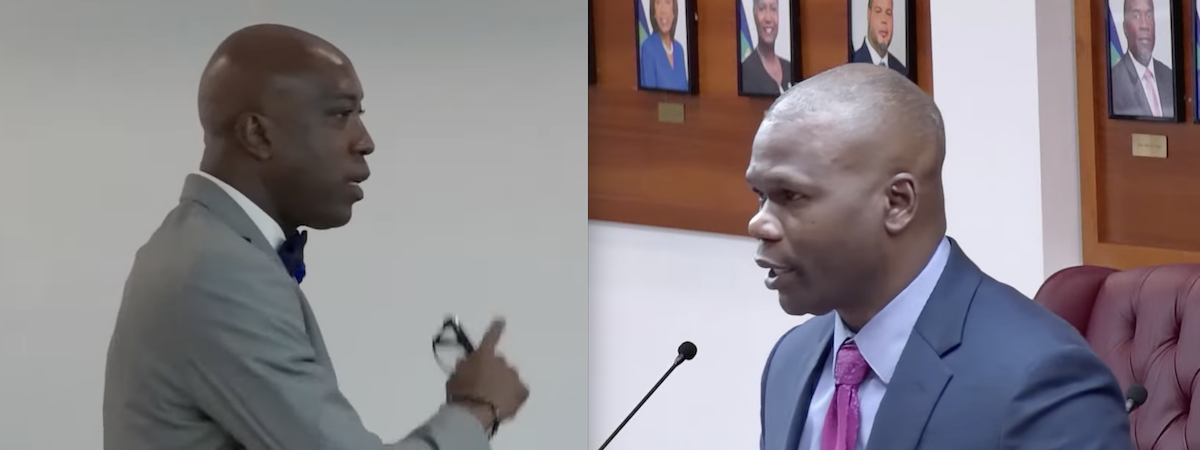

The government’s plan to merge the territory’s power and water utilities sparked three days of heated debate in the House of Assembly before members entered a closed-door committee session on Tuesday to continue the discussions outside the public eye.
Under the Virgin Islands Energy and Water Corporation Bill, 2026, the Water and Sewerage Department and the BVI Electricity Corporation would become one statutory body.
During the debate, government representatives praised the proposal, which they said will cut costs and lead to more efficient management of both utilities.
But opposition members expressed concerns about the merger — and some strongly opposed passing the bill altogether at this time.
‘Status quo has failed’
Communications and Works Minister Kye Rymer kicked off the discussion last Thursday by explaining the bill’s provisions and arguing that the merger is “the most prudent, fiscally responsible and future-ready solution.”
“The status quo has failed,” Mr. Rymer said. “Water challenges in our territory is at its worst. But, Madam Speaker, we cannot expect to repair water doing the same thing. We cannot expect a different outcome by doing the same thing.”
He argued that there are various benefits to combining the two entities.
“This bill is not symbolic: It is a pragmatic, evidence-based framework to deliver reliable water and electricity services to protect public health, to spur economic development and to strengthen resilience against future shocks,” he said. “The evidence is clear: Separate authorities mean higher costs; integrated utilities mean shared strength.”
He added that “water and electricity are operationally inseparable.”
Mr. Rymer also explained some of the safeguards he said are written into the bill.
“Board composition rules ensure sector expertise and opposition representation,” he said. “The minister retains policy direction and the power to commission special audits, and Cabinet approval is required for certain disposals.”
Other safeguards, he said, include separate accounting to make the “financial position of water and energy transparent,” as well as a provision requiring the government to “cover water operating shortfalls during transition.”
‘I can’t support it’
Opposition Leader Myron Walwyn spoke after Mr. Rymer, strongly criticising the proposal. “I can’t support the bill,” he said. “I can’t support it. It going to pass because the government got the numbers, but it’s not the right thing to do at this time. Fix water and sewerage first.”
Mr. Walwyn said he is not against such mergers in general, but he added that “timing is everything.”
He went on to quote from a section of the Standing Finance Committee report that describes BVIEC General Manager Neil Smith outlining the corporation’s financial challenges.
“‘[Mr. Smith] said the corporation has a solid strategic plan and adequately skilled technical and managerial staff, but is ‘severely financially strapped,’’” Mr. Walwyn read. “Where is BVIEC going to get the money from to fix the water infrastructure?”
He also argued that the merger would not fix the problems the Water and Sewerage Department is currently facing.
“This corporation, Madam Speaker, would not be able to provide a reliable supply of potable water any faster than Water and [Sewerage] would have been able to do it with the requisite resources given to them to do the job,” he said.
He also noted a provision in the bill that would have government fund the water unit for the next 15 years unless the unit becomes economically viable before that.
“So the bill is already anticipating that this newly formed corporation will not be profitable,” he said.
Cut short
Due to the late hour and the fact that legislators had community meetings in the evening, the House recessed before Mr. Walwyn concluded his contribution.
When the debate continued Friday morning, however, Mr. Walwyn was not present due to illness. On Tuesday, after Culture and Tourism Junior Minister Luce Hodge-Smith voiced her support of the bill, Mr. Walwyn asked to continue his contributions from the prior Thursday.
Speaker of the House Corine George-Massicote used her discretion to allow him 15 minutes to finish, but she stipulated that he would not be allowed to respond to other members’ contributions.
Instead of accepting the stipulations, Mr. Walwyn said the time limit would not allow him to “do justice to the bill,” and he chose to sit.

Premier’s response
Deputy Speaker Karl Dawson and Health and Social Development Minister Vincent Wheatley voiced their support of the bill on Friday.
Then, Premier Natalio “Sowande” Wheatley gave his remarks supporting the bill and refuting Mr. Walwyn’s contributions, which he called “low quality.”
“Madam Speaker, the Water and Sewerage Department is confounded by government bureaucracy,” he said. “In fact, Madam Speaker, I will say it’s almost impossible for them to run a successful organisation in present circumstances.”
He went on to say that the idea of merging the two utilities is not new.
“I know that we are not the only ones who believe this, because in 2013 — 2013 — the Ministry of Communications and Works prepared a Cabinet paper for the merger of electricity and water under the then-National Democratic Party,” the premier said.
Room to improve
While he strongly supported the merger and argued that the Water and Sewerage Department needs to become a statutory body, the premier also conceded that there was room to improve the bill during the committee stage.
“The bill is not beyond reproach,” he said. “It’s not beyond amendment. It’s not beyond critical scrutiny. And that’s why we have the committee stage to go through clause by clause.”
As an example of a shortcoming in the draft bill, he argued that the new entity should not start out in the red.
“Madam Speaker, it is my view that we should not transfer, you know, a whole list of receivables to this new entity — whole bunch of toxic debt,” Mr. Wheatley said. “Madam Speaker, as much as we can, we should keep the balance sheet as clean as possible. Madam Speaker, we should allow government — if government believes it can collect some of this revenue — to collect the revenue and let [the Virgin Islands Energy and Water Corporation] start fresh with these customers.”

Tuesday’s debate
On Tuesday, the public debate resumed.
On the government side, support for the bill came from Ms. Hodge-Smith; back-bencher Stacy Mather; Financial Services and Economic Development Junior Minister Lorna Smith; Education, Youth Affairs and Sports Minister Sharie de Castro; and Deputy Premier Julian Fraser.
Mr. Mather, who recently crossed the aisle from opposition to government, said the bill is “perhaps one of the most consequential pieces of legislation to come before this House of Assembly in this decade.”
But he also urged caution.
“Madam Speaker, today when I speak, I speak with hope, but I have some tempered caution: While the bill offers a path of modernisation, it must not be viewed as a blank cheque or a mere structural rebranding,” he said. “It must be a contract, again, of accountability with the people of the Virgin Islands.”
Opposition members
On the opposition side, Mitch Turnbull, Ronnie Skelton and Marlon Penn shared concerns about the bill.
“I cannot support this bill that merges dysfunction instead of fixing it, burdens staff instead of empowering them, risks essential services instead of protecting them, and passes government’s failures on to a new entity,” said Mr. Turnbull (R-D2). “Madam Speaker, this bill as it stands is not reform: It’s a retreat.”
Unlike his opposition colleagues, Mr. Skelton did not categorically oppose the bill. He did, however, raise questions about some aspects of it, including the provision that would keep the accounts of the two utilities separate.
He also noted some details of the bill he said should be discussed further in the closed-door committee stage, such as board member appointment and resignations.
In closing, he added that he had “some concerns” with the proposed law.
“I don’t think it’s a bad idea,” he said. “It just need a little more thinking, a little more corrections to the water side of it.”
‘Work cut out’
Mr. Penn also expressed concern about the merger, and he noted some provisions that he said could be improved in the committee stage.
“I believe that we have a lot of work cut out to get this bill to a point where we could leave this House and get a bill that could try to deliver on what the bill is intended to promise,” said Mr. Penn (R-D8).
Among his concerns, he echoed criticism of the provision that would require government to help fund the cost of water and sewerage for the first 15 years.
“We have to make sure that once it’s done, we have a bill and we create an entity that has the capacity to deliver for the people of the Virgin Islands,” he said.
Related News

Gov’t warns of entry-card fraud

New 2026 Police Association board elected

St. Croix Man, in Alleged Restraining Order Violation, Appears at Ex-Wife’s Job and Thre...