US seeks Hamas ‘political surrender’ in new Gaza plan
 26 March 2026

United States envoys have presented a written demand for the complete disarmament of Hamas and all its allied Palestinian armed factions in the Gaza Strip, as part of a plan to ensure what experts say is the complete “political surrender” of the group.
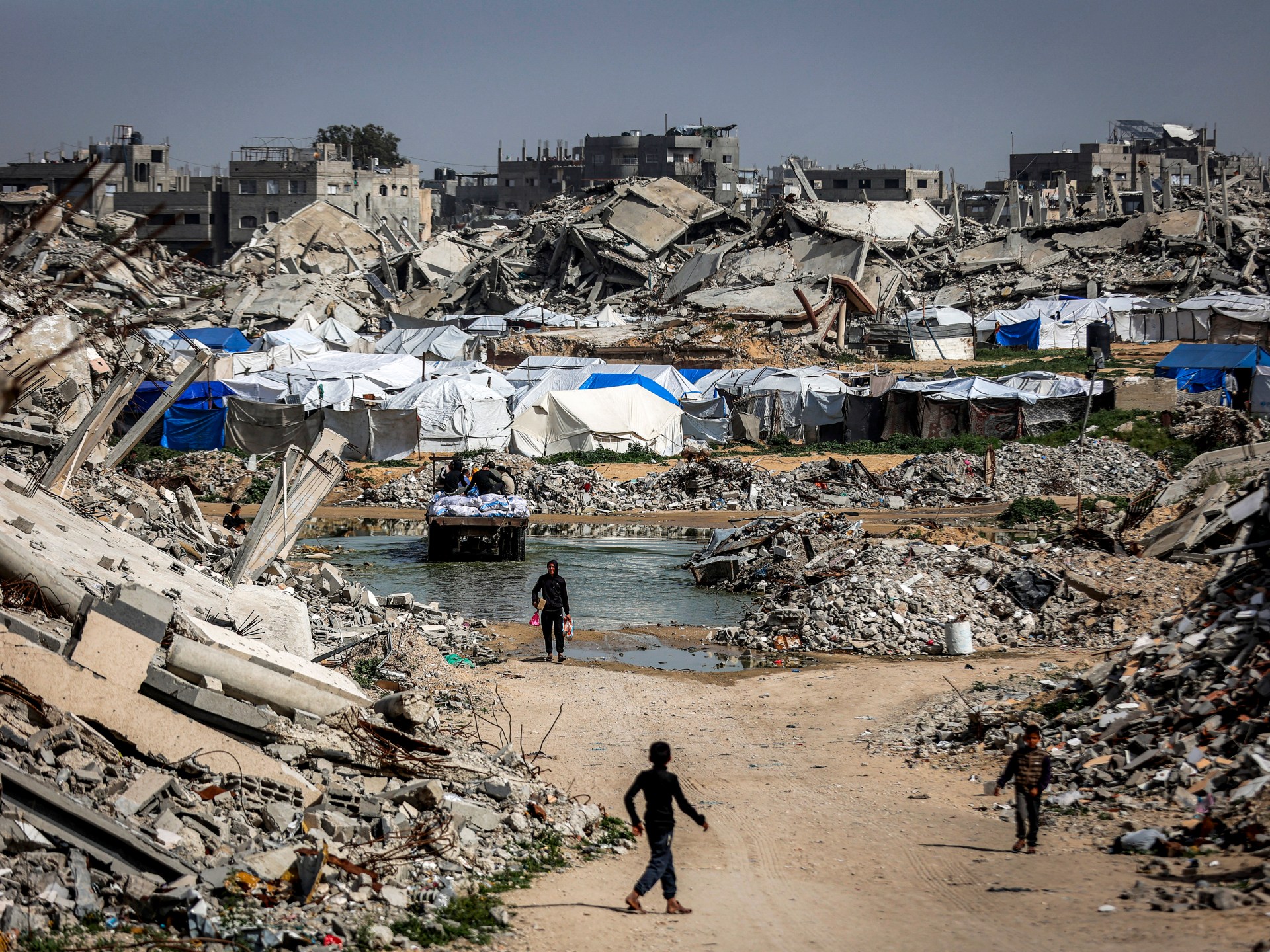
The document, presented by US President Donald Trump’s “Board of Peace” during meetings in Cairo in mid-March, advances a controversial US vision for the enclave, as Israel’s ongoing war and military occupation continue to ravage the territory and its two million residents, in the aftermath of its two-year genocidal campaign that killed more than 72,000 people, mostly children and women. Thousands more are missing, lost under the rubble, and believed dead.
According to media reports, the proposal pushes forward Trump’s 20-point plan, centred on the second phase of the US-brokered October “ceasefire” agreement for Gaza. Under the US framework, Israeli troops – which currently occupy more than half of the enclave – will withdraw, and reconstruction will begin only once Hamas and other armed groups surrender their weapons.
Appearing before the United Nations Security Council on Tuesday, Nickolay Mladenov, the Trump-appointed Board of Peace envoy to Gaza, urged Palestinian factions to accept the framework “without delay”. He claimed the disarmament process rests on “reciprocity”, stating that “decommissioning proceeds in parallel with staged withdrawal”.
Footing the political bill for a regional war
However, rather than a genuine diplomatic proposal, Palestinian factions and political observers view the US plan as a coercive ultimatum designed to bypass previous agreements and enforce a one-sided reality.
Advertisement
Wesam Afifa, a Gaza-based political analyst who has closely followed the Cairo meetings, noted that the proposed document has been presented as more of a “threat message” than a negotiating initiative.
Afifa pointed out that the new US approach abandons Israel’s and the US’s obligations laid out under previous agreements in favour of a sweeping demand for the surrender of all weapons, including personal firearms, and links the enclave’s desperately needed reconstruction directly to this condition.
He identified three main shifts in US strategy for Gaza, which are now being pushed by Trump’s special envoy Steve Witkoff and mediators, and which seek to enforce new realities on the ground:
- ‘Militarising’ the NCAG: Established under UN Security Council Resolution 2803 to oversee the day-to-day civilian rebuilding of the enclave, the National Committee for the Administration of Gaza (NCAG) has had a shift in its mandate. At the UN, Mladenov confirmed the committee has begun “vetting thousands of civilian police candidates”. Afifa said this is a clear attempt to saddle the body with an early security role before addressing the humanitarian disaster, turning it into an enforcement tool rather than a purely civilian administration.
- A ‘one-sided security doctrine’: Despite Mladenov’s claims of reciprocity, Afifa warned that mediators have reduced the diplomatic process to the single condition of Palestinian disarmament. “Israel is to be granted a free hand to conduct security operations against any perceived threats,” Afifa said. He noted that, at the same time, Palestinians are being asked to surrender their weapons without receiving any concrete guarantees for reconstruction, a halt to military operations or an Israeli withdrawal.
- ‘Piecemeal’ reconstruction: The plan seeks to deal with Palestinian areas “in instalments”. Reconstruction would be linked to disarmament: areas deemed to have surrendered their weapons would receive aid, while those suspected of retaining arms would be isolated and treated as “rogue zones”.
Ultimately, Afifa argued, these conditions bypass the phased framework previously agreed upon. “Gaza is being forced to pay a political bill for the ongoing war on Iran and Lebanon,” Afifa said. “The aim is to strike this regional axis, and now it is time to make Gaza pay part of that price.”
Rival armed groups and international forces
US officials have indicated that Hamas could be offered amnesty and targeted investments if it and allied factions surrender their weaponry. At the UN, Mladenov announced that a decommissioning framework had been developed with guarantors including the US, Egypt, Turkiye and Qatar, while countries like Indonesia, Morocco and Kazakhstan have committed troops to a temporary International Stabilization Force (ISF).
Advertisement
But Hamas and its allied resistance factions remain deeply suspicious of both the security and financial promises.
According to sources close to Hamas, quoted by Reuters, the group is highly unlikely to relinquish its rifles, fearing vulnerability to rival armed factions operating in Gaza, some of which reportedly receive backing from Israel.
While the US plan demands all groups disarm, Hamas fears Israel will turn a blind eye to, or even actively arm, rival clan-based armed groups to police the Strip.
Furthermore, Palestinian analysts and faction leaders argue that the financial incentives promised by Washington are simply not there. While Trump has attracted approximately $7bn in reconstruction pledges in February, primarily from Gulf nations, only a fraction has materialised in the US-backed NCAG funds.
The widening regional conflict sparked by US-Israeli strikes on Iran on February 28 has also severely complicated the financial logistics, as donor mechanisms have stalled.
For all these reasons, Afifa said, the chances of success for the US-led diplomatic track demanding disarmament for reconstruction are limited, and Hamas and its allied factions are demanding that the first phase of the October ceasefire agreement – which entails an Israeli withdrawal and the entry of unconditional aid – be implemented before the subject of weapons is addressed.
As Washington and Tel Aviv attempt to engineer Hamas’s political capitulation, roughly 1.4 million Palestinians remain displaced across the Strip. For them, these diplomatic manoeuvres offer no relief, leaving their daily survival entirely dependent on the arrival of aid amid an ongoing Israeli military occupation.
Related News
Tipster claims to have seen ‘grave-like plots’ at Epstein’s Zorro Ranch
US-Israel war on Iran: What’s happening on day 25 of attacks?
Iran hits Qatar gas operations in response to Israeli attack