UN discusses prevention of genocide: Six times it failed to do just that
 06 July 2026
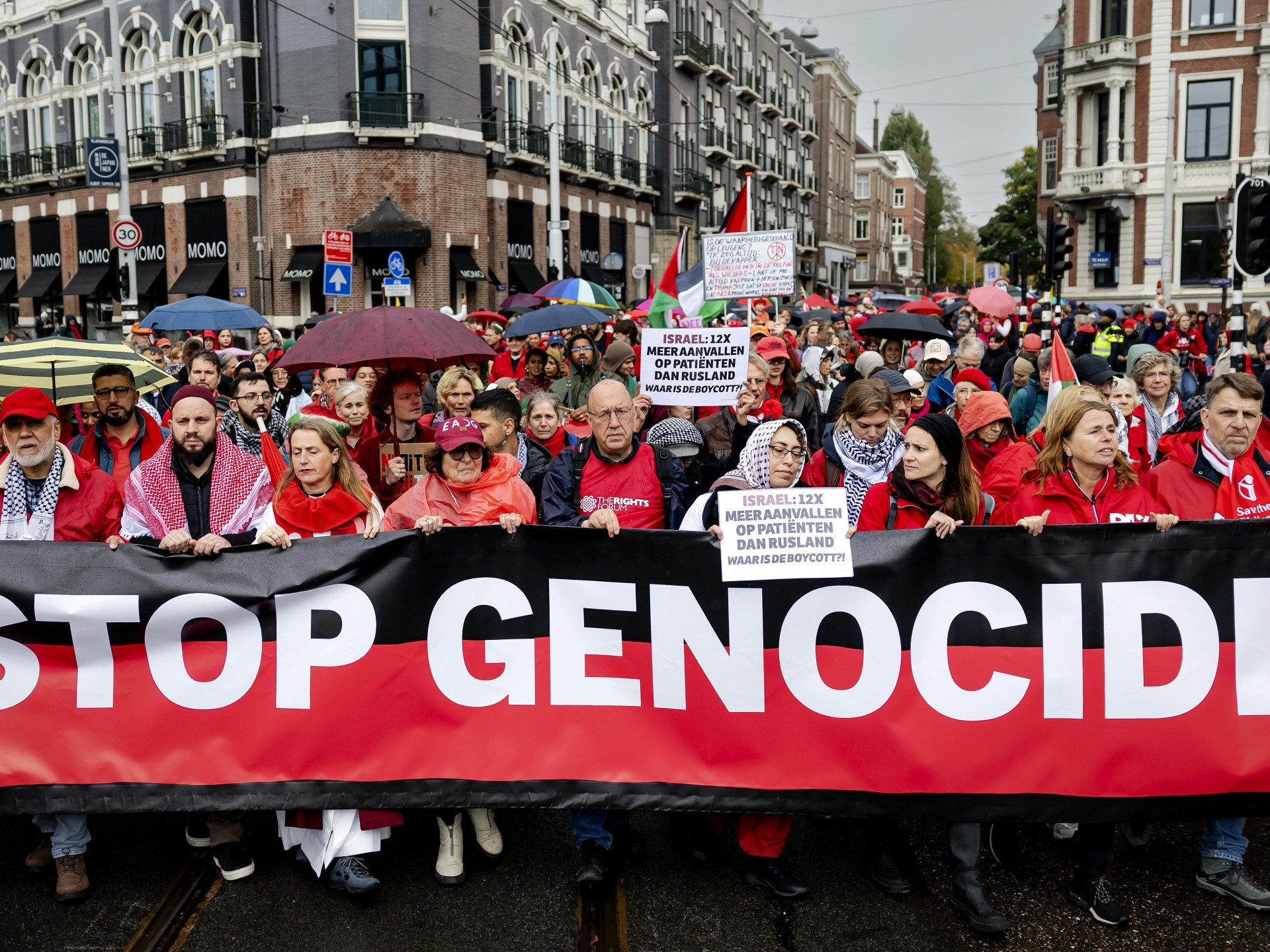

The United Nations General Assembly is holding a plenary session on Monday to discuss nations’ responsibility to prevent genocide, war crimes, ethnic cleansing and crimes against humanity.
But the meeting on Monday at UN headquarters in New York comes amid Israel’s genocide in Gaza, the Rapid Support Forces’ and allied militias’ ongoing genocide in the Darfur region of Sudan, and other humanitarian crises around the world, which many critics say the international community has done very little to address.
- list 1 of 3Trump administration renews pressure on International Criminal Court
- list 2 of 3Thirty-two years on, young Rwandans reflect on progress, pain and hope
- list 3 of 3Israeli attacks on Gaza kill at least 6 as ‘ceasefire’ violations continue
end of list
While the UN meeting may result in protocols that countries need to follow to prevent future genocides, observers are sceptical that these will make much difference to victims on the ground.
What is the UN’s definition of genocide, and which are some of the genocides the UN has ultimately failed to act on? Here, Al Jazeera takes a look.
How does the UN define genocide?
In 1944, Polish lawyer Raphael Lemkin used the term “genocide” for the first time in his book Axis Rule in Occupied Europe. The prefix of the word is “genos” and means “race” or “tribe” in Ancient Greek. The suffix “cide” is Latin and means “killing”.
In 1946, the UN General Assembly recognised genocide as a crime for the first time. According to the world body, the term genocide was then “codified” as an independent crime in the 1948 Convention on the Prevention and Punishment of the Crime of Genocide, or the Genocide Convention, which came into effect in 1951 and has been ratified by 196 countries.
The UN’s Geneva Conventions define genocide as any act committed “with intent to destroy, in whole or in part, a national, ethnical, racial or religious group”.
Advertisement
This includes “killing members of the group, causing serious bodily or mental harm to members of the group, deliberately inflicting on the group conditions of life calculated to bring about its physical destruction in whole or in part, imposing measures intended to prevent births within the group, [and] forcibly transferring children of the group to another group”.
Which are some of the genocides the world has failed to act on?
Genocide in Rwanda
In 1994, members of the majority Hutu ethnic group in Rwanda massacred an estimated 800,000 minority Tutsis, moderate Hutus and members of a third ethnic group, the Twa, in one of the darkest episodes in world history.
A combination of colonial-era favouritism towards the Tutsis, which had angered other groups, a media landscape that was ripe for spreading hate, and the slowness of the international community to respond to the crisis all combined to fuel the genocide, which began in April 1994 and continued for 100 days.
Before the genocide, the 1991 census counted the Tutsi population at 657,000, or 8.4 percent of the overall population, although some have alleged without proof that Rwandan President Juvenal Habyarimana’s government undercounted Tutsis to limit their access to education and other opportunities. Human Rights Watch estimated at least 500,000 Tutsis – 77 percent of their 1991 population – were killed.
Global leaders were aware of the genocide, but did not intervene.
For a long time, the UN actually avoided using the word “genocide” under pressure from the United States, which had been reluctant to send troops to Rwanda. Former UN chief Ban Ki-moon said on the 20th anniversary of the killings that the organisation was still “ashamed” of its failure to prevent the genocide.
The UN did, however, establish the International Criminal Tribunal for Rwanda in November 1994 in Arusha, Tanzania. The court has since tried several high-profile leaders of the massacres, including caretaker Prime Minister Jean Kambanda, who was handed a life sentence for inciting, aiding, abetting and failing to prevent genocide. He was also sentenced on two counts of crimes against humanity. The tribunal has convicted 61 people so far.

Israel’s genocide in Gaza
It has been more than 1,000 days since Israel launched its genocidal war on Gaza in October 2023, killing at least 73,066 Palestinian people in the enclave following the Hamas-led assault on southern Israel in which more than 1,100 people were killed. Since then, more than 90 percent of the Gaza Strip has been destroyed, with infrastructure and healthcare facilities almost completely obliterated, and Israeli forces remain in control of 80 percent of the besieged territory, authorities in the enclave have said.
Advertisement
The genocide began in response to attacks on southern Israel by fighters from the Qassam Brigades, the armed wing of Hamas, and other Palestinian groups, during which 1,139 people died and about 240 were taken into Gaza as captives.
While a ceasefire came into effect in October 2025, Israeli attacks on Palestinians in the enclave have continued. According to Gaza’s Ministry of Health, Israeli army violations of the ceasefire have killed over 1,000 people and wounded over 3,000 others since the truce took effect.
Under the ceasefire deal, the parties were also expected to move to a second phase after Hamas released the remaining captives covered by the first-stage deal in exchange for Palestinians held in Israeli prisons. That phase was meant to include disarmament by Hamas and a gradual Israeli military withdrawal from Gaza.
However, negotiations remain stalled. As during the war itself, world leaders have done little to prevent Israel from continuing its attacks in Gaza.
Furthermore, each time the UN Security Council has held a vote to enable a ceasefire in Gaza, the US has vetoed and blocked all ceasefire resolutions.
In March 2024, the UN Special Rapporteur on the occupied Palestinian territories, Francesca Albanese, said there were clear indications that Israel was violating three of the five conditions listed under the UN Genocide Convention. She said she had found “reasonable grounds to believe that the threshold indicating the commission of … acts of genocide against Palestinians in Gaza has been met”.
“The overwhelming nature and scale of Israel’s assault on Gaza and the destructive conditions of life it has inflicted reveal an intent to physically destroy Palestinians as a group,” Albanese said.
Her report was, however, immediately rejected by Israel as an “obscene inversion of reality”.
As well as receiving death threats and harassment for speaking out over Israel’s potential war crimes, Albanese has been sanctioned by the US government for her investigations.
In September 2025, at a point when only independent UN inquiries and UN officials had described Israel’s actions as “genocide”, a United Nations fact-finding mission delivered its most damning verdict yet: genocide. Navi Pillay, chairwoman of the UN Independent International Commission of Inquiry on the Occupied Palestinian Territory, said Israeli leaders’ statements and the destruction on the ground prove intent.
In May this year, UN High Commissioner for Human Rights Volker Turk also called upon Israel to “prevent the commission of acts of genocide”, to ensure displaced Palestinians are allowed to return home, and to “end its unlawful presence in the Palestinian territory”.
But with Israel repeatedly slamming UN inquiries and probes on its actions in Gaza and calling them “outrageous” – and with the US supporting Israel – the UN has been unable to take a stronger stance to stop genocide in the enclave.
And, despite the findings of many investigations, Western nations continue to sell weapons to Israel while the US continues to provide financial and military aid.
Srebrenica genocide
Bosnia and Herzegovina is still scarred by the ethnic cleansing campaigns that tore through the country, killing about 100,000 people and displacing more than two million, in the mid-1990s.
Advertisement
The 1992-1995 war, triggered by ethnic tensions and competing nationalist projects in the wake of the violent breakup of Yugoslavia, was marked by the systematic targeting of civilians and culminated in the 1995 Srebrenica genocide – the worst atrocity to be perpetrated in Europe since World War II.
A post-war research project commissioned by the Bosnian authorities estimated that about 104,000 people were killed, most of them civilians. Roughly two-thirds of those killed were Bosniaks.
International and Bosnian sources estimate that about 2.2 million people, more than half of the pre-war population, were forced from their homes as refugees or internally displaced. Most have never been able to return.
Western governments had initially been reluctant to intervene decisively earlier in the war, but the massacre at Srebrenica forced a shift in approach. In August and September 1995, NATO launched a sustained air campaign against Bosnian Serb forces – a turning point that paved the way for the Dayton Peace Agreement, which formally ended the war.
It was, however, only in 2007 that both the UN-established International Criminal Tribunal for the Former Yugoslavia (ICTY) and the International Court of Justice (ICJ) concluded that the acts committed in Srebrenica in 1995 during the wider conflict in Bosnia and Herzegovina (1992–1995) constituted genocide.
The UN itself took years to recognise the genocide, with Russia vetoing a UN Security Council resolution recognising the war in Srebrenica as genocide in 2015. International rights organisations called this failure of the UN an “insult to the memory of the dead”.
It was only in 2024, 29 years after the massacre, that the United Nations General Assembly adopted a resolution designating July 11 as the International Day of Reflection and Commemoration of the 1995 Genocide in Srebrenica to be observed annually. “With the adoption of this Resolution, the General Assembly made the atrocities committed in Srebrenica a subject of international observance at a global scale,” the UN said.
Also, the only legally recognised genocide of this war was when Serb fighters rounded up and killed more than 8,000 Bosniak men and boys in a United Nations-declared “safe zone” in the town of Srebrenica on July 11, 1995.
Last July, in an interview with Al Jazeera, Nimer Sultany, Palestinian legal scholar at the University of London, said: “In both cases [Bosnia and Palestine], there is a failure of prevention [of genocide] mechanisms.”
“And the fact that it fails again … is a miscarriage of justice in itself that requires us to rethink the international legal order.”
The failure to describe events such as this as genocide, Sultany added, gives aggressors a “justification for the killing of civilians” and makes the killing more palatable to society.
Genocide in Sudan
Since April 2023, Sudan has been mired in a brutal war between its military and the Rapid Support Forces (RSF) paramilitary, which has killed tens of thousands and displaced nearly 14 million others, according to the United Nations.
Both sides have been accused of atrocities, while the RSF has been implicated in atrocities in Darfur that the United Nations says may amount to genocide.
Between early 2024 and October 2025, scores of people were killed in attacks by RSF forces during their capture of the city of el-Fasher in Sudan’s western Darfur region.
“The massacres the world is witnessing today are an extension of what occurred in el-Fasher more than a year and a half ago, when over 14,000 civilians were killed through bombing, starvation, and extrajudicial executions,” the Sudan Doctors Network said last October.
Advertisement
In July this year, Amnesty International also said the RSF committed crimes against humanity and ethnic cleansing during their attack on el-Fasher city.
“The RSF’s crimes included murder, forcible transfer, imprisonment, torture, rape, sexual slavery, other forms of sexual violence, enslavement, extermination and persecution,” it said in a report.
A UN independent fact-finding mission in February concluded that the 2025 assault on el-Fasher bore the “hallmarks of genocide”.
The UN has since warned that the same may be about to happen again in the city of el-Obeid, which has been under a barrage of drones for the past 18 months.
But last May, the International Court of Justice (ICJ) also dismissed Sudan’s case accusing the United Arab Emirates of enabling genocide in Darfur by supplying the paramilitary forces with weapons. The ICJ, the top court of the UN, said it lacked jurisdiction, rejecting Sudan’s request for emergency measures and ordering the case be removed from its docket.
The UAE, a federation of seven sheikhdoms on the Arabian Peninsula and a US ally, has been repeatedly accused of arming the RSF, something it has strenuously denied despite evidence to the contrary.
Due to a lack of political will, UN members have so far been unable to prevent this genocide – and may be about to watch from the sidelines as it happens all over again in el-Obeid.
China’s genocide against the Uighur people
The Uighurs are an ethnic minority group mostly living in the Xinjiang autonomous region of the People’s Republic of China. They are predominantly Muslims.
According to official Chinese records, there are 12 million Uighurs, representing almost half the population in Xinjiang. The World Uyghur Congress, a group of Uighur exiles advocating for human rights in their homeland, puts their number at about 20 million living inside and outside of China.
In the late summer of 2018, the United Nations revealed that at least one million Uighurs had been detained in “counter-extremism centres” in China’s northwestern Xinjiang province, thrusting the treatment of a once-obscure mostly Muslim ethnic group into the spotlight. The report also revealed that a further two million Uighurs had been “forced into so-called re-education camps for political and cultural indoctrination” since mid-2017.
The detentions, as well as forcible training and alleged abuses inside enclosed government facilities, were later described by the US and many international human rights groups as a form of genocide constituting “crimes against humanity”.
In September 2022, the UN Human Rights Office said in a long-delayed report that China’s detention of Uighurs and other mostly Muslim ethnic minorities in Xinjiang may amount to “crimes against humanity”.
The government of the US as well as parliaments in the United Kingdom, Canada and France have since labelled China’s treatment of the Uighurs as “genocide”.
China has, however, rejected the allegations, saying its policies towards the Uighurs and other Muslim minorities living in its far western region are necessary to “fight extremism” and to promote upward economic mobility for the impoverished ethnic groups. Beijing is also a permanent member of the UN Security Council, making it challenging for the world body to prevent the genocide in Xinjiang.
Myanmar Rohingya genocide
Myanmar’s military has targeted the Rohingya minority in the country since 2017, in a bid to destroy the community.
The Rohingya, considered “outsiders” by the military government as well as by many of Rakhine’s Buddhist residents, have long suffered persecution in Myanmar, including a brutal military offensive that drove some 750,000 members of the community into Bangladesh in 2017.
Last June, the Burmese Rohingya Organisation UK (BROUK) called for global action over what it called an “intensifying genocide” against Myanmar’s Rohingya.
BROUK, in its report, said the 600,000 Rohingya who remain in Rakhine are facing increased persecution after fighting between the military and the Arakan Army (AA) resumed last October. The AA represents Rakhine’s Buddhist majority and is fighting for autonomy for the region.
“Rohingya remaining in Rakhine State face either a fast death being killed by the Myanmar military or Arakan Army, or a slow death as a result of being systematically deprived of the basic necessities of life,” Tun Khin, president of BROUK, had said.
“We are witnessing another significant increase in violence against the Rohingya, and once again the UN Security Council looks on and does nothing.”
The UN has been dogged for years by uncomfortable questions about its approach to the Rohingya.
Senior officials have been accused of downplaying human rights abuses and ignoring the warning signs in the run-up to military-led mass killings.
UN insiders told Al Jazeera in 2019 that a key obstacle for the UN has been opposition from China and Russia, both allies of Myanmar with UN Security Council vetoes.
In January this year, the International Court of Justice (ICJ) opened a landmark case brought forward by the Gambia accusing Myanmar of committing genocide against the Rohingya.
The trial is the first genocide case the ICJ has taken up in full in more than a decade, and the court has yet to declare its final verdict.
Related News
Israeli settlers intensify attacks in West Bank, targeting water supplies

VIDEO: France ends Morocco’s World Cup run, cruises into semifinals
‘Not Nigel Farage’: Who is Count Binface, contesting as MP for Clacton, UK?