Trump threatens to use Insurrection Act in Minnesota: What it means
 16 January 2026
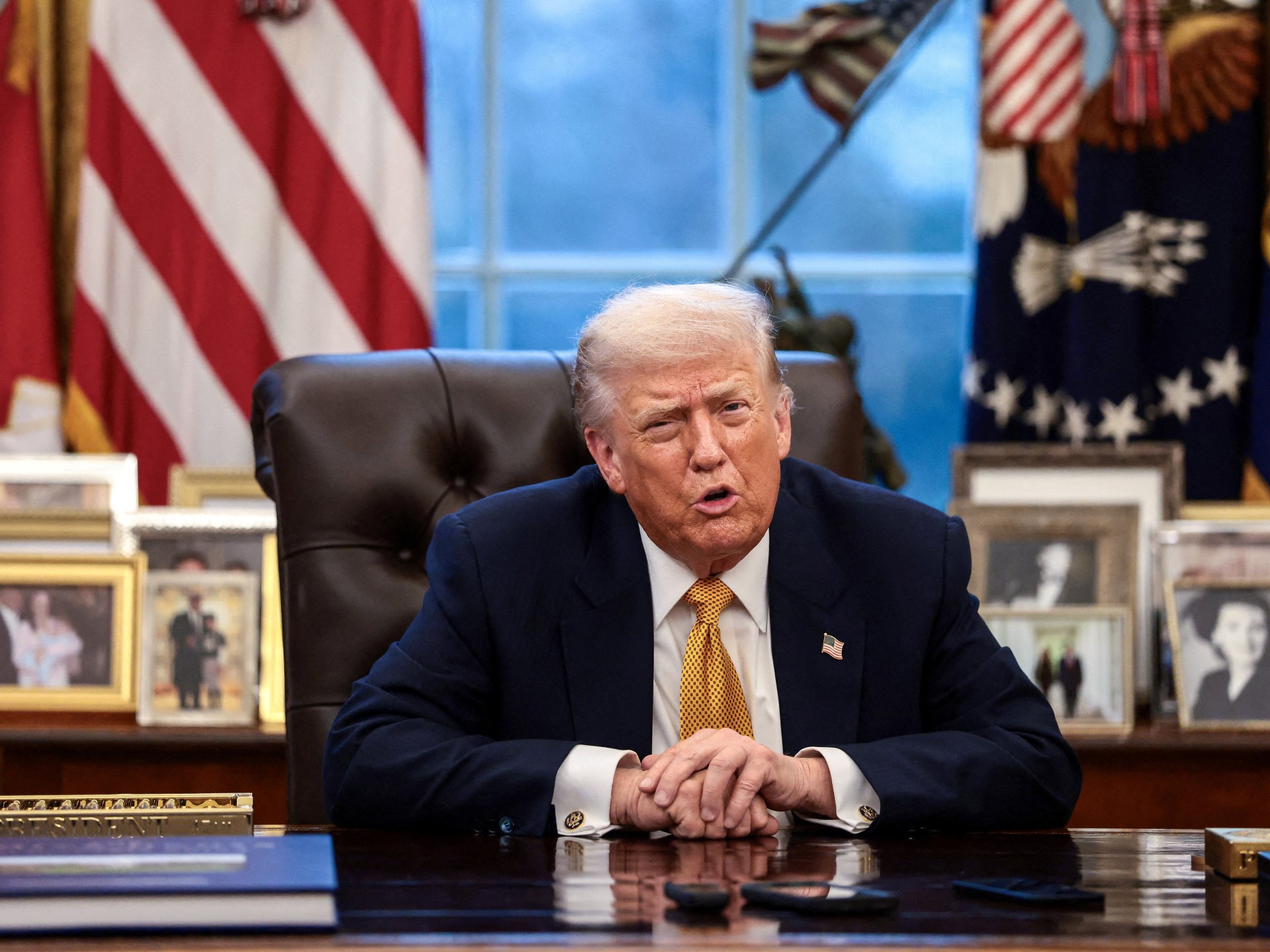

United States President Donald Trump has warned he might invoke the Insurrection Act to deploy US troops to Minnesota if state officials do not work to calm the protests there against federal immigration authorities, who he said are “only trying to do their job”.
His warning came at a time when widespread protests and political tension have gripped Minneapolis – Minnesota’s largest city – following two recent shootings involving federal immigration agents. Those include the fatal shooting of Renee Nicole Good, 37, by an Immigration and Customs Enforcement (ICE) officer.
end of list
Here is what we know:
What has Donald Trump said?
On Thursday, Trump threatened in a social media post that he might use the Insurrection Act to crack down on protesters in Minnesota.
“If the corrupt politicians of Minnesota don’t obey the law and stop the professional agitators and insurrectionists from attacking the Patriots of I.C.E., who are only trying to do their job, I will institute the INSURRECTION ACT, ” Trump said on his Truth Social platform.
Following the post, White House Press Secretary Karoline Leavitt told reporters that Trump alone would decide whether and when to invoke the centuries-old law.
“That’s only a question … the president can answer, but the Insurrection Act is a tool at the president’s disposal,” Leavitt said.
“I think the president’s Truth Social post spoke very loud and clear to Democrats across this country, elected officials who are using their platforms to encourage violence against federal law enforcement officers, who are encouraging left-wing agitators to unlawfully obstruct legitimate law enforcement operations,” she added.
Advertisement
Democrats, including Minneapolis Mayor Jacob Frey, Minnesota Governor Tim Walz and members of Congress from the state have pushed back against accusations from the Trump administration and allied Republicans that they have been provoking protesters against ICE.
Instead, they have criticised the behaviour of ICE officers and accused the Trump administration of using the enforcement agency to sow chaos and violence in Minneapolis.

Meanwhile, Department of Homeland Security (DHS) Secretary Kristi Noem said she had discussed the possibility of using the Insurrection Act with the president.
“He certainly has the constitutional authority to utilise that,” Noem told reporters outside the White House.
What is the Insurrection Act of 1807, and what does it do?
The Insurrection Act is a law from 1807 that allows a US president to deploy federal military troops inside the country to restore order and enforce the law.
When the law is invoked, it temporarily overrides another rule that normally prevents the military from carrying out civilian law enforcement. A president can use it if he decides that unrest or rebellion makes it impossible to enforce the law through the regular courts and police.
The law does not clearly define what counts as an “insurrection” or “rebellion”. In a 1827 ruling, the US Supreme Court said the president alone has the authority to decide when the law applies.
Legal experts say the Insurrection Act is meant to be used only in extreme situations, when normal law enforcement has broken down.
It has been used 30 times in US history, including to enforce school desegregation in the 1950s and 1960s, according to the Brennan Center for Justice.
The last occasion it was used was during the 1992 Los Angeles riots following the acquittal of police officers who beat Rodney King, a Black man. Republican George HW Bush was president at the time.
However, this is not the first time that Trump has threatened to invoke the Insurrection Act.
Last July, when courts blocked the president’s attempts to deploy the National Guard to Portland, Trump threatened to use the Insurrection Act to bypass legal challenges.
How is the Minnesota government responding?
Minnesota Governor Walz urged President Trump to dial back his rhetoric and reduce tensions in the state.
“I am making a direct appeal to the President: Let’s turn the temperature down. Stop this campaign of retribution. This is not who we are.”
Advertisement
And he added a message to Minnesotans. “I know this is scary. We can – we must – speak out loudly, urgently, but also peacefully. We cannot fan the flames of chaos. That’s what he wants,” Walz posted on X.
Minneapolis Mayor Frey, meanwhile, wrote on X that “Minnesota needs ICE to leave, not an escalation that brings additional federal troops beyond the 3,000 already here.”
On Wednesday night, Deputy Attorney General Todd Blanche said Walz and Frey, both Democrats, needed to be stopped from “terrorism”.
“Minnesota insurrection is a direct result of a FAILED governor and a TERRIBLE mayor encouraging violence against law enforcement. It’s disgusting,” Blanche posted on X. “Walz and Frey – I’m focused on stopping YOU from your terrorism by whatever means necessary. This is not a threat. It’s a promise.”
Protests and unrest in Minneapolis, Minnesota, began after a fatal shooting by a federal immigration officer earlier this month.
On January 7, an ICE officer shot and killed 37-year-old Renee Nicole Good while she was sitting in her car during a federal immigration operation.
Federal authorities said the officer acted in self-defence, claiming Good used her vehicle as a weapon.
City leaders said Good, a prize-winning poet, was present as a legal observer monitoring ICE activity. Her death prompted vigils and protests, with demonstrators accusing federal agents of using excessive force.

The shooting occurred during a large federal immigration crackdown that brought a heavy law-enforcement presence to the Twin Cities, a metropolitan area in Minnesota centred around its two largest cities, Minneapolis and Saint Paul.
Civil rights groups, including the American Civil Liberties Union of Minnesota, said residents reported aggressive tactics such as masked agents stopping vehicles and detaining people. Federal officials have denied wrongdoing.
The protests gained national attention, and days later, actors Mark Ruffalo and Wanda Sykes wore badges referencing ICE and Good’s death at the Golden Globe Awards in Los Angeles on January 11.
“This is for Renee Nicole Good, who was murdered,” Ruffalo told local media, referring to his “BE GOOD” pin.
Tensions escalated again on January 14, when another federal officer shot Julio Cesar Sosa-Celis, a Venezuelan national without legal status, in the leg during a traffic stop.
DHS said the officer was attempting a targeted arrest when Sosa-Celis and two other men assaulted him with a shovel and a broom handle.
DHS spokeswoman Tricia McLaughlin said the officer feared for his life and fired his weapon. Both the officer and Sosa-Celis were taken to hospital and are out of danger.
Later that night, protesters clashed with police in parts of Minneapolis. Officers used tear gas, while a number of demonstrators threw rocks and fireworks.
Vice President JD Vance said Good’s death was “a tragedy of her own making”, but polling suggests that many Americans disagree.
Advertisement
A Yahoo/YouGov poll of 1,709 US adults, conducted between January 8 and 12, found that only 27 percent of respondents believe the shooting was justified. By contrast, 52 percent said it was not justified.
Public concern goes beyond this single incident.
Separate polling shows that many Americans think Trump is going too far in using presidential power. An AP-NORC poll found that 62 percent of Americans believe Trump has overstepped his authority in pursuing his goals.
That view extends to several policy areas, including the use of federal law enforcement, tariffs, and foreign policy.
On the specific issue of deploying federal forces in Minnesota, another YouGov poll revealed more opposition than support, with 51 percent opposed and 34 percent in favour. Support was higher among Republicans, while most Democrats and independents opposed the move.
Related News
Gaza plan phase two: US to discuss Hamas disarmament, Israeli withdrawal
Syrian forces search for explosives, weapons after SDF pulls out of Aleppo
Iran experiencing nationwide internet blackout, monitor says