Trump files emergency motion to continue building White House ballroom
 04 April 2026
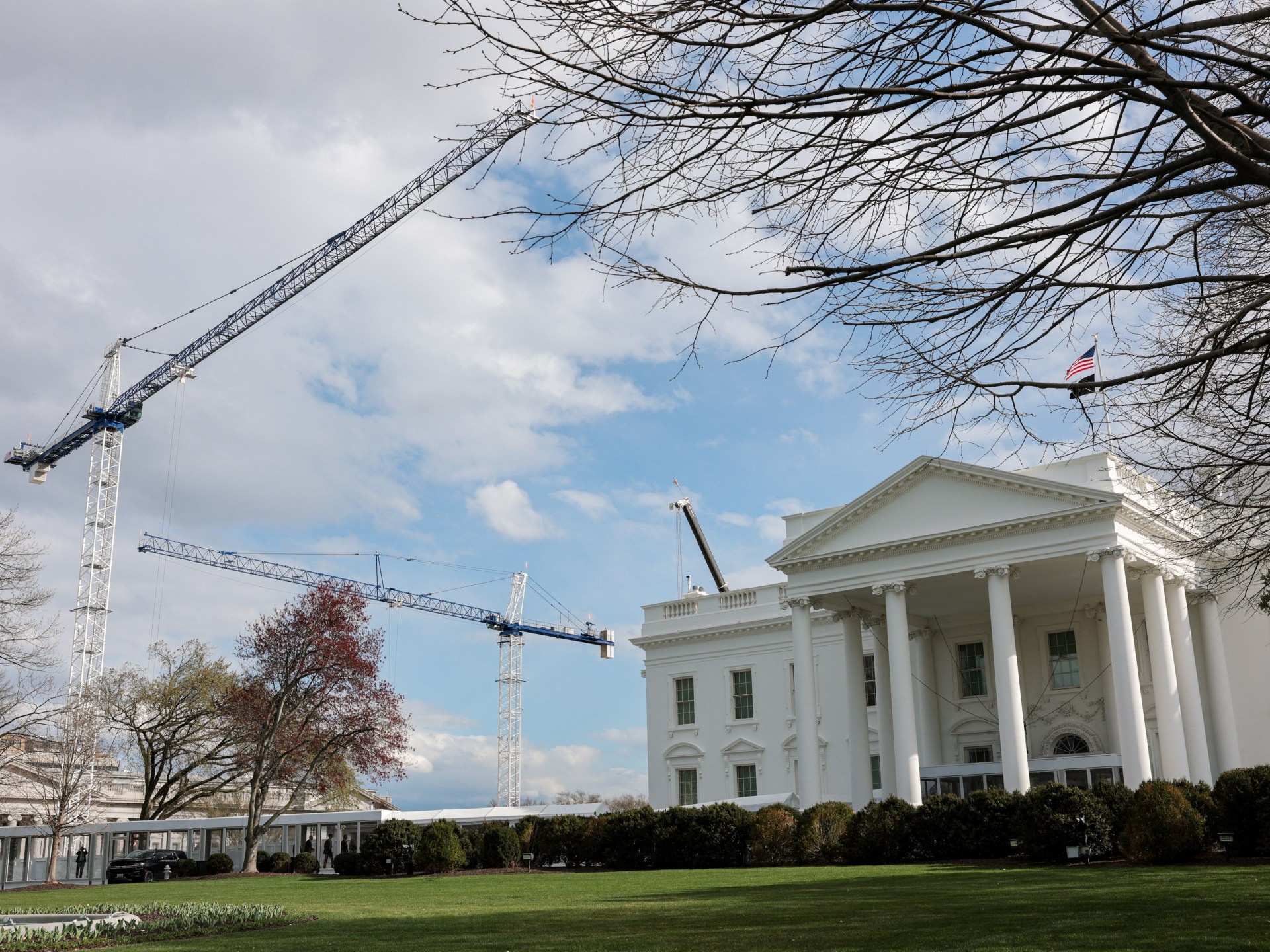

The administration of United States President Donald Trump has filed an emergency motion to resume construction on its White House ballroom, arguing that completing the work is necessary for national security.
On Friday, lawyers for the Trump administration and the National Park Service called a recent court decision to pause construction “shocking, unprecedented, and improper”.
- list 1 of 3Judge temporarily halts Trump’s $400m White House ballroom project
- list 2 of 3Judge halts Trump ballroom project; Trump says work can go on
- list 3 of 3Planning commission approves Trump’s White House ballroom plans
end of list
They argued that the court-ordered suspension left a “massive excavation” site next to the executive mansion, “threatening grave national-security harms to the White House, the President and his family, and the President’s staff”.
“This order is untenable and must be stayed,” the motion (PDF) said. “The building is under construction, with deep Top Secret excavations, foundations, and structures, already built.”
The motion outlines various security measures slated to be incorporated into the ballroom project, including drone-proof roofing materials and glass meant to withstand bullets and blasts.
“Time is of the essence,” the motion reads.

Destroying the East Wing
The court filing was the latest response from the Trump administration to a March 31 ruling from Judge Richard Leon, an appointee of former Republican President George W Bush.
Judge Leon had issued a 35-page ruling (PDF) ordering construction on the project to stop, citing the need for congressional approval for a project so transformative.
Advertisement
Trump has long sought to leave his mark on Washington, DC, the nation’s capital. And upon his return to the White House for a second term, he quickly announced plans to revamp the White House.
Among his plans were proposals to pave over the Rose Garden and construct a ballroom with more space to accommodate White House functions. He cited his South Florida resort, Mar-a-Lago, as inspiration for the renovations.
Still, his designs alarmed historians, architects and preservation advocates, who worried that the changes could destroy existing designs and structures, including the East Wing, which was first built in 1902.
Trump dismissed such concerns and initially pledged to preserve the East Wing.
“It won’t interfere with the current building,” Trump said of his ballroom plans in July last year. “It’ll be near it but not touching it and pays total respect to the existing building.”
But in October, Trump abruptly demolished the East Wing, which was torn down in a matter of days.
The sudden reversal prompted widespread public outcry. After attempting to reach out to the White House and express concern, the National Trust for Historic Preservation, a nonprofit that protects historic sites, filed a lawsuit in December to stop the ballroom project.
The nonprofit argued that the Trump administration had failed to get the appropriate authorisations to build its new ballroom.

Inside Judge Leon’s decision
Judge Leon sided with the trust’s call for an injunction against further construction, though the injunction he granted in March was temporary.
He also included a period of time before the injunction took effect to allow the Trump administration to appeal.
“The President of the United States is the steward of the White House for future generations of First Families. He is not, however, the owner,” Leon wrote in his decision.
His ruling did acknowledge the Trump administration’s argument that leaving the construction site incomplete would “imperil national security”. But Leon brushed aside that suggestion, saying that the defence was “grasping for straws”.
“While I take seriously the Government’s concerns regarding the safety and security of the White House grounds and the President himself, the existence of a ‘large hole’ beside the White House is, of course, a problem of the President’s own making!” Leon wrote.
“Bald assertions of ‘national security’ cannot excuse the Government’s failure to follow the law and then insulate those failures from judicial review.”
Advertisement
Leon did, however, issue an exception to his injunction against further construction. Under his order, the Trump administration was allowed to proceed with limited construction to “ensure the safety and security of the White House”.
For the rest, Leon said Trump must petition Congress for approval. “Unfortunately for Defendants, unless and until Congress blesses this project through statutory authorization, construction has to stop!”

Commissions grant approval
The Trump administration, however, has appealed Leon’s injunction against the project and has claimed broad authority to make changes to the White House, citing past renovations under earlier presidents.
Since Trump announced the ballroom last year, the project has grown from a $200m structure to a nearly $400m one, by current estimates.
Trump has pledged to use private donations to fund the construction, which is set to span 90,000 square feet (about 8,360 square metres).
Such a massive structure is expected to dwarf the White House’s executive mansion, its main structure, and throw off the symmetry built into Washington, DC’s historical centre.
Critics have also questioned the ethics of accepting private donations, as such funds could be seen as a means of purchasing influence.
But commissions helmed by Trump allies have already given the project their approval, despite lingering questions about the ballroom’s shifting designs.
In February, the Commission of Fine Arts gave the ballroom its go-ahead, and this past week, the National Capital Planning Commission also voted in its favour.
Related News

Details revealed of Board of Peace plan for Gaza disarmament

Lawyers search for Epstein survivors for Bank of America $72.5m settlement

Ukraine announces ‘mutually beneficial’ defence deal with Saudi Arabia