Series returns with lecture on Chagos Islands
 13 February 2026
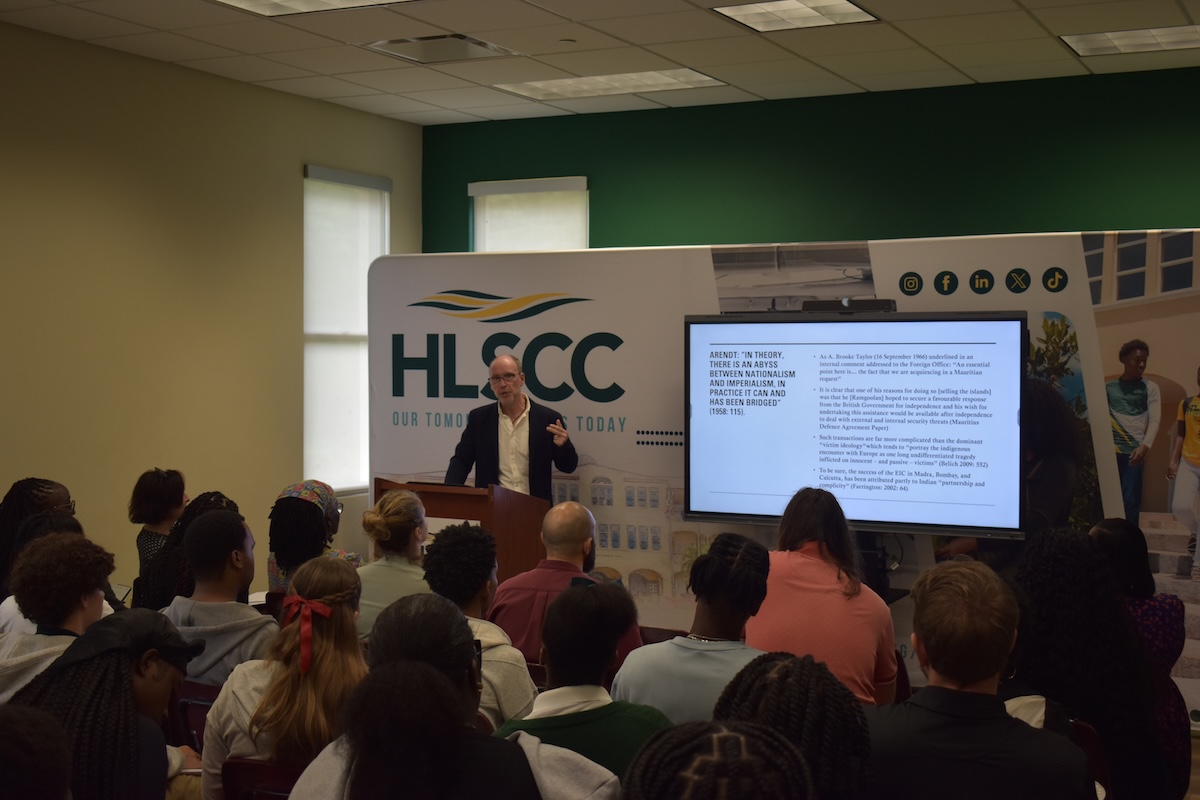

Students and other residents packed the Green Room at the H. Lavity Stoutt Community College’s Learning Resource Centre to welcome history professor Dominic Alessio at the latest installment of the Humanities Talk Series.
The lecture, titled “The Never-ending Stories of Empire,” centred on the atoll of Diego Garcia, the largest of the 60-island Chagos Islands archipelago in the Indian Ocean.
The only inhabited Chagos island, Diego Garcia has had a controversial colonial history — especially since the archipelago became a British Indian Ocean territory in 1965.
Between 1968 and 1973, Chagossians were expelled as part of the United Kingdom’s plan to use the island as a military base in conjunction with the United States.
Today, no Chagos Islanders live there permanently, and the island’s approximately 4,000 residents are military personnel and civilians who support the base.
More controversy arose last May when the UK and Mauritius signed an agreement to transfer the islands’ sovereignty from the UK to Mauritius. As part of the deal, the UK will continue to use Diego Garcia under a 99-year lease.
In his lecture, Mr. Alessio described his discussions with Alain Vincatassin, the first and current president of the Diego Garcia and Chagos Islands Council.
Mr. Vincatassin, he said, told him that the UK decided to be hand over the islands to Mauritius without meaningful consultation with Chagossians.
“Vincitassin’s position makes it clear that there was no discussion,” said Mr. Alessio, a professor of history at Richmond American University London. “They were informed. They weren’t asked. Consequently, the Chagossians are deeply divided. So there is, not surprisingly, a lot of Chagossians who were critical of the deal.”
Mr. Alessio also compared this situation to other global conflicts. As one example, he cited Ukrainian President Volodymyr Zelensky’s critiques of recent peace talks held between the US, Russia and Saudi Arabia — without Ukraine.
The lecture, which lasted for about an hour, ultimately suggested that decolonisation may have largely stalled around the globe.
“If you think of the end of 20th Century as the era of decolonisation, given what’s going on now in the Ukraine, the Indian Ocean, the South China Sea, Syria, Ethiopia, Gaza, Turkey, Venezuela, maybe Greenland, Canada, etcetera — maybe the 21st Century is not a continuation of decolonisation,” Mr. Alessio said. “Maybe it’s a new era of recolonisation.”
‘So much to unpack’
Traci O’Dea, head of humanities and social sciences at HLSCC, said she became interested in Mr. Alessio’s research — which focuses on the postcolonial, political and cultural history of imperialism and the extreme right — because of parallels to the Virgin Islands’ situation.
“I read some of his articles and his work and [thought] we’d be really interested in hearing a talk on empire,” she said, adding, “We’re a British overseas territory, and they’re a British Indian Ocean territory — or they were. And how does that affect us?”
The Humanities Talk Series is designed to stimulate reflection and discussion among students, but members of the public are also invited to attend.
Attendee Ron Massicott said he was drawn to the lecture because of his interest in geopolitics.
“I loved it because there was so much to unpack,” Mr. Massicott said. “He went into the Caribbean Court of Justice, decolonisation, imperialism. All those things could go in any direction. There’s so many dynamics that are coming to play. Those are the kind of things I really am interested in.”
Related News
Potter Rebukes Governor Bryan Over Summer’s End Dispute, Citing Law and CZM Authority
Food Fete to kick off on sister islands
VI National Guard Exits Federal Oversight After Six Years of Transformation