Satellite imagery shows erasure of southern Gaza as Israel expands control
 31 May 2026

Palestinian journalist Muhannad Qishta yearns to visit the graves of his sisters – Reem and Walaa – in Khan Younis in southern Gaza, but there is a problem: they no longer exist on a map.
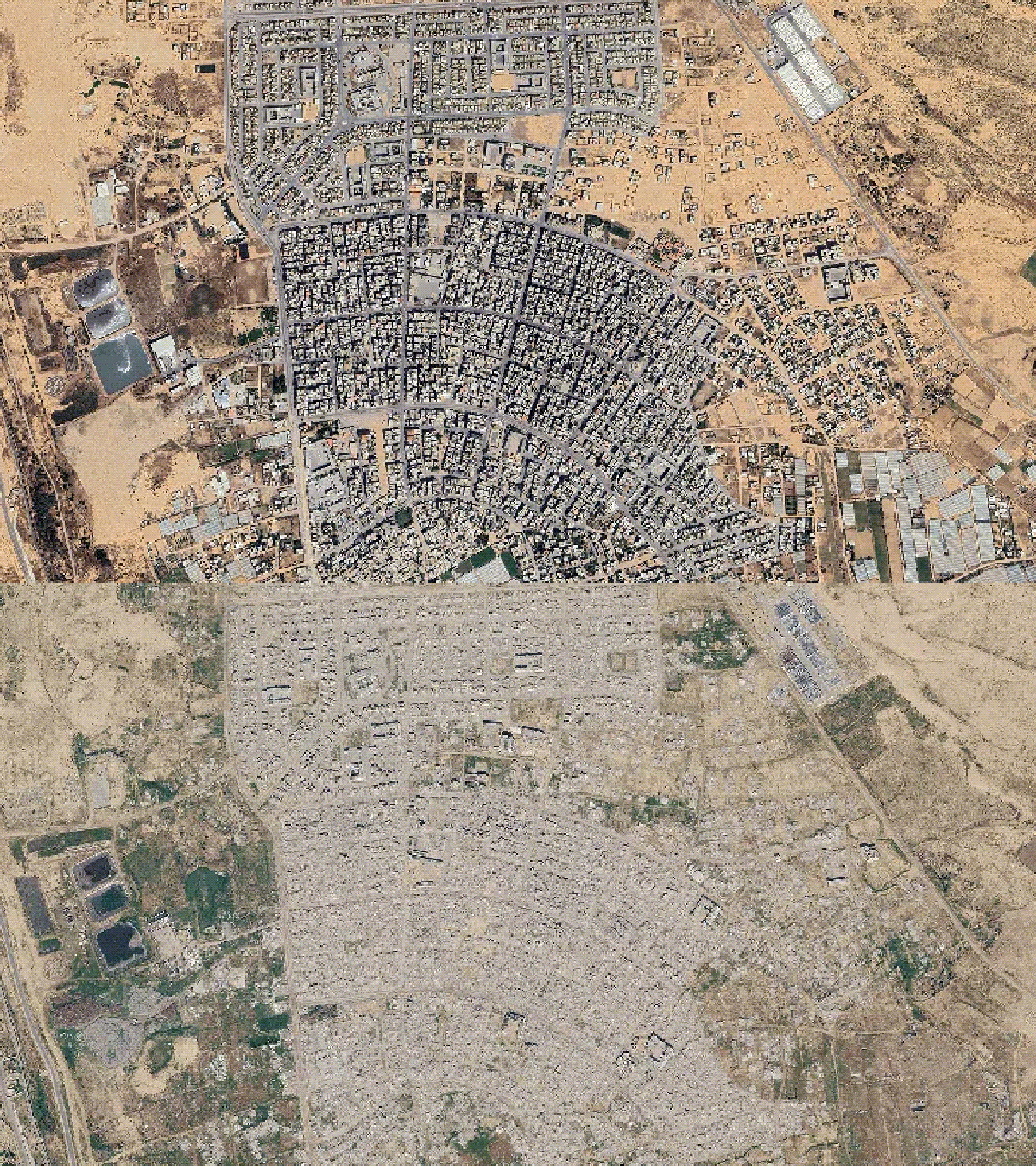
The Sheikh Mohammed cemetery in the Maan area of Khan Younis has been wiped from the map, and replaced by the tents and armoured vehicles of an Israeli military outpost, according to recently updated satellite imagery added to Google Earth.
“Even the dead have not been spared from this war,” Qishta told Al Jazeera. “How will I feel if I go and find the place a desert, without my sisters’ graves to read a prayer over?”

The high-resolution pictures, captured on February 25, 2026, expose a landscape where entire neighbourhoods have been reduced to ash, and the surviving population is squeezed into suffocating encampments that spill onto the beaches of the Mediterranean Sea.
For Palestinians, the updated maps provide a devastating, wide-angle view of an ongoing genocide that has killed nearly 73,000 people.
According to the Euro-Med Human Rights Monitor, Israeli forces have fully or partially destroyed 94 percent of Gaza’s cemeteries, transforming places of memory into military barracks.
Erasing geography and memory
The satellite imagery confirms that major residential centres have vanished, altering the geography of the Strip beyond recognition.
Advertisement
In Rafah, the crushing scale of destruction has rendered neighbourhoods indistinguishable from others. The Saudi neighbourhood in Tal as-Sultan – a sprawling 752-unit housing project – has been flattened into vast mounds of rubble.
US President Joe Biden initially drew a ‘red line’ over the invasion of Rafah in early 2024, but Israel went ahead with its brutal operation. Israel faced no consequences for its actions in Rafah, which has largely been flattened.
General views of southern Rafah now show a largely erased urban footprint, with only faint outlines of streets remaining amidst the debris.
To the far west, the Swedish village in Rafah has been systematically wiped from the map, transformed from a vibrant coastal community home to roughly 1,300 people, into a military zone. Founded in 1965 with international assistance to shelter Palestinian refugees, the village’s economic lifeblood was intimately tied to the Mediterranean Sea.
For decades, residents relied entirely on fishing, with dozens of local fishing boats operating from its shores. The village housed small beachfront commercial stalls, boat maintenance sheds, and a tight-knit community centre built as a gift from the Swedish people. Today, it has been turned into an Israeli military outpost, with only five houses left standing.
The Rafah border crossing, which previously served as the sole lifeline connecting the besieged population to the outside world, has been gutted. Its civilian infrastructure – which previously featured expansive passenger departure and arrival halls, a VIP reception terminal, a dedicated logistics facility for humanitarian aid trucks, and administrative offices for passport control and cross-border coordination – has been replaced by heavily fortified Israeli military observation posts and razor wire.
Straight through the eastern neighbourhoods of Bani Suhaila, Abasan and al-Zana, embedding tanks among civilian homes. Before the war, these eastern districts were among Khan Younis’s most densely populated agrarian and residential hubs, housing nearly 120,000 residents in closely-knit multi-generational family apartment blocks.
Following intense bombardment, and the systematic demolition of entire blocks to carve out military supply lines, the majority of the population was forcefully displaced. Most fled to the parched, overcrowded tent camps of al-Mawasi on the coast, or squeezed into remaining schools and makeshift shelters in Deir el-Balah in central Gaza.
Hamad City in Khan Younis – a residential complex built with Qatari funding – is now a ruined shell surrounded by displaced families. The flagship $135m public housing project comprised 53 modern residential buildings rising five stories high, containing approximately 3,000 housing units.
Advertisement
Prior to its destruction, Hamad City was home to an estimated population of over 15,000 people, primarily low-income families displaced by previous conflicts. The imagery captures apartment blocks reduced to piles of rubble.
The methodical destruction extends to the territory’s educational foundation. UNICEF says more than 97 percent of schools have been damaged or destroyed, leaving 658,000 children without formal learning for more than two years. Universities have either been blown up or transformed into displacement shelters.
The Islamic University of Gaza (IUG), which catered to over 20,000 students, and Al-Azhar University, which enrolled more than 16,000 students, have been razed. Both major campuses, along with Al-Israa University in the south, were completely levelled through controlled military detonations, ending the academic future for tens of thousands of young Palestinians.
‘On the verge of famine’
The agricultural lands and greenhouses of Rafah and Khan Younis once served as the territory’s food basket. The fertile areas produced the vast majority of Gaza’s fresh vegetables, including tomatoes, cucumbers, peppers, citrus fruits and olives, alongside hundreds of greenhouses that supplied more than 40 percent of the entire Strip’s daily domestic food needs. Today, the UN Food and Agriculture Organization (FAO) reports that less than five percent of Gaza’s agricultural land remains usable.
In the Shakoush area, Israeli bulldozers have razed greenhouses and confiscated the topsoil, directly exacerbating the man-made starvation of the population.
“Scenes of searching for food are cruel, and we are on the verge of a famine that could rear its head at any moment,” said Ola Abu Moamer, a Palestinian journalist in Khan Younis. “Many families return with empty pots from soup kitchens, without securing any food,” she told Al Jazeera.
![Ola Abu Moamer, pictured here in full press gear, has become a prominent voice reporting on the famine and displacement from the camp. [nstagram/@ola_abu_moamer]](https://www.aljazeera.com/wp-content/uploads/2026/05/474396531_18482308981045547_6026607297129257791_n-1780219180.jpg?w=770&resize=770%2C513&quality=80)
With 1.9 million of 2.3 million Palestinians internally displaced – many forced to flee more than 10 times – and 60 percent of the population having lost their homes completely, families are forced into an ever-shrinking perimeter.
The satellite images show the extreme density of displacement camps in the al-Mawasi area, where deteriorating tents are packed tightly together, pressing right against the shoreline.
Deepening the occupation
This visual documentation of mass destruction provides the physical blueprint for explicit directives from the Israeli government to deepen its military occupation. In leaked video recorded by Israel’s Channel 12 and aired on Thursday, Prime Minister Benjamin Netanyahu instructed the army to expand its control.
“At this point, we are fully in control of 60 percent of the territory of the Gaza Strip … and my directive is to get to … 70 percent,” Netanyahu told an audience. “We’ll start with that.”
Despite a United States-brokered “ceasefire” last October that established a “Yellow Line” demarcating occupied areas, the military has steadily advanced. Analysts say Israel’s continued occupation of Gaza’s territory is in breach of the October truce agreed with Hamas.
Advertisement
In mid-March, the Israeli army quietly distributed maps to aid organisations indicating it had seized 64 percent of the Palestinian territory, denying Palestinians access to two-thirds of the enclave. Israel was supposed to withdraw by the second round of the ceasefire deal.
The nominal truce has failed to halt the bloodshed. An Al Jazeera tally recorded at least 2,400 Israeli violations between October and April, a rate of bombardment that conflict monitors warn has only accelerated since the US-Israel war on Iran began in February.
Nickolay Mladenov, the high representative for the US-founded Board of Peace for Gaza, warned the UN Security Council last week that the enclave’s deteriorating status quo risks becoming “permanent”.
For Palestinians enduring this reality, the trauma runs far deeper than collapsed buildings. Abu Moamer noted that journalists often turn off their cameras out of respect for the tears of children weeping for a stolen childhood.
“Satellites photograph the destroyed buildings, but they cannot document the feeling of a human searching for their home to no avail,” Qishta, the Palestinian journalist, said. “The hardest thing is not the destruction itself, but the stories buried beneath it.”
Related News

How Philadelphia’s Democratic primary tests the bounds of US progressivism

Iran sends response to US proposal to end war via mediator Pakistan

Cuba says it has ‘legitimate’ right to defend itself amid US threats