More than 50 million votes cast in US midterm elections: What does it mean?
 01 November 2026
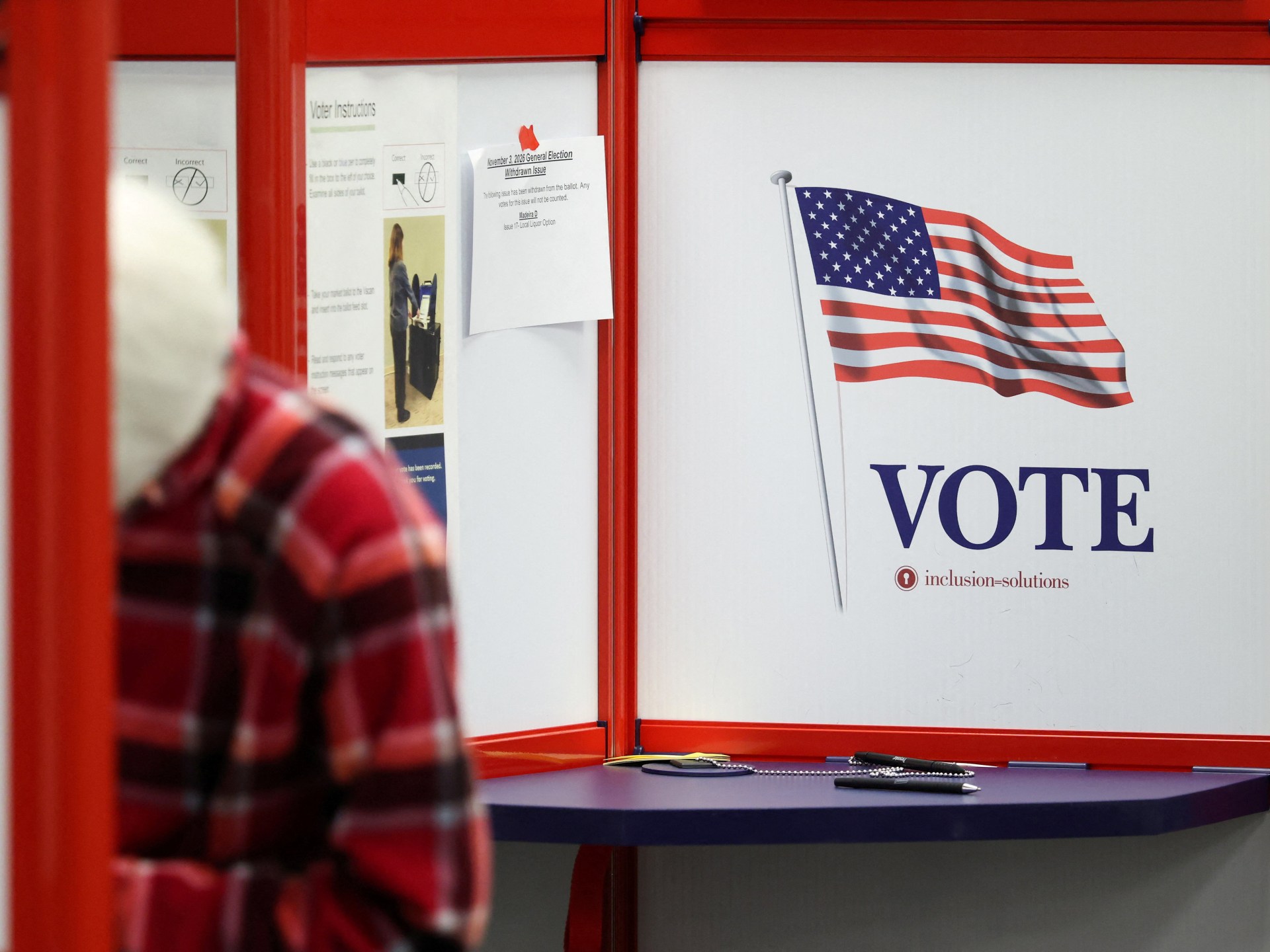

Early voting has surged in the 2026 United States midterm elections with more than 50 million Americans casting their ballots as of Sunday, according to an analysis by the University of Florida.
Most of the 50 states allow early in-person voting while all of them allow mail-in voting. About 23 million people voted through mail-in ballots, which President Donald Trump unsuccessfully tried to curb before the elections.
- list 1 of 3Georgia midterm elections: Why this is a key US battleground
- list 2 of 3Trump reverses course, reinstates cancelled campaign rallies
- list 3 of 3Mamdani says Trump to grant visa to mother of boy killed in Bronx shooting
end of list
With two days left to go before Election Day on Tuesday, support for Democrats was 51.5 percent and for Republicans 43.1 percent, the latest national polls suggested.
The president’s tariff policy and his decision to launch a war with Israel on Iran are hurting his Republican Party. Both have been blamed for contributing to a cost-of-living crisis.
Why are so many Americans voting early? How does it work?
Here’s what we know:
How many Americans have voted early?
Early voting gives US citizens a chance to cast their ballots before Election Day.
According to the US government, people may vote early in person in most states by visiting designated polling stations. All states offer vote-by-mail options, in which registered voters may receive and return ballots by Election Day by mail.
The number of states offering options to vote in person before November expanded from 24 in 2000 to 47 in 2026, plus Washington, DC. But early-voting periods, eligibility requirements and procedures vary widely by state.
This year, out of about 210 million registered voters, 53.14 million had voted early as of 6:56am East Coast time (11:56 GMT) on Sunday , according to the University of Florida analysis. This includes 29 million in-person votes and 23 million mail-in ballots.
Advertisement
In the 2022 midterm elections, 46 million people had voted early.
Early voting enthusiasm has been higher among Democrats this year with more than 11 million registered Democrats having voted early, compared with about 8 million registered Republicans, according to the university’s analysis.
Early voting has particularly surged in the state of Texas, a key battleground, where more than 7 million people have already voted early. This is over 1.5 million more than voted early in the 2022 midterms, according to the University of Florida analysis.
According to an Associated Press polling analysis, in South Carolina, where Trump won by nearly 18 percentage points in 2024, early voting has surged 83 percent compared with the same point in 2022. The state has open races for governor and US Senate this year.
In Kansas, where Republican Senator Roger Marshall faces Democratic Methodist minister Adam Hamilton, early voting has increased 34 percent with roughly 83,000 more ballots cast than at the same point four years ago, AP reported.
In Maine, where Republican Senator Susan Collins faces Democratic former state Senate President Troy Jackson, early voting is up 44 percent. Michigan has also recorded roughly 409,000 more early votes than at the same point in 2022, a 32 percent increase.
Why are people voting early?
According to the University of Maryland’s Center for Democracy and Civic Engagement (CDCE), there are many reasons why Americans are voting early.
This could be because “some voters find early voting to be more logistically convenient than Election Day voting” or have been “mobilised” to vote early, it said.
“Many voters report voting early because of anxiety about the election or a feeling of wanting to ‘get it over with’ or ‘cross it off their list’ as soon as possible,” the CDCE said.
The centre added that some voters choose to vote early for social or cultural reasons. It noted how efforts like “Parties at the Polls” and community celebrations of voting “try to create a more celebratory environment at certain voting locations, especially during early in-person voting”.
While early turnout figures don’t show which candidates voters have chosen or what the final results will be, Democratic political strategist Celinda Lake told Al Jazeera this past week that many voters were looking for change.
“You got a lot of voters who say, ‘I’m going to do a Hail Mary for change, but I hope you do something,’” she said.
“We all just really want a better future for everyone, especially like the next generation,” one young voter told Al Jazeera.
Advertisement
Another young voter pointed to social media as a reason for the increased interest in the election. “Definitely social media. Social media and the media have put voting in the limelight,” the voter told Al Jazeera.
Trump has repeatedly cast doubt on the security of mail-in voting, which enables people to vote early by mail. Trump, who himself has repeatedly voted by mail, cited debunked claims of widespread election fraud associated with it.
Mail-in ballots, which have been in place for decades, have been found to increase voter turnout and currently account for a third of all votes cast in the US.
State and county officials in eight states send ballots to the homes of all registered voters, who then mail them back before a deadline. The rest of the states send ballots only to the registered voters who request them. Voters may return the ballots through official election drop boxes. In some states, the ballots have to reach the voting centre by Election Day while in others, ballots postmarked by Election Day but received after it may still be counted.
Eight states, several of them Democratic-leaning – California, Colorado, Hawaii, Nevada, Oregon, Utah, Vermont and Washington – as well as the District of Columbia allow all elections to be conducted entirely by mail.
Others allow smaller elections to be conducted by mail.
Trump has falsely blamed his 2020 presidential election loss on mail-in voting fraud. He and his supporters also opposed changes made during the COVID-19 pandemic to expand mail-in voting.
In March, Trump signed an executive order directing the US Postal Service to take control of mail-in voting by designing new envelopes with special barcodes that would allow the federal government to ensure ballots are only from eligible voters.
For the midterms, that move would have forced all states to adopt a uniform envelope style in a short time.
Democrats and activists challenged the order in several courts, resulting in a series of back-and-forth rulings from May to August.
Last month, however, the Supreme Court rejected Trump’s bid to require the mail-in voting restrictions before this month’s elections.
Related News
Fuel costs force US cruise ship to suspend multi-year voyage in Cambodia
30-year sentence in Minnesota fraud that drew Trump backlash

Photos: Lula supporters flood streets in celebration of historic win