Iraq’s semi-autonomous Kurdish region suffers as US-Iran war drags on
 11 August 2026
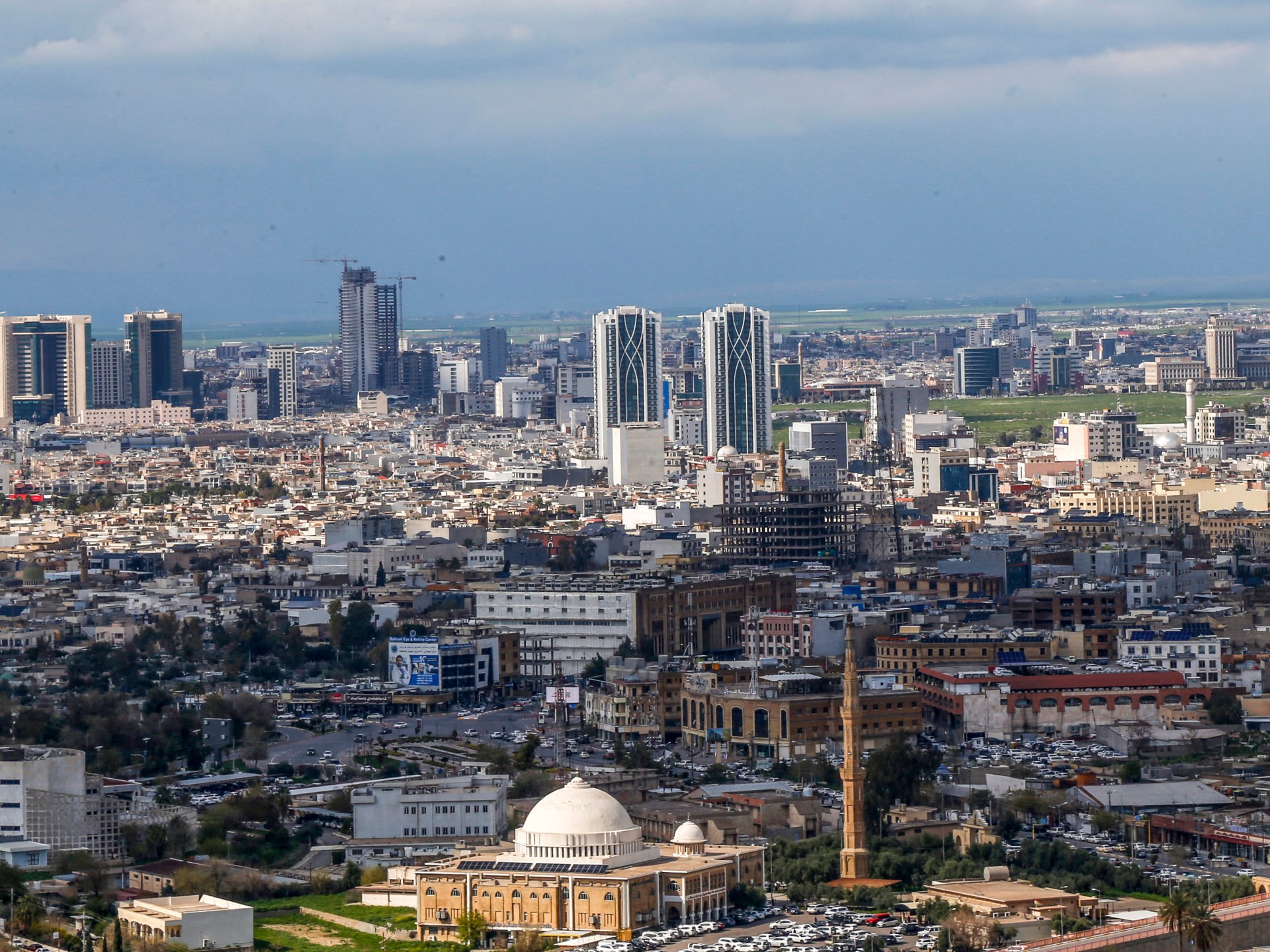

Erbil, Iraq – For the last five months or so, Iraq’s Kurdistan region has suffered the impact and ramifications of the ongoing United States-Israel war on Iran.
Despite efforts by the government to distance itself and not take sides or allow attacks on Iran from its territories, the repercussions were heavy on the semi-autonomous region and Iraq as a whole.
- list 1 of 4Iraq’s Kurdish region wants to stay out of regional conflicts: PM Barzani
- list 2 of 4Turkiye approves pardon-like bill for thousands of PKK fighters
- list 3 of 4Former Iraqi provincial governor arrested as graft crackdown continues
- list 4 of 4Iran hierarchy consolidation as IRGC veteran tapped for key security role
end of list
Since the outbreak of the war in February, hundreds of missiles and drones have hit the Kurdish region.
Masrour Barzani, prime minister of the Kurdistan Regional Government (KRG), told Al Jazeera the region has ”paid a heavy price” in the war.
”We have been targeted more than 1,000 times by missiles and drones directly from Iran or from inside Iraq by some of the militias. We think these are all unjustifiable attacks on Kurdistan. Unfortunately, we had casualties and we lost people. Many of our infrastructure have been hit badly,” Barzani told Al Jazeera in an interview.
”The regional conflict and the security repercussions led to a 70 percent decrease in trade across the Kurdish region,” he added.
According to KRG data, the attacks hit military and security sites, energy facilities, bases and headquarters of opposition Iranian Kurdish parties, in addition to civilian areas.
A direct casualty of these attacks is the economy: The oil and gas sectors, and the movement of companies and investment. And it comes at a time when the Kurdish region is facing a chronic financial crisis amid ongoing disputes with the federal government in Baghdad over salary payments for state employees, oil sales, and revenues.
Advertisement
“The scale of losses inflicted on the Kurdistan region as a result of the war, up to April, is estimated at one trillion and 500 billion Iraqi dinars ($1.14bn), and these figures were also handed over to the Iraqi government,” Peshawa Hawramani, spokesman for the KRG, told Al Jazeera.
“There is no convincing reason to strike the Kurdistan region. We were not a party to this war, nor will we be a party to it, and we have not worked to make the territory of the Kurdistan region a launching point for striking Iran,” Hawramani said, adding that attacks were a “violation of the sanctity of Iraqi territory and Iraqi sovereignty”.
Iran-backed armed groups
Kurdish authorities say they have named the perpetrators behind the attacks and provided them to the central government in Baghdad.
“We have provided the names of these factions to the former and current Iraqi governments. These are factions that bear arms outside state institutions illegally, and yet, no measures have been taken so far by the Iraqi government towards these factions, whether the former or the current one,” the spokesman said, adding that attacks were taking place even before the Iran war began.
Within hours of the US-Israel attacks on Iran, US assets in Iraq’s semi-autonomous Kurdish region came under retaliatory attacks from Tehran-backed groups, dragging the country into the conflict that has since expanded across the Middle East and beyond.
Since then, US assets in Iraq have come under multiple attacks from pro-Iran groups and Iran’s powerful Islamic Revolutionary Guard Corps (IRGC). In response, the US has also carried out attacks against the Iraqi groups.
The IRGC has also attacked Iranian Kurdish groups based in the Iraqi Kurdish region, after reports that Washington planned to arm them to fight Tehran. Last week, the leader of an Iranian Kurdish nationalist group based in the Kurdish region told Al Jazeera that it is “highly likely” that Iranian Kurds will stage a cross-border ground operation into Iran.
During the war, Iraq was also attacked. Drone and rocket attacks have hit Baghdad International Airport, which houses a military base and a US diplomatic facility, as well as oilfields and other facilities.
For many in the Kurdish region, the Iran-backed armed groups are a cause of destabilisation and a source of concern.
Jabbar Yawar, security expert and former secretary-general of the Ministry of Peshmerga in the KRG, said these groups do not adhere to the orders of the Iraqi government.
Advertisement
“The continuous shelling by armed groups operating outside the law, which are known to everyone, and which do not abide by the decisions of the commander-in-chief of the Iraqi Armed Forces, creates security problems for the Kurdistan region,” Yawar said.
“There are five or six armed groups bombing Kurdistan, and they are known to everyone; among them are Iraqi Hezbollah, Sayyid al-Shuhada Battalions, Imam Ali Battalions, and the al-Nujaba Movement,” Yawar explained.
“Most of the bombing operations … come from the areas of the Nineveh Plains and the areas near the vicinity of Kirkuk and Salah al-Din,” he said, adding that the KRG and the Iraqi government do not have comprehensive air defence systems.
The Hormuz shock
But economic worries are also weighing heavily not just on the Kurdish region but the whole of Iraq. Its Ministry of Oil announced a case of force majeure on all oilfields developed by foreign oil companies, citing disruptions to navigation through the Strait of Hormuz that have halted most of the country’s crude exports.
Force majeure is an unforeseeable event that prevents a contract from being fulfilled. In this case, the Iraqi government has ordered a shutdown in oil production and no compensation to be paid to the foreign firms under their contracts.
The crisis comes at a time when the government of Prime Minister Ali al-Zaidi was proposing an economic programme based on implementing the “Development Road” project and expanding partnerships with the private sector and international companies, in an attempt to restructure the economy and reduce its reliance on oil.
However, the closure of the Strait of Hormuz exposed the limits of Iraq’s ability to face crises. The halt in oil exports led to a sharp decline in revenues, compounded by the stalling of projects to diversify export outlets through Turkiye, Syria, Jordan, and Saudi Arabia due to years-long political disputes, leaving the government facing an unprecedented financial strain.
For Erbil, the continuation or expansion of the war could turn the security concerns into a deeper economic crisis, especially if the shutdown of oil and gas production is prolonged, or the attacks on energy facilities continue.
Aland Kareem Salih, an economy researcher and vice president at the Vision Foundation for Strategic Studies, warns a total shutdown of oil exports could be disastrous for the Kurdish region.
“If the war continued and became wider, it will inflict huge harm on the energy sector such as oil and gas and the damage then could be 100 percent,” Salih warns, adding that the Iranian bombardment led to halted operations in Khor Mor gasfield and impacted electricity for the Kurdish region.
“There is an agreement with the central government to export 200,000 barrels of oil daily. Now production has fallen to only 30,000. The figures are changing based on the security developments,” he said.
“The KRG was already witnessing a financial crisis for years and with this war, its non-oil revenues fell by around 70 percent, which cannot meet the basic needs of government departments. Even the real estate market witnessed a decline ranging between 15 percent and 20 percent of its prices as a result of the war,” he says.
Advertisement
Fears in the region’s main cities – Erbil, Sulaymaniya and Duhok – are growing not only because of the attacks, but over the possibility of the region turning into a permanent arena for settling scores between Iran and its proxies versus the US and its allies.