
“I Hope You Don’t Judge Me by One Moment”: White Weeps, Supporters Warn of ‘Brain Drain,’ and Judge Orders Prison but Urges Him to Talk About the Fall
 23 January 2026
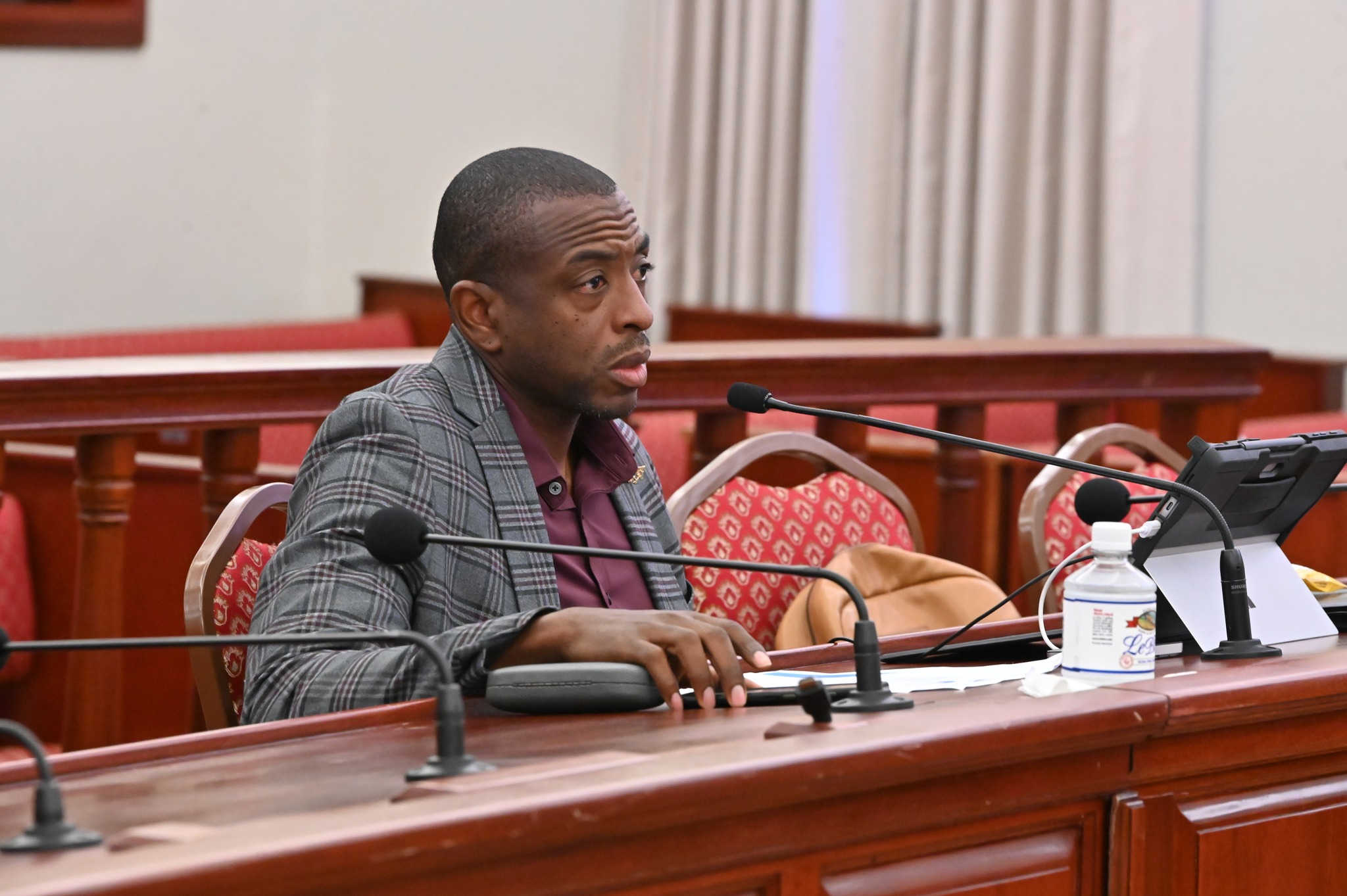

Former Department of Sports, Parks and Recreation Commissioner Calvert White was sentenced Thursday to 60 months (five years) in federal prison, followed by 36 months (three years) of supervised release, after being convicted of honest services wire fraud and bribery concerning programs receiving federal funds.

Judge Mark Kearney allowed White to self-surrender on March 2, 2026, at 2 p.m., ordering that he remain on GPS monitoring during the period leading up to his surrender.
Co-defendant Benjamin Hendricks was sentenced to five years and eight months in prison, followed by three years of supervised release, after being convicted of honest services wire fraud and bribery concerning programs receiving federal funds. According to prosecutors, Hendricks acted as an intermediary, facilitating alleged bribe payments between cooperating witness David Whitaker and White tied to the DSPR camera contract.
Guideline Exposure and Reduction
White was facing up to 30 years in prison when he entered the courtroom for sentencing — 0–10 years for bribery involving federal funds and 0–20 years for honest services wire fraud. However, sentencing guidelines, the fact that this was White’s first offense, and extensive pleas for leniency — submitted through letters, live testimony on Thursday, and White’s own statement to the court — ultimately resulted in a sentence significantly lower than even the prosecution initially sought.
Also helping White was his attorney’s successful argument concerning the proper valuation of the “benefit” used to calculate the federal sentencing guidelines. The guideline range initially stood at 151–188 months, driven by the government’s theory that the intended benefit of the bribery scheme justified a higher monetary enhancement.
The dispute centered on how to measure the “benefit” of a contract that was never carried out. Prosecutors contended that even without execution, projected costs showed Mon Ethos would have spent about $600,000 on equipment and another $600,000 on labor, and that sentencing law required only a reasonable estimate of value. Defense attorneys pushed back, arguing the figures were speculative, pulled from estimates and emails rather than real-world performance, and that because the deal never advanced, no money changed hands, no work occurred, and no profit was earned. As a result, they said the government had not proven a benefit sufficient to justify the higher guideline range.
Judge Kearney ultimately sided with the defense in part. While acknowledging that some measurable benefit existed, he rejected the government’s highest valuations and instead found that the evidence supported a benefit exceeding $150,000 but not more than $250,000, substantially lower than prosecutors had urged.
That determination reduced the monetary enhancement and lowered the offense level from 14 to 10, recalibrating the advisory guideline range — first narrowing it to 121–151 months, and then to a final range of 97–121 months. The reduction proved pivotal, substantially lowering the benchmark the court was required to consider and directly influencing the ultimate sentence imposed.
Testimony for Leniency
White had several high-profile individuals testify on his behalf. Chief among them was longtime Virgin Islands attorney Key Walker, who acknowledged the difficulty of Judge Kearney’s decision and spoke about White’s extensive community service, both as commissioner and long before his tenure at DSPR, particularly his work with youth.
She argued that losing White to prison would exacerbate what she described as a persistent “brain drain” in the territory. “I view Calvert in the context of his service and a community that suffers from a brain drain,” Walker said, adding that a lengthy prison sentence would only worsen the problem.
Veterans Affairs Director Patrick Farrell testified solely as a longtime friend, stating they had known each other since childhood. He urged the judge not to impose prison time, arguing that the public humiliation stemming from the case and extensive media coverage amounted to sufficient punishment. “Calvert has already served his time because he was tried in the court of public opinion,” Farrell said, also highlighting White’s “significant contributions” to the community.
Family member and former probation officer Dionne M. Simmonds, who spoke first, pleaded for mercy and described the family’s “unashamed” advocacy for White. She told the court there were “no words to describe the agony, pain and suffering” the case had inflicted on the family.
White’s Statement to the Court
Perhaps the most powerful testimony came from White himself. He told the court that of the “hundreds” of speeches he had given in his life, Thursday’s statement was the most difficult. He began by apologizing to his parents, telling the judge their health had deteriorated since his arrest. He also apologized to the Virgin Islands community, his extended family, and his three children.
“This is not the vision I had; this is not the role model I wanted to set,” White said tearfully.
He spoke about returning home in 2007 to help his community, beginning at the lowest level of DSPR and working his way up to commissioner. He said working with youth had always been his calling, explaining that recreation played a pivotal role in his own success — from scholarships to a four-year professional basketball career.
“I hope you don’t judge me on this one situation but the entirety of my life,” White told the judge. “I won’t let this define the rest of my life.”
“I ask for your leniency. I hope I am not taken away from my children who depend on me,” he said, as Judge Kearney and a packed courtroom of at least 21 supporters listened.
White’s attorney Clive Rivers also urged the court to impose a sentence below the guidelines.
The Court’s Reasoning
Judge Kearney acknowledged the significant community support shown to White, noting that many respected individuals had written letters on his behalf. “Those who don’t live their lives in paradox, they don’t live their lives,” the judge said, describing White’s case as an example of someone who lived remarkably well yet committed conduct unbecoming of his position.
He noted that White’s decision to go to trial was not held against him, stressing that seeking a trial is a constitutional right and that the burden always rests with the government.
But the judge made clear early on that White would serve prison time. He said the laws governing the offenses were designed for individuals in positions of power who abuse public trust for personal gain.
“Calvert is a paradox,” Judge Kearney said, noting White’s background, salary, and family of public servants. “He’s all of us.” But, he said, White gave in to wrong motives and made a decision he knew was unlawful.
“You have to go [to prison] and start over again,” the judge told him.
“Because of who you are, what you know, the nature of your arrogance, the nature of your lies,” the judge said, he had to ensure others understood there are consequences when leaders defraud the government. “The law does not bend because of who you are.”

Judge Kearney added that his goal was to see White complete his sentence and return to the community, particularly to work with youth, encouraging him to speak openly about his fall from grace as a lesson to others.
Related News

Historic Preservation Commission Orders Reversal of Unauthorized Alterations at Christians...

Amandala #3899 Tuesday, January 23, 2026

St. Croix Marks Martin Luther King Jr. Day With March, Rally, and Community Reflections