
Humanoid robots perform advanced martial arts at Chinese New Year gala
 17 February 2026
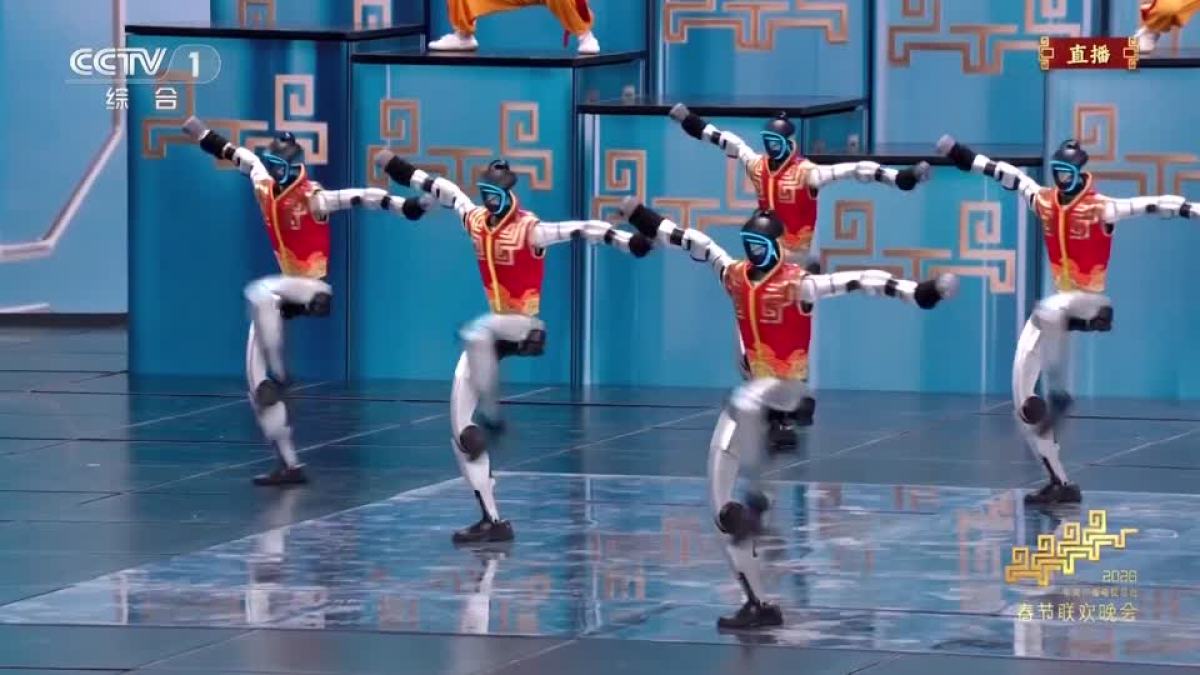

China’s annual gala on Lunar New Year’s Eve has showcased Beijing’s giant leap in technology as humanoid robots took centre stage to perform a joint martial arts routine featuring several firsts.
China’s Spring Festival Gala, which aired on Monday on state broadcaster CGTN, has gone viral, drawing nearly half a million views on YouTube.
- list 1 of 4India’s hosts AI Impact Summit, drawing world leaders, tech giants
- list 2 of 4‘An apocalypse’: Why are experts sounding the alarm on AI risks?
- list 3 of 4Can the US challenge China’s dominance in critical minerals?
- list 4 of 4Year of the Fire Horse: Can Lunar New Year festival boost China’s economy?
end of list
Two dozen humanoid robots performed the world’s first continuous freestyle table-vaulting parkour, the first aerial flip, continuous single-leg flips, a two-step wall-assisted backflip, and the first 7.5-rotation Airflare grand spin, CGTN reported.
The performance marked a stark contrast with last year’s show, when robots twirled handkerchiefs and performed simple movements.
Four firms – Unitree, Magiclab, Galbot, and Noetix – partnered with the gala in deals reportedly worth about 100 million yuan ($14m), according to the South China Morning Post.
The first robots to appear were Noetix’s Bumi models, who performed a comedy sketch. Unitree’s robots later exhibited martial arts alongside child artists, including backflips and trampoline jumps, followed by Magiclab’s humanoids in a musical segment.
Ramesh Srinivasan, an artificial intelligence policy specialist and lecturer at the University of California (UCLA), told Al Jazeera that Beijing is sending a clear “statement” about its capabilities to the world, and to its US rivals specifically.
The performance highlighted China’s rapid progress in humanoid robotics, an area that sees its longer-term potential in industrial and agricultural applications as the country’s population steadily declines.
Advertisement
It comes weeks since US tech mogul Elon Musk told his first-ever Davos World Economic Forum that he is confident humanoid robots will be sold to the public by the end of next year, and that there will soon be more robots than people.
These developments raise important questions.
“What happens when AI is in these robotic forms?” Srinivasan said. “What is this going to mean for working-class people economically? What about the emergence of more and more humanoid robots on the battlefield?”
This technology will change “our futures, economically, militarily and even personally, as people turn to robots and AI as therapists, companions and even potential mates”, he added.
The ultimate questions, Srinivasan said, are: “Do we really want this?”, and “What are the appropriate domains for these humanoid robots and domains that are inappropriate for us?”.
“For me, it’s really about re-investing in the human condition and the ways we want to work with technologies to have a flourishing future,” he said.
“But first and foremost, everyone needs to feel more secure and taken care of, because in the US, AI is more and more disentangling us from one another, and there’s clear research showing that.”
Related News

Gunmen kill at least 32 people in northern Nigeria, residents say

Trump’s ‘Board of Peace’ to convene in Washington, discuss Gaza: Report

EU opens probe into online global retailer Shein after sex-doll scandal