How to hold a referendum
 15 December 2025

With the Virgin Islands government pushing to set a 2031 date for a referendum on the territory’s political status, a recent report by leading academics offers advice for the way forward.
The report — a policy brief titled “Referendums in Small States and Territories” — warns that small territories like the VI should proceed very carefully when deciding whether to hold such a referendum.
“When thoughtfully implemented, [referendums] can serve as catalysts for meaningful constitutional reform and nation-building,” the report states. “When mishandled, they risk deepening divisions and undermining trust in democratic institutions.”
The report was produced following an April conference in London, where about 30 academics, policymakers and political commentators discussed growing calls for greater autonomy in British, French and Dutch territories — as well as Jamaica’s planned vote on severing ties with the British monarchy and becoming a republic.
The two-day event was coordinated by Peter Clegg, a professor at the University of the West of England who has studied the United Kingdom overseas territories for more than 20 years, along with Godfrey Baldacchino, a sociology professor at the University of Malta, and Caroline Morris, a constitutional law professor at Queen Mary University of London.
Delicate balance
The post-conference report — which was co-authored by the three coordinators — recommends striking a delicate balance when organising referendums in places like the VI.
“As small states and territories navigate complex futures, the referendum remains a vital, if imperfect, tool: It demands both caution and courage in its application,” the report states.
To maximise democratic potential, the authors advised, a referendum should be embedded in “inclusive, deliberative processes that reflect the diversity of voices” within the electorate.
“The symbolic and strategic dimensions of referendums — particularly in post-colonial and semi-autonomous contexts — highlight their role not just in shaping policy, but in articulating identity, legitimacy and aspirations for self-determination,” the report states.
Critical time for VI
The analysis comes at a critical time for the VI.
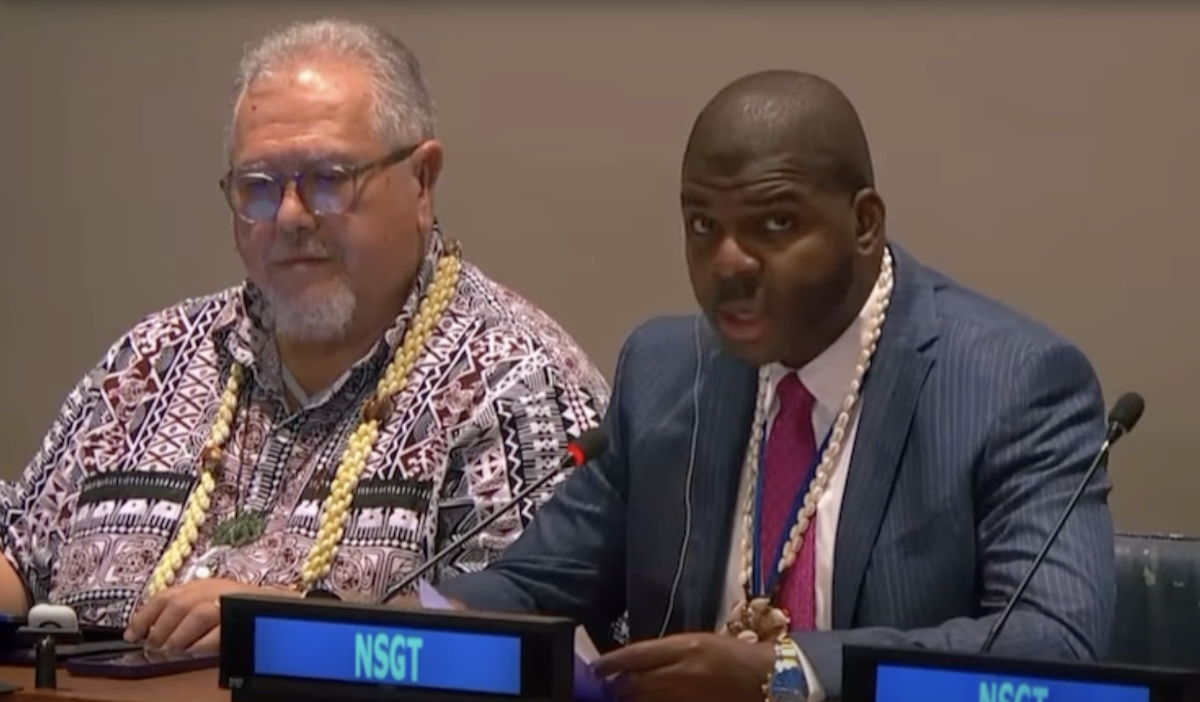
The House of Assembly recently concluded a debate on constitutional reform ahead of negotiations with the UK, and Premier Natalio “Sowande” Wheatley used an October speech at the United Nations to call for a fixed date for a referendum on the territory’s political status.
Mr. Wheatley said in a press conference last month that the HOA subsequently decided during the closed-door portion of its constitutional debate that the referendum should be set for 2031.
This proposed timeline, he said, will be included in a forthcoming report disclosing the HOA’s position on the way forward.
The HOA’s report, in turn, will guide the government’s coming constitutional negotiations with the UK.
Experts’ advice
The academics’ 14-page policy brief, which was released in August, offers several recommendations for a successful referendum in territories like the VI.
They advised, for instance, that voices including marginalised groups should be heard in public debates; that misinformation should be confronted; and that any referendum outcome should be respected and implemented.
“Only then can referendums truly fulfil their promise as instruments of democratic renewal,” the report states.
It also warns that referendums should not be allowed to become a tool for an elitist playbook.
“While referendums are often seen as democratic tools, elites can also use them to consolidate power or deflect responsibility,” the report states. “In authoritarian contexts, they have been used to legitimise regimes. Even in democracies, referendums can be manipulated through biased wording, strategic timing and/or campaign financing.”
To avoid such pitfalls, the authors advised, referendums should be carefully planned.
“The effectiveness of referendums depends on design,” the report states. “This includes clear and unambiguous rules, thresholds and procedures; deliberation, with opportunities for information campaigns, informed debate and public education; and context, such as political culture, media environment and institutional safeguards.”
Referendums elsewhere
As examples, the authors cited referendums carried out in recent decades in other small jurisdictions — which they said further demonstrated the importance of clarity in question framing and the need for “robust public education.”
“As the experiences of jurisdictions such as Bermuda, Bougainville, Grenada, New Caledonia and Puerto Rico show, referendums can falter when poorly structured, inadequately supported or manipulated for partisan gain,” the report states.
Bermuda’s 1995 independence referendum, it adds, became more focused on the premier’s future than on independence itself.
“Independence was rejected, and the premier resigned,” the report states.
As a positive example, the academics cited the Scottish referendum of 2014, where voters decided against independence by a margin of 55.3 percent to 44.7 percent.
That referendum’s success, the authors wrote, was facilitated by transparency, pre-agreed rules and question testing, civic engagement, respectful debate and pride in participation.
Continuum
The academics also contended that referendums should not be treated as isolated events, but as part of a wider democratic continuum.
Additionally, they warned about the potential negative effects of a referendum where the results are likely to be close to a 50-50 split.
“Such narrow, cliff-hanging margins of victory (and defeat) can render referendums emotionally divisive and nationally damaging,” they noted. “The losing camp may not accept the result gracefully: They may feel cheated by such a slim margin of defeat and may wish to push for a re-run.”
To mitigate against such risks, they added, the threshold for action can be upped to more than a simple majority.
The scholars also noted that the appetite for full sovereignty among non-independent states has diminished greatly since 1984.
“Other than the breakup of empires and unwieldy countries, few territories have sought and obtained independence: Namibia, South Sudan and Timor-Leste,” they wrote. “Indeed, the authorities of many small territories have rejected options for independence via referendum, pragmatically opting instead to enhance their strategic autonomy, with direct links to the metropole, and to craft ‘shared rule’ arrangements with larger powers as subnational jurisdictions. Examples include Bermuda, Niue (twice), Puerto Rico (various instances), and Tokelau (twice).”
In the VI
In a January interview with the Beacon, the premier said there are three possible models if the VI-UK relationship is to change from its current form: independence; free association with the UK; and integration into the UK.
He added that he believes integration is “not realistic for us,” leaving the other two options to be considered.
“I don’t think free association with the UK would be bad at all,” Mr. Wheatley said at the time.
He added that such questions will be addressed during the coming negotiations with the UK to adopt a new constitution.
UN visiting mission
At the government’s invitation, the UN’s Special Committee on Decolonisation, also known as the C-24, sent a mission to the territory in August 2024.
The mission’s subsequent report, which was released in February, recommended various steps for the VI to follow if it aims to seek independence from the UK.
They include developing a national education programme on the “quest for independence;” establishing a “timetable for independence;” engaging in negotiations with the UK using a UN-appointed mediator if needed; and holding a territory-wide referendum on the issue.
At the UN in October, the premier welcomed the UN mission’s call for a “timetable for independence,” but he stopped short of calling for the territory to sever ties with the UK.
And last month, he clarified that he would “prefer to say” that the VI should set a “timetable for a change of political status.”
C-24 aspirations
Though the C-24 listed the year 2030 as an “aspirational timeline” for the world to eradicate colonialism, the delegation noted that the VI’s journey towards that goal remains ongoing.
Mr. Wheatley also told the HOA in January 2024 that a referendum would be held on same-sex marriage later that year, but no such vote has been organised.