
How the US naval blockade has bled Iran of nearly $6bn in oil revenues
 05 June 2026
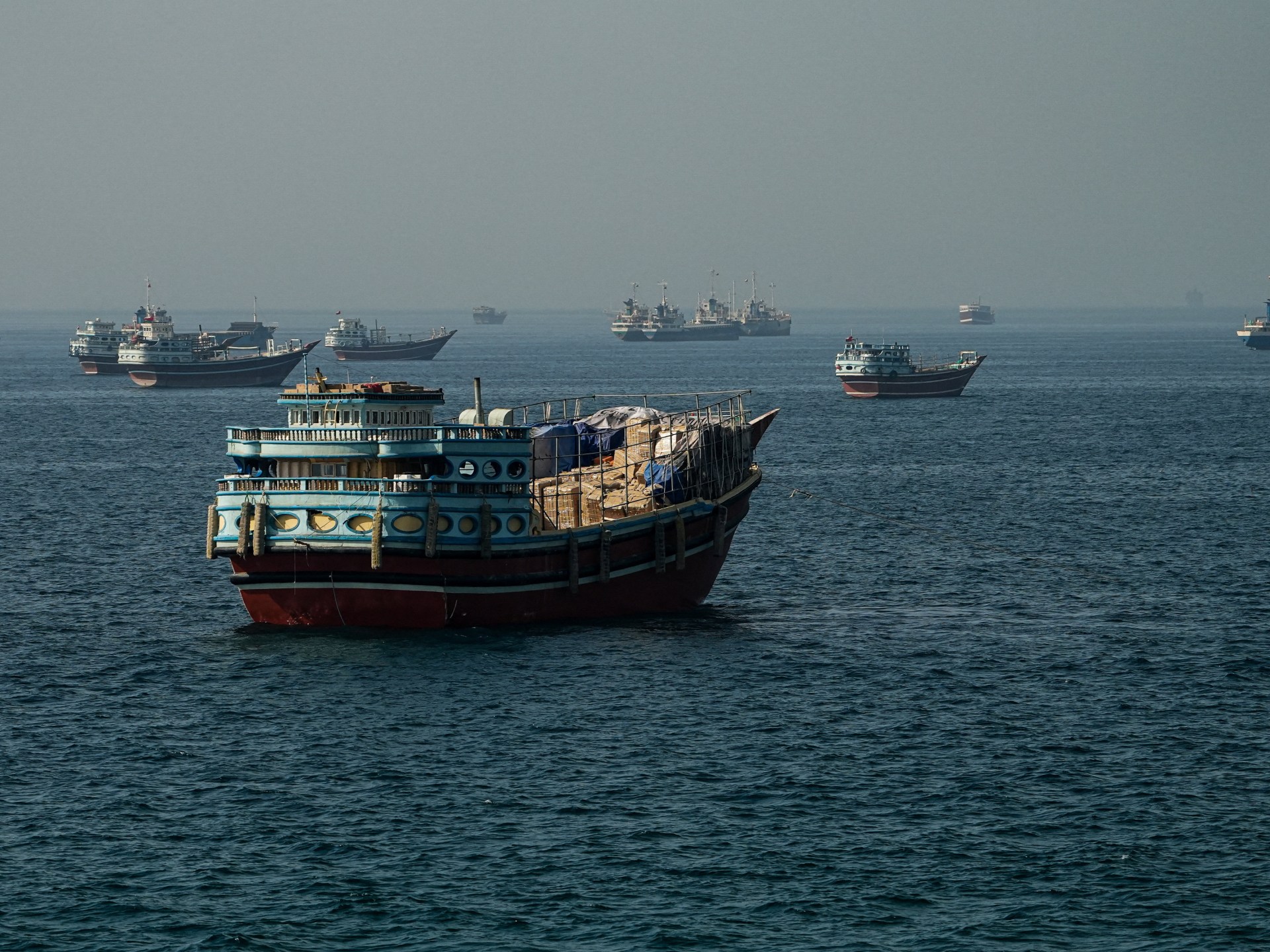

Iran’s crude oil exports fell to their lowest level in at least six years in May, as a United States naval blockade squeezes Tehran’s most important source of income amid a fragile ceasefire between the two nations.
The blockade on Iran’s ports, which Washington commenced on April 13, is part of President Donald Trump’s effort to pressure Iran to agree to its terms for a peace deal. Tehran has condemned the move as illegal and described the US seizure of ships around its ports as an act of “piracy”.
- list 1 of 4Putin says ‘too early’ to talk about staying in power until 2036
- list 2 of 4US raises pressure on Cuba as it sanctions President Diaz-Canel
- list 3 of 4Thousands protest in Albania over Kushner-linked resort project
- list 4 of 4How the world failed a mother’s children, killed in Israeli strikes on Gaza
end of list
The US action came after Iran closed the Strait of Hormuz to ships from most countries following the start of US-Israeli attacks on February 28. The narrow waterway is the Gulf’s main route to the open ocean and normally carries about 20 percent of the world’s oil and gas supplies.

The disruption sent global energy prices soaring and severely curtailed exports from chief Gulf producers, including Saudi Arabia, Kuwait, Iraq and the United Arab Emirates.
During that period, however, Iran was largely able to continue exporting its own oil. With fewer competitors able to move cargoes through the strait, Iranian exports remained strong through March and some of April, while higher oil prices boosted revenues.
New data now shows that has changed since the US began its naval blockade of Iranian ports.
Oil exports through the Strait of Hormuz account for about 80 percent of total Iranian exports. The latest shipping data suggests the blockade has sharply reduced the amount of crude Iran can sell abroad, particularly to China, its largest customer.
Advertisement
Analysts say the blockade is now beginning to inflict a high financial cost on the Iranian economy, raising questions about how long Iran can sustain the war.
How have Iranian oil exports been affected by the US blockade?
According to data from trade intelligence firm Kpler, Iranian crude oil and condensate exports fell from close to 2 million barrels per day (bpd) to below 300,000bpd in May. Kpler used figures for the 40 days before the blockade began for comparison.
The collapse comes despite Iran initially benefitting from the disruption it caused in the Strait of Hormuz. After Tehran closed the strategic waterway following the outbreak of war, global oil and gas prices surged. Iran continued to export its own oil through the strait, while restrictions on other Gulf producers helped push prices higher.
Before the blockade, Iranian exports were relatively strong through March and much of April – and benefitted from the surge in the oil price caused by the closure of the Strait of Homuz to all other shipping.
Iranian crude grades have generally traded above $90 a barrel and have occasionally exceeded $100.
Using a conservative price estimate of $90 a barrel, exports of 300,000bpd would generate about $27m in revenue each day, or roughly $837m over the course of May.
That is a sharp drop from earlier in the year. In March, when exports averaged 1.84 million bpd, Iran was earning an estimated $165.6m a day, or about $5.13bn over the month.
In April, exports averaged 1.34 million bpd, generating about $120.6m a day, or roughly $3.62bn during the month.
The figures suggest Iran’s oil revenues in May were approximately 84 percent lower than they were in March, according to Lloyd’s List, which offers a glimpse into the growing economic impact of the blockade.
And if Iran expected monthly revenues on the scale of its March returns, it has lost $5.8bn over April and May.
Kpler told Al Jazeera that while the data shows the blockade has sharply reduced the amount of new oil leaving Iran, it may not capture all the Iranian oil reaching buyers, because some cargoes are being transferred between vessels near Malaysia after leaving Iranian waters.
Is Iran still producing oil?
For now, yes. However, Tehran is increasingly being forced to store the crude that it cannot sell.
Marc Ayoub, an energy policy researcher and consultant, told Al Jazeera that “Iran is strategically using the storage capacity it has left. The data shows the blockade is working, but the real pressure comes once that storage starts running out.”
Advertisement
Much of that storage is floating on tankers at sea. According to Kpler, about 147 million barrels of Iranian crude and condensate are currently being held in floating storage. Of that total, roughly 67 million barrels are stranded inside the Gulf and Gulf of Oman, unable to move beyond the US blockade line.
Iran has increasingly relied on oil tankers as temporary storage facilities, loading crude onto vessels and leaving them anchored offshore while it searches for ways to move cargoes to buyers.
How are some exports still getting through – and can that continue?
About 300,000bpd per day were still eluding the US blockade in May.
“Some vessels have still passed through maritime boundaries since the blockade began,” Ayoub said. “Iran has found ways to bypass some restrictions, which is why exports continue, even at much lower levels.”
According to Ayoub, the blockade’s immediate effect has not been to stop production but to interrupt the flow of money from oil sales, particularly to China, Iran’s largest customer. “That is painful in the long term, but it does not necessarily create an immediate economic shock,” he said.
Iran and China have spent years developing overland trade routes to reduce their dependence on maritime chokepoints such as the Strait of Hormuz and the Strait of Malacca.
But analysts say rail transport is unlikely to provide a meaningful alternative for Iran’s oil exports. Most freight trains moving between China and Iran carry manufactured goods and consumer products rather than crude oil.
There are also major logistical challenges, with most Iranian oil fields located in the country’s south, while much of the Chinese refining capacity that processes Iranian crude is concentrated on the eastern coast, thousands of kilometres away from the rail corridors crossing Central Asia.
A typical oil shipment by rail carries between 60,000 and 70,000 barrels. At a price of $90 per barrel, a 70,000-barrel shipment would be worth about $6.3m. By comparison, a single conventional oil tanker can carry more than 600,000 barrels of crude, while a Very Large Crude Carrier (VLCC) can transport more than 2 million barrels in one voyage. In other words, dozens of train shipments would be needed to move the same volume of oil carried by a single tanker.
Can Iran weather this economic blow?
Analysts say the blockade is ultimately a contest over which side can sustain economic pain for longer. While lower oil revenues could gradually undermine Iran’s ability to finance military operations and support its wartime economy, the costs are not borne by Iran alone.
The continued disruption of the Strait of Hormuz has also prevented major Gulf producers from exporting normally, contributing to higher energy prices worldwide and more pressure on the global economy, which is inextricably tied to the US markets.
“The pressure is now starting in Iran,” Ayoub said. “The question is whether the United States can sustain the broader economic consequences long enough for that pressure to have its intended effect.
Advertisement
“Whatever agreement eventually emerges, the central issue remains who controls the strait,” he said. “Either Iran retains influence over it in one form or another, or the confrontation continues for months.”
Related News
Israeli air attack kills at least two in southern Lebanon

Zelenskyy asks Putin for meeting: What’s he offering, could Russia accept?

Israel, Russia among new additions on UN sexual violence ‘blacklist’