
How can Ukraine rebuild China ties after they were scarred by Russia’s war?
 17 December 2025

Kyiv, Ukraine – Back in the 1990s, China’s nascent capitalism triggered demand for Ukrainian steel slabs and iron ore, corn and sunflower oil.
However, the most prized export items from impoverished Ukraine were the Soviet-era arsenal of weapons it did not think it needed any more.
- list 1 of 4Ukraine claims strike on Russian submarine in Novorossiysk with sea drones
- list 2 of 4Europe establishes Ukraine reparations commission amid push to end war
- list 3 of 4“Security guarantee” for Ukrainians remains a “circular discussion”
- list 4 of 4Russia-Ukraine war: Is a ceasefire deal on the horizon?
end of list
Kyiv sold Beijing aerospace components, helicopter and tank engines, and technology transfers for the manufacturing of radars, naval gas turbines and jet engines, helping to reshape China’s defence industry.
It even admitted to illegally shipping six nuclear-capable Kh-55 cruise missiles.
The pinnacle of military-industrial exports was the 1998 sale of the Soviet-era Varyag aircraft carrier, whose construction began but never finished on the wharves of the southern Ukrainian city of Mykolaiv.
Beijing pledged to use the 306-metre (1,004-foot) long vessel for training but turned it into its first aircraft carrier, Liaoning.
‘China can end the war’
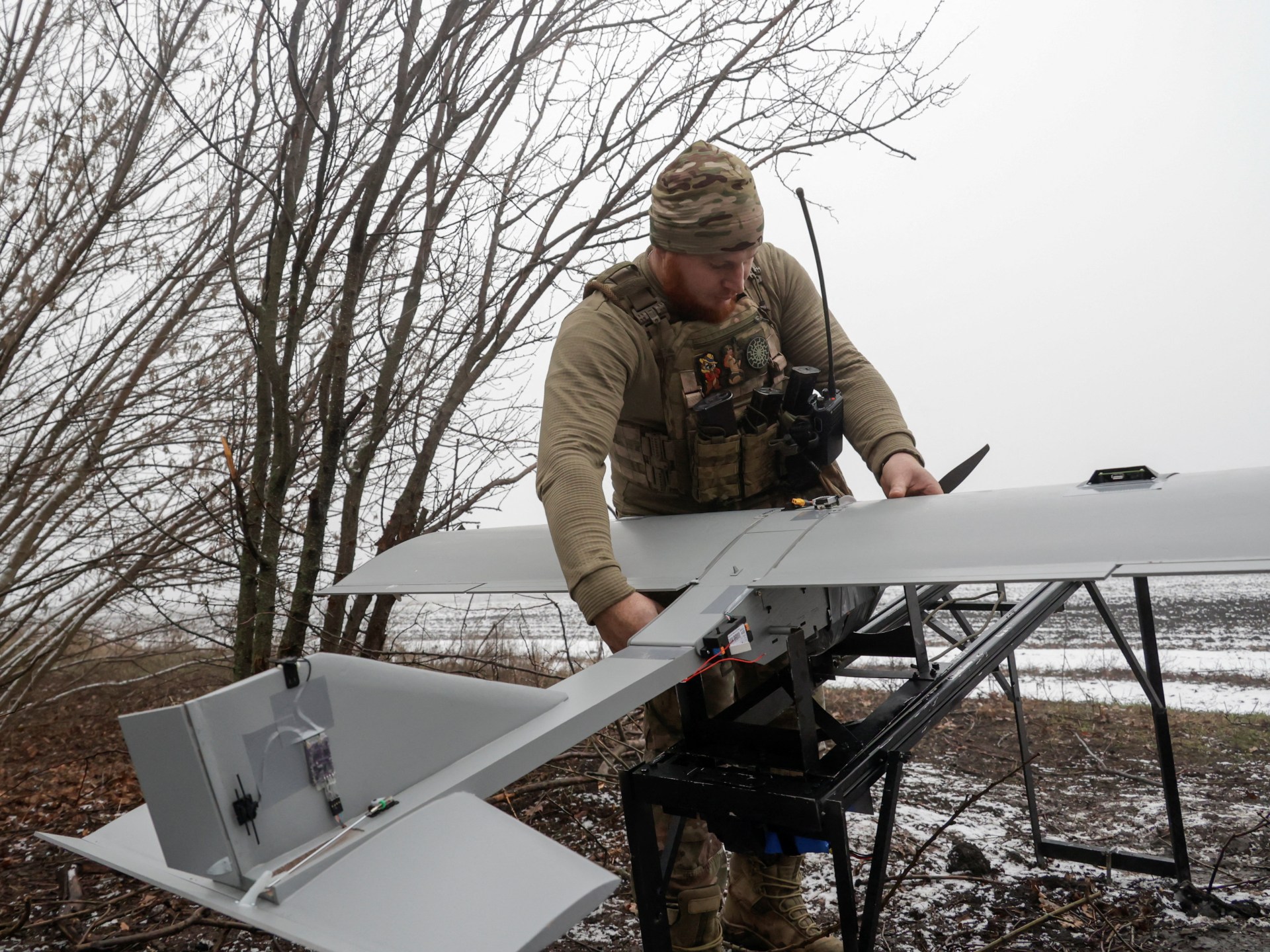
The tables have turned during the Russia-Ukraine war, when China became the side that profits the most from the fierce competition between Russian and Ukrainian drone developers.
It is “always” a Chinese manufacturer of unmanned aircraft “who earns the most”, Andrey Pronin, one of the drone warfare pioneers in Ukraine, told Al Jazeera.
He was standing in the storeroom of his school for drone pilots on the outskirts of Kyiv – next to a dozen drones that ranged from what looked like a tiny replica of a World War I biplane to a jet-driven mini-missile to tiny first-person-view drones.
Advertisement
Each of them consisted of Chinese-made components – engines, flight controllers, batteries, thermal cameras and navigation modules.
These components have been the backbone of Ukraine’s drone industry, which churns out millions of loitering munitions annually.
They are also one of the reasons why Ukraine has not lost the war.
“China can end the war in one day by just turning off the export [of drone parts] either to us or to Russians,” Pronin said.
Ukrainian drone manufacturers work frantically to localise the production of key components, such as frames, avionics, engines and radios, according to a report by Snake Island, a military research group in Kyiv.
And yet, “the industry still depends on a narrow set of critical imports – lithium salts, neodymium magnets, navigation chips, and thermal sensors – where China holds disproportionate leverage”, it said in a report released in October.
Should the strategic partnership be restored?
What is even more important to Kyiv is how, not if, it will rebuild ties with Beijing after the war is over.
In 2011, Chinese President Xi Jinping visited Kyiv and signed a strategic partnership agreement with his then-Ukrainian counterpart, Viktor Yanukovych, who was staunchly pro-Russian.
Before the 2013 launch of its Belt and Road Initiative, a mammoth project to build transport infrastructure from China to Europe, Beijing counted on Ukraine to become its focal point.
Ukraine has a Black Sea coast and borders the delta of the Danube River, an ancient trade route that flows through or borders nine European nations.
But in early 2014, Yanukovych fled to Russia after a months-long popular uprising – and weeks later, Moscow annexed Crimea and spurred a separatist revolt in southeastern Ukraine.
Seeing Beijing as Russia’s main international backer, Kyiv cooled ties with China.
“These days, our ties, political ties, are at point zero – at a moment when China is Ukraine’s main economic partner,” Kyiv-based analyst Vadym Denysenko told a news conference earlier this month.
In 2020, the China-Ukraine trade turnover reached $15.4bn, amounting to about one-seventh of Kyiv’s foreign trade.
Despite the war, China still has not lost its appetite for Ukrainian grain, steel, vegetables, oil and soya beans – and these exports help keep Ukraine’s economy afloat.
After the war, Kyiv will have to rebuild and expand ties with Beijing – at least because its geographic position between the Black Sea and the European Union is still “very interesting” to the Belt and Road Initiative, Denysenko said.
Advertisement
‘Not beneficial for Russia’
Ukraine will need to replace its czarist-era railways with Western ones that have a narrower track gauge and expand its port on the Danube to give China better access to the EU, according to a detailed report by Kyiv-based analyst Igar Tyshkevich.
Irrespective of Beijing’s post-war ties with Moscow, Kyiv will need to boost its export of steel and foodstuffs to China, allow Beijing to open plants to assemble Chinese cars and machine tools, and use Ukrainian steel, the report said.
“We need localisation with the possibility of buying out rights to certain brands,” Tyshkevich said.
Ukraine could use its Soviet-era expertise to create joint projects to develop aircraft, pharmaceuticals and nuclear energy.
“Because Ukraine’s participation not only as a recipient, but as a transit country, as a key player that also influences the development of these projects, of course, is not beneficial for Russia,” he said.
Other analysts agree that China’s sphere of interest is too large to ignore and that Ukraine should become part of it.
Kyiv’s failure to restore ties with China “will cost our nation dearly”, Kyiv-based analyst Aleksey Kushch told Al Jazeera.
“Essentially, our diplomacy didn’t just write off China, but the entire Global South, or more than half of the globe,” he said, referring to the nations in Asia, Africa and Latin America that were once European colonies and are opposed to Western domination.
Ukraine should become part of “the Eurasian Steppe Corridor” from northeast China via Kazakhstan, the Southern Caucasus to the Black Sea nations – Bulgaria, Romania and Ukraine, he said.
It implies Ukraine joining Eurasian logistical routes and a conception of Ukraine as “a hub nation, a bridge nation, a plastic link nation”, he said.
“Everything should be done so that goods move across the Eurasian Steppe Corridor, not foreign troops,” Kushch said.
Related News

EU’s Kallas says Washington ‘biggest ally’ despite US security downgrade
Honduras issues arrest warrant for ex-president Hernandez after US pardon
EU proposes using Russian assets, loans to fund $105bn package to Ukraine
