
College to offer bachelor’s degrees
 06 March 2026
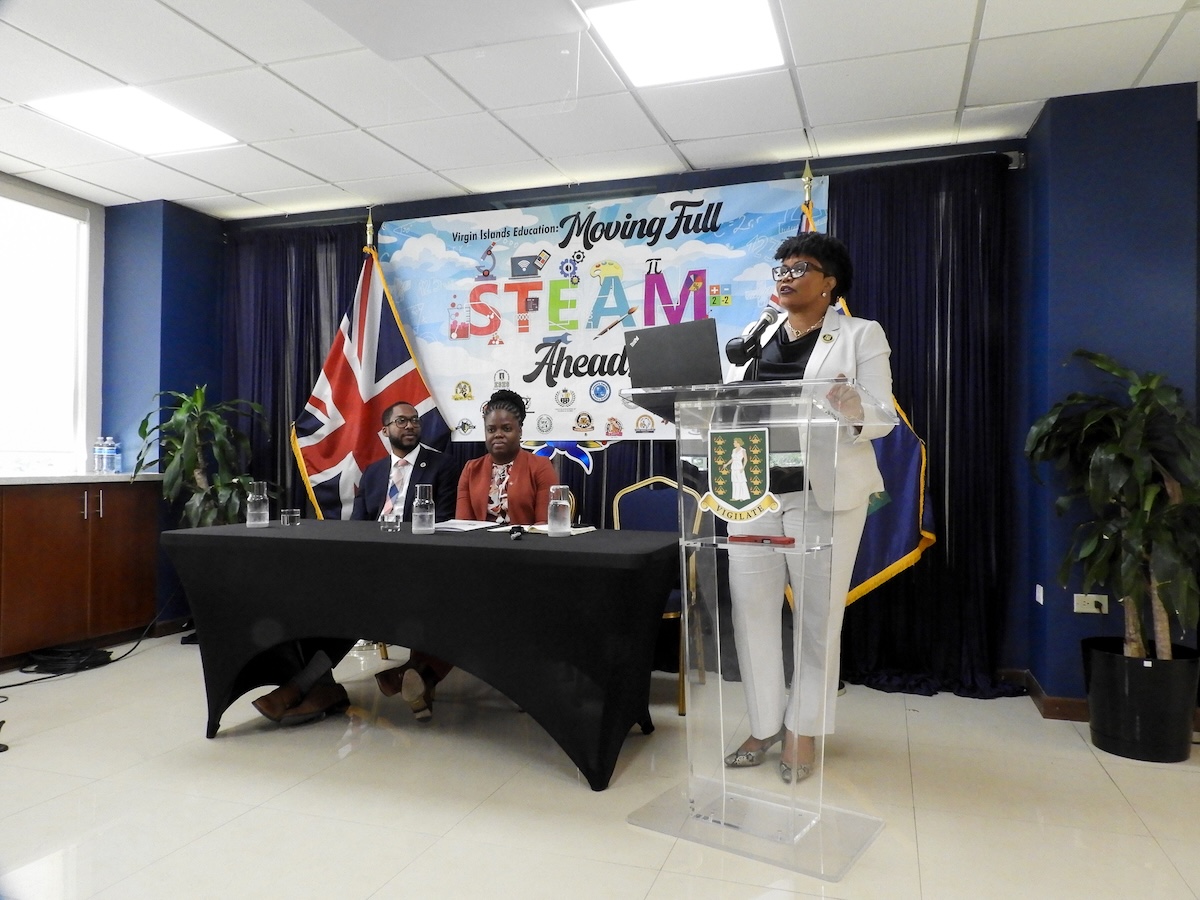

The H. Lavity Stoutt Community College is on its way to offering bachelor’s degrees for the first time, according to Education, Youth Affairs and Sports Minister Sharie de Castro.
During a Monday press conference previewing Education Month, Ms. de Castro announced the school’s plan to start soon by offering a bachelor’s degree in education.
“The Bachelor of Education Programme has been approved by the college board and will now be submitted to the Middle States Commission on Higher Education for accreditation review — the necessary step toward offering a full-year teaching degree here in the Virgin Islands,” Ms. de Castro said.
This step, she added, sets the college on the path toward fulfilling her mandate “to pursue four-year degree-granting status.”
HLSCC President Richard Georges, who also attended the press conference, said the implementation timeline depends on the response from Middle States Commission.
“It could be, you know, ‘Go ahead for fall,’” he said, adding, “That’s the earliest possible scenario.”
But the commission could also respond in other ways, he said.
“Because of the nature of the accreditor and how wide-ranging it is, it could be an operational question that they could have, then they ask us to submit additional information or to have other correspondence with the ministry or the board, etcetera,” Mr. Georges said.

Education abroad
While HLSCC continues to expand, Ms. de Castro also emphasised the importance of ongoing partnerships with universities outside the territory.
“We must build excellence locally, but we must build partnerships globally,” the minister said, adding, “These partnerships ensure that Virgin Islanders have access to the highest levels of opportunity while we continue to strengthen our own national institution.”
To that end, she said, the government signed agreements last week with three United Kingdom-based universities: memoranda of understanding with the University of Westminster and the University of Roehampton and an exchange agreement with Richmond American International University London.
Ms. de Castro added that more collaborations are also in the works.
“We held substantive meetings with City St. George’s University of London; London Metropolitan University; the University of Southampton; Southampton Solent University and its world-renowned Warsash Maritime Academy; University College London; and Sommet Education, the parent institution of Glion Institute of Higher Education and Les Roches,” she said.
Such collaborations, she added, directly benefit VI students.
“These partnerships are designed to create structured pathways where Virgin Islands students complete their associate degree at HLSCC and enter these universities directly into their third year — reducing cost, reducing time and expanding opportunity,” the minister said.
Teacher training
Ms. de Castro also noted that nearly 150 Virgin Islanders have gained or have been actively pursuing teaching qualifications over the past two years.
“Over the past two years alone, we created 20 teacher training positions, bringing young Virgin Islanders into the profession and placing them on a structured pathway toward full qualification,” she said. “But we did not stop there: We rebuilt the professional certification pipeline — 11 educators completed the professional certification in teaching at HLSCC; 15 more are currently in training. We strengthened leadership in our schools: 23 school leaders completed the certificate in effective school leadership at HLSCC; 13 more are preparing to step into leadership roles. Through our partnership with the University of the Virgin Islands, ten teachers completed the certificate in secondary education.”
Additionally, she said, 56 Virgin Islanders are currently expanding their teaching qualifications.
“Twenty-seven Virgin Islanders are pursuing their associate degree in education at HLSCC; 14 educators are advancing through the postgraduate diploma in arts integration; and 15 teachers are pursuing their bachelor’s degrees in education through our partnership with Walden University,” she said.
She added that her ministry is helping fund these programmes.
“The government covers the overwhelming majority of the cost — with educators contributing just ten percent in some instances — ensuring both national investment and personal commitment to their professional growth,” she said.
Expanding training
During the question-and answer segment of the press conference, Ms. de Castro said the teacher-training programme gives students hands-on experience by positioning high school graduates in the classroom with seasoned educators.
“So they return because they’ve already been invested in the spaces,” the minister said.
This framework, she added, could be replicated in other fields.
“We want to similarly do that across the other ministries, so that we create that entry point in the public service, so that our young people understand the environment that they’re working,” she said. “They see the challenges first-hand, and they go off to create the solutions that will ultimately fix those problems.”
Related News

$35,000 Minimum Salary Law Still Incomplete at Six Agencies Five Months Later

U.S. Launches Massive Bombardment of Iran as Reports Emerge of “Anointed by Jesus” War...
Residents urged to ‘fight the bite’ after heavy rains