
Anegada switches to solar
 19 December 2025
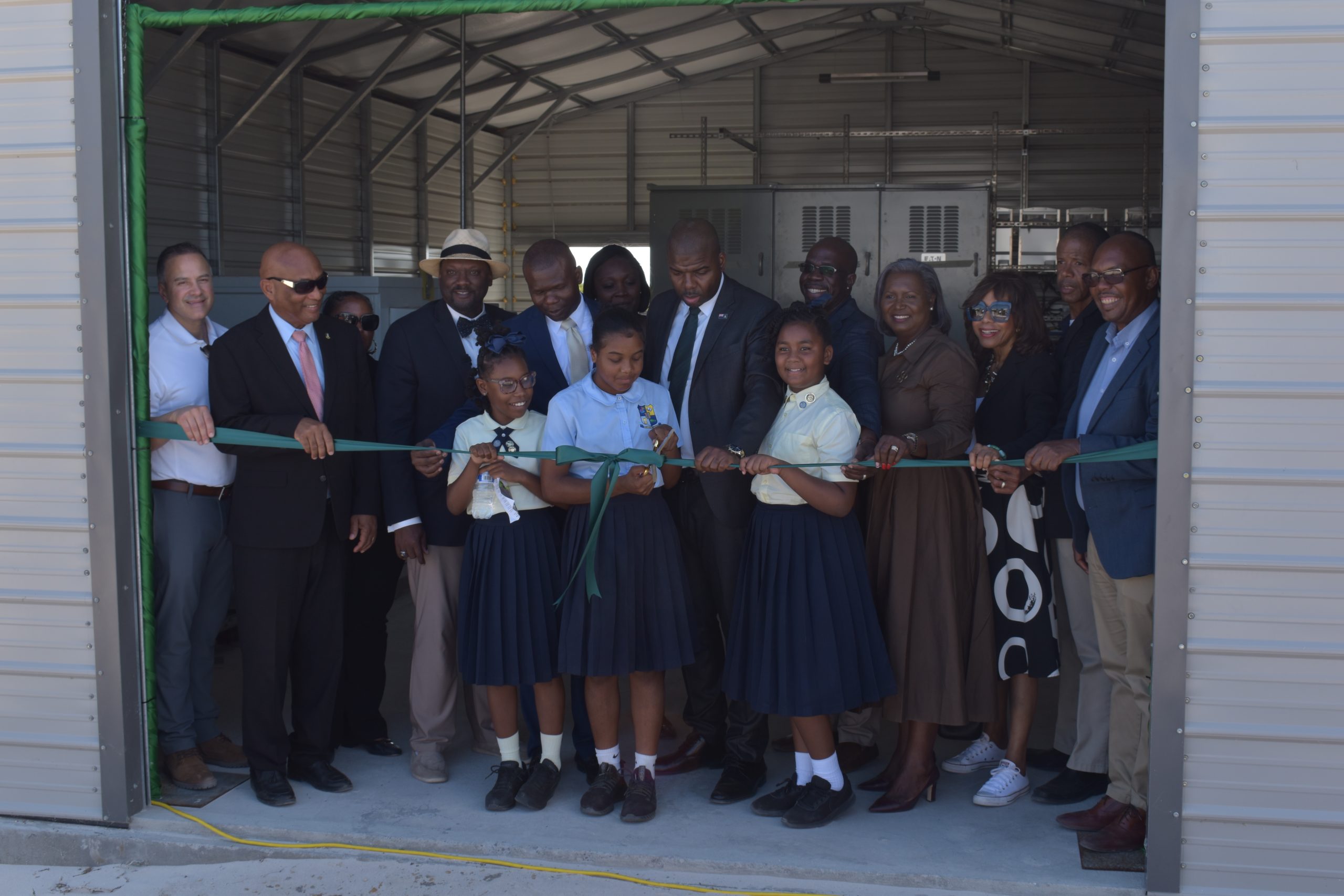

Following the Friday launch of a glistening new solar field on Anegada, officials said the island is now getting up to 65 percent of its electricity from the sun.
The long-delayed energy project — the cost of which climbed from less than $4.7 million to some $6 million over the course of six years — was inaugurated Friday in a ribbon-cutting ceremony as speakers lined a shaded stage to address attendees.
“This solar farm is a beginning, not an end,” said Health and Social Development Minister Vincent Wheatley, who represents the Ninth District in the House of Assembly. “Today I want to honour the people of Anegada. You’ve always stood firm in your belief that this island can be a model of sustainability.”
The plant is the first solar project of its size in the Virgin Is lands, which has long relied almost exclusively on diesel fuel for its electricity needs.
With the launch, Anegada — which has a population of less than 500 people — has become the first island in the VI to rely primarily on alternative energy.
During the Friday ceremony, members of the House of Assembly, employees of the BVI Electricity Corporation, and Anegada residents said the transition to renewable energy will mitigate power outages, cut emissions from diesel fuel, and boost the tourism sector.
Project specs
The project — officially known as the Anegada Hybrid Renewable Energy and Battery Energy Storage System, or “BESS” — includes a 1.3-megawatt solar farm equipped with a four-megawatt-hour battery storage system that can provide up to 19 hours of solar power across the island, according to the BVIEC.
The panels are rated to with stand Category Two hurricanes without having to be removed or covered, said BVIEC General Manager Neil Smith.
The project, he added, is modelled in part after a solar farm in Newton, Mississippi.
“This is using the same construction method, so we expect them to perform the same way,” he said.
Anegada’s existing diesel power plant, which is located adjacent to the solar field, will remain in place and work in conjunction with the new system, according to Kamal Haynes, the BVIEC’s public relations manager.
“This is being monitored and controlled by a microgrid Power Control System (PCS) that is integrated with the generators, solar and battery system,” Mr. Haynes told the Beacon. “Right now, the solar and battery energy storage system powers up 60 to 65 percent of the island.”
Delays and controversy
The project stretches back to 2019, when the BVIEC launched a tender process that drew submissions from five bidders.
In July 2020, BVIEC officials announced that the winner was Power52 Clean Energy Access, a company led by American solar developer Rob Wallace Jr.
Though Mr. Wallace had previously filed for bankruptcy in 2009 — and he was facing multiple lawsuits over allegations of unpaid debts and other issues associated with his projects in Maryland — the BVIEC said it had awarded Power52 a contract worth nearly $4.7 million.
The announcement drew criticism from three of the four losing bidders, who alleged that the tender process lacked transparency and bypassed standard procedures outlined in the 2005 Public Finance Management Regulations.
Years of delays followed amid the Covid-19 pandemic before Mr. Wallace and BVIEC officials ceremonially broke ground on Anegada in December 2022.
About five weeks later, however, the project’s future was again thrown into question when Mr. Wallace declared personal Chapter Seven bankruptcy in Maryland.
BVIEC officials stayed tight-lipped on his situation, but on Friday Mr. Smith told the Beacon that the New Jersey based Core Development Group, one of the original sub tractors since the project’s inception, had ultimately stepped in and finished the project.
Following last week’s ceremony, which Mr. Wallace didn’t attend, Core Development Group CEO Henry Cortes confirmed Mr. Smith’s account.

Cost overrun
Mr. Cortes also explained some of the issues that delayed the project, which he and Mr. Smith said ended up costing about $6 million — about 28 percent over the initial contract amount of nearly $4.7 million.
“It was a very difficult project,” Mr. Cortes told the Beacon. “Logistics is not easy here in order to get tools, equipment. What hurt us on this project was we didn’t have a skilled subcontractor and partner — hence why it took a little bit longer. At the end, we brought in our entire team from the US and finished up the entire project.”
Despite this reliance on a US team, VI residents contributed to the project as well, according to the BVIEC.
Mr. Haynes told the Beacon that eight to ten graduates of H. Lavity Stoutt Community College were hired to assist with the “civil and racking installation” for a period of eight to ten months.
“CORE also hired a local engineer/project manager from the school and kept him on payroll for three years,” Mr. Haynes stated.
‘Hard lessons’
Mr. Cortes said the project was his first in the territory.
“We had a lot of hard lessons learned, but it went well,” he said. “The BVIEC team was great to work with. There were a lot of challenges; we worked through them and eventually we got the project done, which was great.”
Mr. Smith spoke similarly.
“With a project like this, we have to import all the materials, specific tools that we use,” he said. “So it was a bit challenging for the contractor, so that’s the reason why it took a bit longer than we expected it to take.”
Pleased
Anegada resident Lawrence “Bunchie” Wheatley, a 26-year-old small business owner, said he was pleased with the project.
“So far, the perks have been that the power has been more stable,” Mr. Wheatley said. “I’m still waiting to see the benefit to the bills themselves.”
He added, though, that he doesn’t expect the solar field to bring a visitor boom.
“They spoke about eco tourism — that’s not a huge market anyways,” he said, adding, “I don’t think you’ll see an influx of people swarming in. In terms of supporting the businesses and not having to worry — for example, the hotels and stuff — it would be a comfort to them and a better experience for the guests who are on the island not having to deal with outages.”
Other entities will also benefit, he predicted.
“It will benefit the businesses in terms of us having a proper foundation, and benefit the schools in terms of having a proper foundation,” Mr. Wheatley said.
Related News

Trump Designates Fentanyl as Weapon of Mass Destruction, Escalating Drug War Across Caribb...

VI National Guard Exits Federal Oversight After Six Years of Transformation

EDA Boards Close Out Year With Removals, Incentive Approvals, and Compliance Actions