Russian missiles hit Poland: What happened, and could NATO respond?
 21 November 2026

Security cameras captured the moment a suspected Russian missile struck Polish territory during an attack on Ukraine on Friday. Poland’s government says it may have been hit by two missiles and a jet-powered drone.
The incident, which took place as European troops held military drills in the country and as the United States pushes to revive talks on ending the war in Ukraine, have raised questions about whether the strike was deliberate.
Recommended Stories
list of 3 items
- list 1 of 3Poland hit by at least one Russian missile, says Polish govt
- list 2 of 3Poland condemns Russian ‘provocation’ after airspace violations
- list 3 of 3Ukraine strikes Kerch Bridge as Putin ally declares ‘no one needs Europe’
end of list
So what happened, and does this mean Russia has struck Poland, a NATO member?
What happened in Poland?
Poland’s Defence Minister Wladyslaw Kosiniak-Kamysz told a news conference in Warsaw that two missiles and a jet-powered drone fell on Polish territory during Russia’s overnight attack on November 20. The missiles came down at Nowy Lipowiec and Rudnik nad Sanem, while the jet-powered drone fell at Molodycz, all in the country’s southeast.
One missile is believed to have crashed about 35km (22 miles) from where European troops’ military exercises were taking place. A Kh-101 cruise missile went down about 50km (31 miles) from the Ukrainian border, and what officials believe was a jet-powered drone hit about 30km (20 miles) from the border. No immediate injuries or damage were reported.
That night, Russia launched one of its heaviest bombardments of Ukraine. Ukrainian President Volodymyr Zelenskyy said Russia fired more than 400 drones and at least 110 missiles, including 27 ballistic missiles, some with cluster warheads. At least eight civilians were killed and more than two dozen were wounded.
Advertisement
Why did a Russian missile enter Polish airspace?
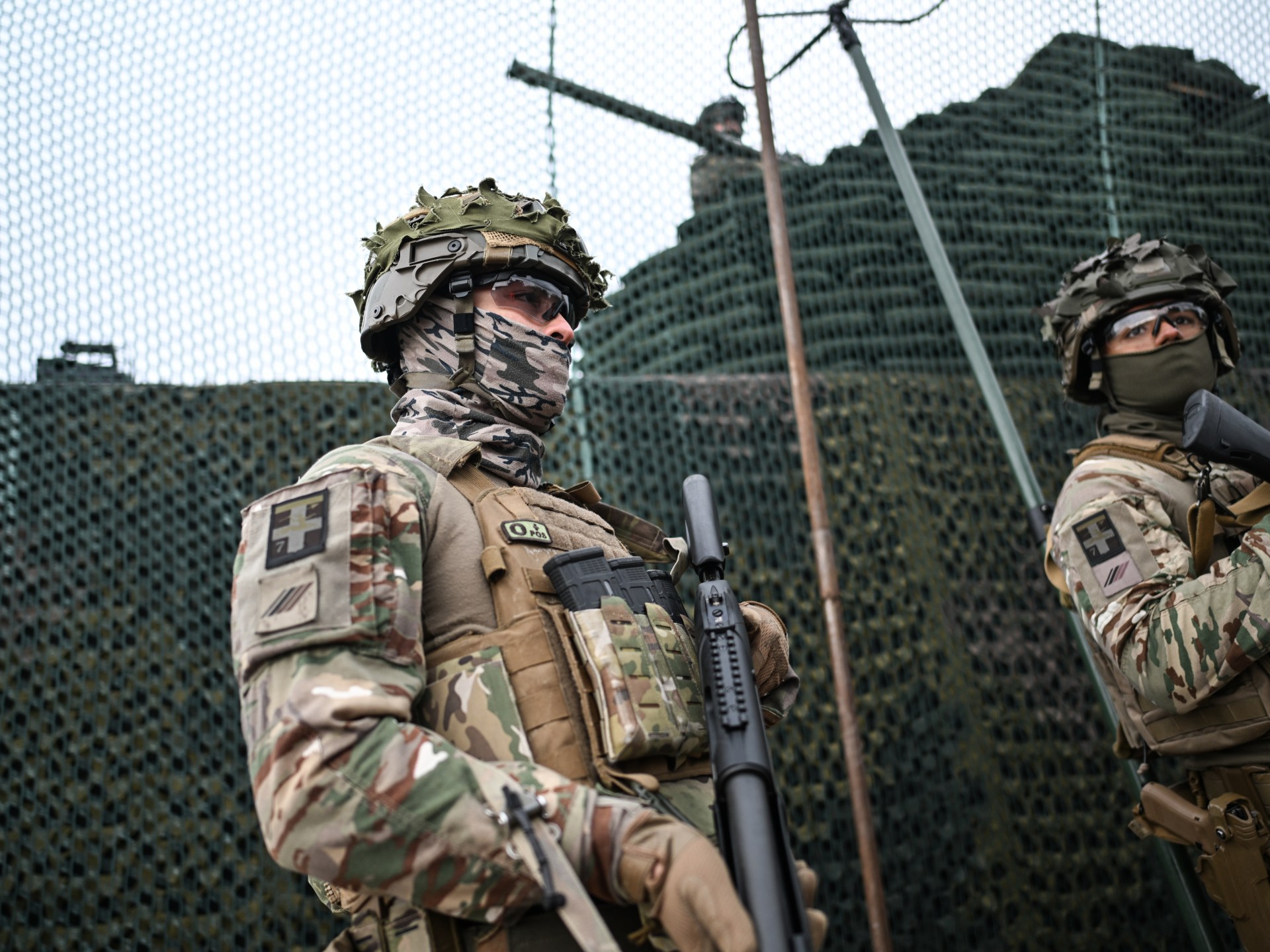
Polish Prime Minister Donald Tusk said it appeared “we are dealing with an intentional provocation” by Russia. He said the incident was likely timed to coincide with the European military exercises in Poland. The unprecedented two-week exercise began on November 9 in southeastern Poland and is preparing forces for a possible post-war mission in Ukraine to help stabilise the country and rebuild its military.
Scott Lucas, professor of international politics at the Clinton Institute, University College Dublin, told Al Jazeera that the incident “fits into a pattern going back for months” of Russia “testing how far they can go”.
“A few months ago, it was flying the drones into airspace, and indeed a couple of times they flew fighter jets across the border into the Baltic states,” he said. “You just test how NATO responds.”
This time, he said, Moscow had “gone a bit further”. “You lob a couple of missiles across and a drone” near where 11 countries are holding exercises.
The Polish Air Force had launched preventive air patrols on September 17 aimed at securing the eastern part of Polish airspace following repeated incursions in the previous weeks.
Harry Nedelcu, partner and senior director for geopolitics at Rasmussen Global, said the testing has not been limited to Poland.
“During the war, there’s been repeated instances of Russia testing NATO allies – Poland, Romania and also non-NATO Moldova as well, which is experiencing – especially over the last few months – increasing numbers of drones and missiles flying over its territory and airspace,” he told Al Jazeera.
He linked the incursions to one of Moscow’s core war aims. “One of the key goals in Ukraine that Russia has had in the full-scale invasion, that has lasted almost five years now, has been to prevent Ukraine from being a part of NATO,” he said. “So their goal clearly is to undermine NATO, to do everything possible to undermine it.
“What Russia is doing with these missiles, drones, that sometimes find their way into NATO territory, tests NATO just under the radar of Article 5 to see how far can they push things. How far can they take hybrid warfare?”
Under Article 5, each member of the NATO alliance understands that if one of them is the “victim of an armed attack, each and every other member of the alliance will consider this act of violence as an armed attack against all members”.
Why has this happened now?
At a meeting on Thursday with European leaders in Germany’s capital, Berlin, US President Donald Trump’s envoy and son-in-law Jared Kushner said he believes Russia would be “comfortable” with NATO-like security guarantees for post-war Ukraine.
Advertisement
Kushner and fellow special envoy Steve Witkoff have been holding talks with Ukraine and Russia in recent days, in a push for peace which has been viewed as sidelining Ukraine’s European allies.
Following the Berlin meeting, French President Emmanuel Macron said Ukraine’s membership of NATO should be considered again, prompting Russian Deputy Foreign Minister Sergey Ryabkov to push back.
Ryabkov said any form of “quasi membership” for Kyiv of the Western military alliance was totally unacceptable for Moscow, Russian state media reported.
Lucas said the timing of the missile incursion into Polish territory now is very likely tied to the ongoing US-led peace talks.
“The Russians cannot be seen to go through talks and completely exclude Europe,” he said. He described the Kremlin’s push for a “Europe-wide security architecture” as a way to avoid discussing a ceasefire or security guarantees for Ukraine.
“Rather than having a strong Europe at the talks, they want to try to divide Europe, they want to try to unsettle Europe, they want to try to scare Europe,” he said.
He also pointed to Ukraine’s recent strikes on the Kerch Bridge, which links occupied Crimea to Russia. He said these were seen as “a very serious attack on Russian capabilities” with “severe political, military and economic consequences”.
The latest Russian bombardment follows President Vladimir Putin’s pledge to retaliate against those strikes.
How have Poland and NATO responded?
NATO Secretary-General Mark Rutte called the missile incident a “grave violation” of Poland’s airspace. On X, he said the incident was “clearly dangerous” and a consequence of Russia’s ongoing war against Ukraine. Rutte is expected to visit Poland this weekend.
UK Prime Minister Andy Burnham called it “utterly unacceptable”. Germany’s Foreign Ministry called it “yet another example of Russia’s ongoing provocations”.
US President Donald Trump had played down earlier incursions hours before. “Putin has been landing drones in Poland and a couple of little missiles, by mistake,” he said.
Nedelcu said Warsaw’s reaction was “definitely a strong one”, with Polish officials “drawing a parallel between the fact that actually around the same time there were exercises by the Coalition of the Willing [those countries willing to provide support to Ukraine] nearby, and that this may have not been a coincidence”.
He said Poland is now “asking for more NATO support under this Eastern Sentry mission that already exists”.
“It’s not if, but what form that additional support will take – maybe an airborne early warning aircraft, or something of the sort,” he said.
“But what they have stopped short of is invoking Article 4,” he added, referring to the clause under which allies consult each other before invoking Article 5. “It’s unclear whether this was at their own volition. Maybe perhaps allies don’t want to use it too often, because Article 4 is also quite serious. It has been invoked not often, and it loses its value if it’s constantly invoked.”
Advertisement
Lucas said the public condemnation from European leaders was itself the message to Moscow. “It’s a signal to the Russians: look, we know what you’re doing, we see what you’re doing here,” he said.
“But you’re not going to run it up into an all-out military confrontation over a couple of missiles.”
He said he expects the response to be “defensive”, built on “preparedness” of ground forces, air, naval and cyber-defence, and defence against disinformation. “These will be the most intense preparations you will have had, certainly since the 1980s and possibly well before that,” he said.
On the same day, Denmark took action on a separate front. It announced that it was expelling Russia’s defence attache after Danish intelligence concluded that Moscow had orchestrated a plot to assassinate Ukrainian-American rapper Kyivstoner during a concert near Copenhagen.
Could a Russian missile strike on Poland trigger NATO’s Article 5?
Probably not. Article 5 treats an attack on any ally as an attack on all 32 members, but invoking it is a political decision requiring agreement from all members, not an automatic trigger. Poland can instead invoke Article 4, which provides for emergency consultations only. Warsaw did so in September 2025, after Russian drones entered its airspace.
Lucas said NATO members want to stop Russia succeeding in Ukraine without allowing the conflict to escalate. “[That] means you set a very high bar for invoking Article 5,” he said.
“You’re talking about what in effect would be a sustained Russian attack on Poland. That’s when Article 5 gets invoked.”
He said NATO is also handling a delicate diplomatic moment. US envoys Jared Kushner and Steve Witkoff are pressing for a negotiated settlement, and “NATO can’t be seen to be the ones to sabotage the talks”.
Those talks remain murky, particularly after Kushner’s comments indicating that Russia would be “comfortable” with NATO-like security guarantees for post-war Ukraine.
“Jared Kushner is going around making statements that make absolutely no sense about what deal is on the table,” Lucas said. He said the US is “so desperate for a deal” that it is “muddying the waters”.
Lucas said Ukraine has no real prospect of NATO membership now, because “bringing Ukraine into NATO would destabilise a ceasefire”. He said the goal should be “security guarantees as if Ukraine was a NATO member”.
Could the incident escalate the Russia-Ukraine war?
Analysts say a direct confrontation between Russia and NATO is unlikely for now.
“The alliance shows every signal that it does not want to show any teeth,” Nedelcu said. “So what will probably happen, Russia will keep on testing the alliance. We should not expect that this is the last instance of this.
“The alliance is not trying to show Russia, you know, enough is enough, so Russia will still keep testing because they want to see where that threshold is,” he said.
Lucas said the bigger danger is a wider campaign of hybrid, or “grey zone”, warfare, including cyberattacks and disinformation, rather than direct strikes. “That’s where the real threat here is right now, rather than direct Russian strikes,” he said.
“I’m not going to say that it couldn’t escalate at some point, because you always have unintended escalation,” he added. “But I don’t want to go to the headlines and say this is it, World War III.”
Inside Ukraine, Nedelcu said, the war is intensifying in the air rather than on the ground. He described the incident in Poland as “a residual, if you will, collateral of the conflict in Ukraine”.
Advertisement
“On the front line, the conflict in Ukraine is pretty much static,” he said. “But what happens in Ukraine is that the air attack has been increasingly amplified, I would say, since the end of the summer.
“Russia is trying to essentially make Ukrainian cities especially unliveable – destroying its energy grid, trying to undermine even water supply, bridges, railways, logistics – in order to, if they cannot break it on the front lines, break it economically and break its civilian population.”
Lucas said any offensive pressure on Moscow would come through Ukraine’s own counterattacks, which he said Europe and NATO back, but the Trump administration does not.
“The more that you limit Russia’s capacity by hitting its refineries, its chemical plants, its engineering plants, by hitting the bridges, the more you increase the pressure on the Russians to try to stop the invasion,” he said.
Related News
Israeli forces kill at least five people in Gaza, including 7-year-old girl
Michigan Dem Haley Stevens endorses Republican Senate candidate Mike Rogers
Trump asks UFC chief Dana White to be White House press secretary