Tigray displaced families fear renewed war as hopes of returning home fade
 10 November 2026
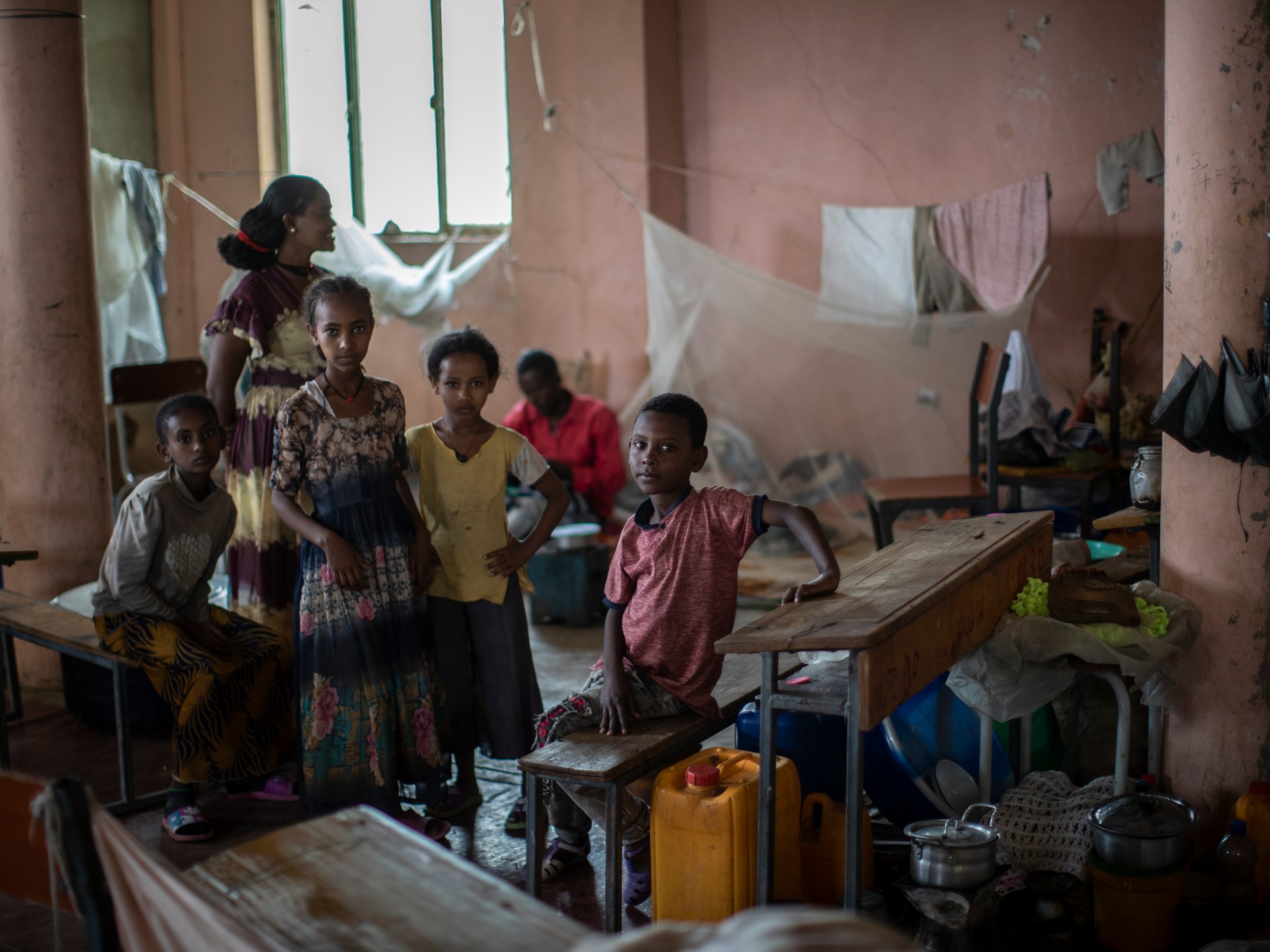

Abi Adi, Tigray, Ethiopia – Classrooms that once echoed with the voices of students have become homes for families displaced by the war in Ethiopia’s northern Tigray region.
At a former high school in Abi Adi, families who fled Western Tigray have spent years waiting to return home. Mattresses, cooking utensils and personal belongings have replaced school furniture as families share rooms originally designed for students.
What was supposed to be temporary shelter is now where children are growing up far from home.
“We thought we would stay here for a few months before returning home. It has been years now. Our children are growing up in this school, and we still don’t know when we will be able to go back,” said Tewolde, who was displaced from Setit Humera in Western Tigray.
His hopes of returning have been further undermined by renewed fighting, four years after Ethiopia’s federal government and the Tigray People’s Liberation Front (TPLF) signed an agreement to end their devastating war.
The Pretoria agreement, signed in November 2022, ended two years of war that left an estimated 500,000 people dead, including from violence, famine and the collapse of healthcare, and displaced millions. But it left major political and territorial disputes unresolved, particularly over Western Tigray, where Amhara forces took control during the war.
The area remains disputed, and the return of displaced Tigrayans has been one of the most contentious outstanding issues.
Disagreements over the withdrawal of non-federal forces, disarmament and the region’s political administration further complicated implementation. Relations between the federal government and Tigray’s authorities deteriorated, while divisions within the region deepened.
Advertisement
Fighting escalated on September 22, 2026. TPLF forces launched an offensive the following day and seized Mekelle’s airport. Both sides disputed responsibility for the escalation, the most serious since the 2020–2022 war.
Federal forces and allied fighters counterattacked, retaking Mekelle on October 4 as Tigrayan fighters withdrew. Fighting continued elsewhere in the region, however, underscoring the fragility of the security situation.
The federal government subsequently established a six-month caretaker administration to govern Tigray, restore public services and prepare the region for elections. But the change in regional leadership has not ended the fighting, and the underlying political disputes have remained.
In an October 8 letter published the following day, Human Rights Watch and other organisations warned the United Nations Human Rights Council that renewed hostilities threatened to undo the Pretoria agreement. They cited reports of drone strikes, mortar fire and artillery attacks, including in populated areas and near camps for internally displaced people, and called for international scrutiny of violations by all parties.
The renewed fighting has exposed how little the agreement did to resolve the heart of the conflict.
Displacement with no end in sight
For families in Abi Adi, the unresolved status of Western Tigray has meant years of uncertainty.
Many fled their homes when the war broke out in 2020 and have struggled to rebuild their lives. At the displacement site, families say they face shortages of food, clean water and essential medicines. Overcrowding has made daily life particularly difficult for children, older people and those with chronic illnesses.
Selass, an internally displaced mother of two from Humera, said the lack of affordable medicine was a constant worry.
“Sometimes, we take our children to the clinic, but the medicines they need are not available. We are told to buy them from private pharmacies, but we have no money,” she said.
For families who have already spent years away from home, renewed fighting has brought renewed fears that their displacement could become permanent.
Hospitals struggle to treat patients
The crisis has also left Tigray’s health facilities struggling with shortages of essential medicines and medical supplies.
Doctors at Ayder Referral Hospital in Mekelle, who spoke to Al Jazeera on condition of anonymity because they were not authorised to speak publicly, said the facility lacked sufficient supplies of essential medicines.
Advertisement
Patients were increasingly being asked to buy prescribed drugs from private pharmacies, where prices were often beyond their means.
“Patients have to go outside the hospital and buy the medicines they need from private pharmacies. But not everyone can afford them, and this makes it difficult for patients to get the treatment they need,” one doctor said.
Although humanitarian organisations have continued to provide medical assistance and some hospitals have resumed operations, significant gaps in healthcare remain.
Years of conflict have damaged health infrastructure and depleted medical supplies. The recent hostilities risk further disrupting services that have yet to recover.
Former fighters seek a way out of war
While displaced families wait to return home, thousands of former fighters are beginning the process of leaving military life behind.
On November 5, Ethiopia’s National Rehabilitation Commission said about 5,500 former Tigrayan fighters were receiving rehabilitation training at a centre in Mekelle. The programme aims to help former fighters return to civilian life through education, vocational training and employment opportunities.
Alem, a 28-year-old former fighter from Mekelle, said she wanted the chance to build a future beyond the conflict.
“I want to have a future and build a life for myself. I want to get married and have children, like any other woman. I survived the last war, and I do not want to go through the same experience again. I have spent enough time living with uncertainty. I want to leave that life behind and have the chance to plan my own future,” she said.
Atsbeha, another former fighter, joined the military in 2020, abandoning his university studies. He now hopes to return to civilian life and find work.
“I left my university studies and joined the military in 2020. But now I want to leave that life behind. I want to work, earn a living and rebuild the future I put on hold. I do not want to keep fighting. I want to have a chance to live a normal life,” he said.
But renewed fighting threatens to undermine a programme that depends on security and practical support to help former fighters make a lasting transition to civilian life.
There are also concerns about whether young people in Tigray can freely choose to remain civilians. In a September 25 statement, UN human rights chief Volker Turk condemned reports of forced recruitment by the TPLF, including of children and previously demobilised fighters. He also raised concerns about arbitrary conscription by government forces.
The allegations highlight the environment in which former fighters are trying to leave military life behind – voluntary disarmament cannot succeed if people continue to face pressure to join armed groups.
For those entering the rehabilitation programme, access to education, employment and lasting security will be essential to building a life outside the military.
In Abi Adi, displaced families are still living in classrooms. At hospitals, patients struggle to find medicines. Former fighters are trying to leave military life behind, but renewed fighting threatens to pull the region back into war.
Advertisement
For Selass, the years of displacement and the prospect of another war have left one wish above all others:
“We survived one war and lost almost everything. We don’t want our children to experience another one. All we want is to return home and live normally.”
Related News
Canadian publisher cuts ties with best-selling writer Orelien over AI use

Polls open in closely contested US midterm elections 2026

Photos: Clashes erupt in France during protests over rising living costs