Information Session on Disaster Risk Reduction held in Belmopan
 04 November 2026


By Orlando Pulid (Freelance Writer)
SANTA ELENA TOWN, Cayo District, Tues. Oct. 27, 2026
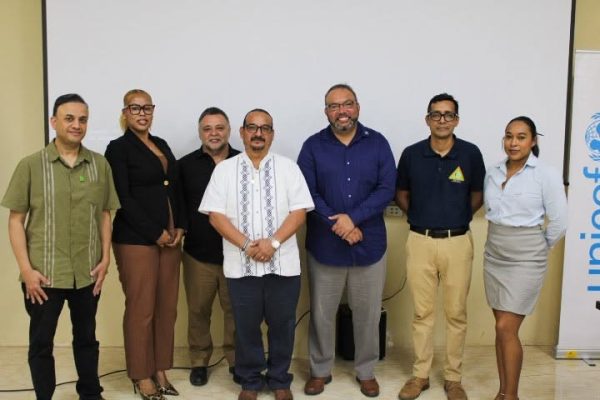
An information session on Disaster Risk Reduction (DRR) was held at the Ministry of Sustainable Development auditorium in Belmopan on Monday of this week.
In his opening remarks, Daniel Mendez, National Emergency Coordinator within the National Emergency Management Organization (NEMO), stated: “The need for disaster management has never been greater.” He reported that NEMO recognizes the importance of exploring innovation.
Next to speak during the program was Sajid Ali, United Nations Children Fund (UNICEF) Representative in Belize. Ali commented that UNICEF remains committed to building local capacity and advocating for the rights of children and noted that “… resilience is not built when the storm is approaching.”
It was then the turn for Monica Coe, Assistant Geographic Information System (GIS) Officer at NEMO, to introduce the ‘Shelter Inspection Dashboard’, a centralized digital innovation which can now provide insight to support decision-making during emergencies. GIS maps, said Coe, transform inspection data into a geographic story “… showing exactly where safe or vulnerable shelters are located.”
Coe also took the opportunity to show the audience the online ‘Hurricane Shelter Locator’ on NEMO’s official website at www.nemo.org.bz. Users who type a location within the search bar, will now be able to locate hurricane shelters anywhere in Belize.
Cordelia Belezaire, Director of the Training and Development Unit within the Ministry of the Public Service, Disaster Risk Management, and Enterprise (MPSDRME), then detailed the training assistance that has been obtained from UNICEF. Some 213 public officers have completed a two-week online course, which was launched on April 30, 2026. The training, known as the National Shelter and Shelter Management Program, was deployed by the University of Belize via its Moodle Platform.
“This inter-agency approach leads to effective management in times of disaster,” she said.
In the next half of the morning session, Daniel Mendez again spoke, reporting that the Government had allocated $500,000.00 and $ 900,000.00 for shelter repairs during 2025 and 2026, respectively.
“This really is an investment in education and community development,” he said.
In his keynote address, Hon. Henry Charles Usher, Minister of the MPSDRME, commented: “The most important measure of success is resilience. Yes, we have to be able to recover, but the more we build our resilience, we bring back people as fast as you can to normalcy.”
Minister Usher then thanked both UNICEF and the World Food Programme (WFP) for their investments in Belize.
At the end of the morning session, Amandala asked participants to reflect on what had been achieved.
The Hon. Henry Charles Usher said: “I think it is a very important update of all the issues on the investments that are being done at the Ministry of Public Service and at NEMO through disaster risk management There are three areas that we wanted to focus on today: it was investment in infrastructure, meaning investment in the different shelters; it is also the investment in people that we had with the training of shelter management for public officers; and then thirdly, it is the creation and investment in technology that we are using, a dashboard using technology to be able to have the shelters tracked, check the status of the shelters, and having the public know where the shelters are.”
Sajid Ali said, “I think their main message here was also that the public needs to be aware of the shelter management plan that is in place. You saw the demonstration of the Dashboard and the NEMO website. There is very clear information on how you can track shelters in times of disaster, and now the message is that we are looking at these shelters and retrofitting them and repairing them. We need to also take into consideration that they need to be inclusive so that persons with disabilities can also access them. I think a lot of investment needs to be made, and continue to be made in this regard.”
Daniel Mendez commented: “Today is a presentation on different technologies and changes that NEMO has been making towards inspecting shelters and educating public officers and the general public. Through our work with UNICEF, and the investment UNICEF has made, we are highlighting our ability to better understand shelter needs across the country, improve those shelters, and better prepare public officers to provide essential services. That service of shelter management is very key. We found that we must continue to focus more on children, who are among the groups most impacted by any disaster. It is important that NEMO and the government also continue to ensure that we maintain that focus. So, UNICEF has been helping us to keep that at the forefront.”
The mayor of Belmopan, Pablo Cawich, also commented. “As you heard, today’s presentation was on disaster risk reduction and the initiatives that the Government of Belize is doing. The Belmopan City Council works very closely with BEMO [Belmopan Emergency Management Organization], a branch of NEMO. We have noticed some of the gaps when it comes to information management. So, one of the things that, through our participation in the preparations for emergency management, the Council has embarked on [is] the implementation of a system, or the design of a system that will assist the Government of Belize to better capture data required for these types of managements. As you heard, Captain Mendez had expressed, that data is very important when it comes to the planning and adjustments that they need to make in terms of processes, so that data and the system process flows. [It] will allow the government and the municipalities to better manage these types of emergencies. We are part of the working committee that the government has, so it won’t be an overlap. We are part of the team.” It is interesting to note that NEMO was established on the 1st of February 1999 after Category-5 Hurricane Mitch had threatened Belize for five days in October 1998. Thus, NEMO became the sole Government of Belize Department responsible for keeping Belize in a state of preparedness for any emergency that may require a national response.
Related News

Stacey Plaskett Makes American History as First Black Woman Elected Governor, Wins USVI in...

Tourists Call for Taxi Reform, Rideshare Options and Better Payment Systems in Virgin Islands
Birth Certificate Bill Would Require Mailing Within Five Business Days and Mother’s Surn...