
Rare Ethiopian manuscript stolen by British triggers restitution row
 17 September 2026
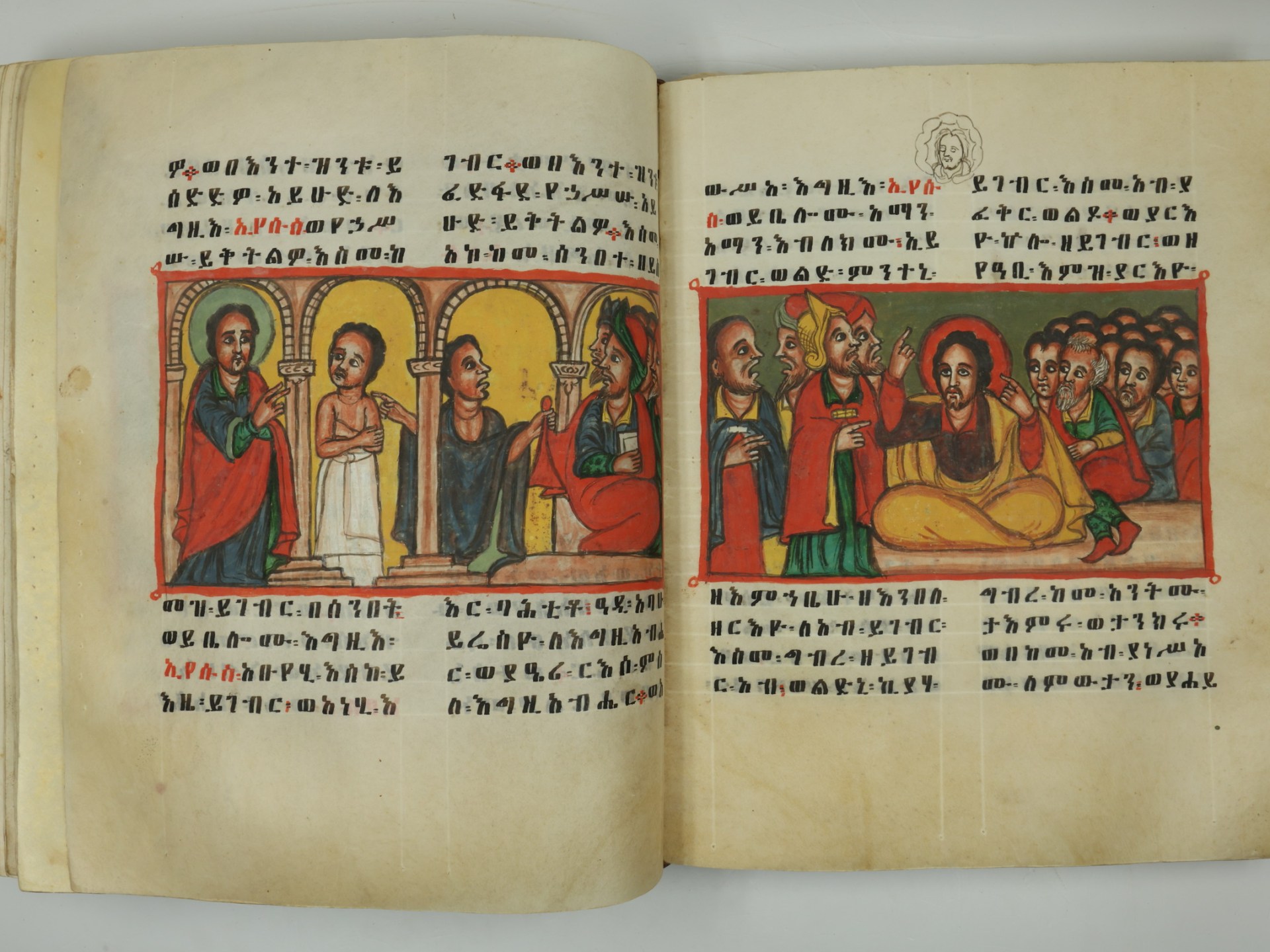

A sacred book looted by British forces from an Ethiopian king has prompted an intense ownership dispute after it resurfaced in a private sales catalogue nearly 160 years after it was stolen.
The Gondarine Gospel, an ancient bible originally in the possession of Emperor Tewodros II, was listed among rare books meant to be sold at the ongoing Abu Dhabi International Book Fair. It was listed for sale at $250,000.
- list 1 of 4‘For Ethiopia’s heritage’: War hero’s family fights to reclaim stolen medal
- list 2 of 4Lebanon returns 37 artefacts smuggled out of Egypt six years ago
- list 3 of 4Stolen Matisse art found in Brazil
- list 4 of 4Art offers young Gaza survivors solace and escape from war’s devastation
end of list
Ethiopian authorities have urgently requested that the relic be removed and returned on ‘moral and ethical’ grounds.
The matter has provoked calls for wider-scale restitution of looted artefacts in Ethiopia. It has also reignited ongoing global debates over the responsibility of Western museums and collectors to return hundreds of thousands of Africa’s stolen treasures.
“There are clear moral grounds for art dealers to avoid selling items which are established as having been looted,” Abebaw Ayalew, head of the Ethiopian Heritage Authority (EHA), wrote in a letter seen by Al Jazeera and sent to Inlibris, the Vienna-based dealer of rare books which listed the book for sale on behalf of a private owner.
“It is considered morally unethical and raises serious reputational risks for famous art dealers such as Inlibris to be involved in the sale of items that are questionably looted,” he wrote.
However, Inlibris, in its response to the EHA, rejected the call, arguing that there are “no legal grounds for restitution”, as no laws existed before the 18th century guiding against the looting of cultural items during conflict and that the book’s present owner is thus not obliged to surrender it.
Advertisement
Speaking to Al Jazeera, Inlibris head Hugo Wertscherk did not name the collector but said handing over the book to Ethiopian authorities would be illegal.
“Of course I want to see all these manuscripts returned to their rightful owners, but I do not write the laws. I am only a businessman,” he said.
Wertscherk denied attempting to sell the bible at the Abu Dhabi fair and said it was only listed as a prop.

A long-lost treasure
The Gondarine Gospel, bound in glossy leather and featuring intricate gold patterns, was stolen from the library of the powerful monarch, Emperor Tewodros.
Written in Ge’ez, an ancient South Semitic language, the manuscript contains 235 striking illustrations narrating the Gospel of Luke and John in vivid reds, greens and yellows. It was likely originally commissioned between 1730 and 1734 in the city of Gondar.
“It is not simply an old religious book, nor should its significance be reduced to its association with Emperor Tewodros,” said Abreha Kiros, a professor of art history at Ethiopia’s Aksum University, pointing out that it is also important for studying Ethiopian manuscript culture, ancient Geʽez literature, as well as the artistic traditions of Gondar, once famous for its artwork and architecture.
“It is also connected to a painful moment in Ethiopia’s history… The absence of a clear legal mechanism does not mean that there is no basis for dialogue or restitution,” he added.
Emperor Tewodros ruled Ethiopia from 1855 until he died in 1868, during the Battle of Magdala. On his many conquests, he gathered a vast collection of treasures for his great imperial library, which some historians call Ethiopia’s first modern museum.
In the mid-1860s, as his empire was increasingly threatened by an expanding Ottoman Empire and lesser, rival lords, Tewodros wrote to Queen Victoria for support, having long allied with Britain as a fellow Christian power.
When she failed to respond, Tewodros imprisoned British diplomats, prompting Britain to declare war.
On April 9, 1868, 13,000 troops dispatched from then-British India descended on the king’s court in Magdala and killed Tewodros’ 4,000 soldiers. Instead of surrendering, Tewodros shot himself.
The soldiers looted Magdala, taking everything from treasured artefacts to locks of Tewodros’ hair. Robert Napier, the British commander who led the mission, took the Gondarine Gospel. It has since been passed to other British colonial officers and British museums. About a decade ago, it fell into private hands.
Advertisement
Return or not return?
Thousands of relics stolen from Magdala and from other periods remain outside Ethiopia, although authorities there have actively sought their return.
Amid widespread calls from activists and African governments for the repatriation of looted objects held in Western museums, Britain, Germany, France, Belgium, among others, have begun instituting permanent returns or agreeing to temporary “loans”.
In May, the British returned a lock of hair believed to be from Emperor Tewodros, and a piece of cloth believed to be stained with his blood, to Ethiopia.
However, it remains uncertain whether the Gondarine Gospel will also find its way home.
Wertscherk of Inlibris told Al Jazeera that communication from Ethiopian authorities has been “threatening” in nature. The book dealer said his firm is open to dialogue and is willing to come to a “preferential price” settlement but that the final say ultimately rests with the manuscript’s legal owner.
“We are prepared to consider a serious institutional purchase proposal, but will not negotiate on the premise that restitution is owed,” he said.
However, British historian Alula Pankhurst, who first alerted Ethiopian authorities to the exhibition, rejected the claim.
“The Ethiopian Heritage Authority wrote them a polite letter which was not a threat,” Pankhurst said.
Ethiopian authorities “take the position that since the manuscript was clearly looted, as Inlibris openly acknowledged, it should first be withdrawn from the sale, and then negotiations can go ahead.
This has been the case in several successful recent cancellations of auctions in the UK, the US and Italy where the sellers have accepted the principle that looted items should not go to open sales and where subsequent negotiations have led to settlements,” he added.
A resolution does not have to be confrontational and could take the form of a negotiated return, donation, long-term loan, shared custodianship, or other mutually agreed arrangements, Kiros of Aksum University said, urging both sides to choose a constructive pathway.
“What matters is that the country and communities from which the cultural object originated are taken seriously in determining its future,” he concluded.
Related News

US says it will use regional body to isolate Nicaragua

Trump administration announces global economic war on Iran

UK government refuses slavery reparations as Jamaica urges king to act