Mali crisis: Who are the key leaders to know about?
 30 April 2026
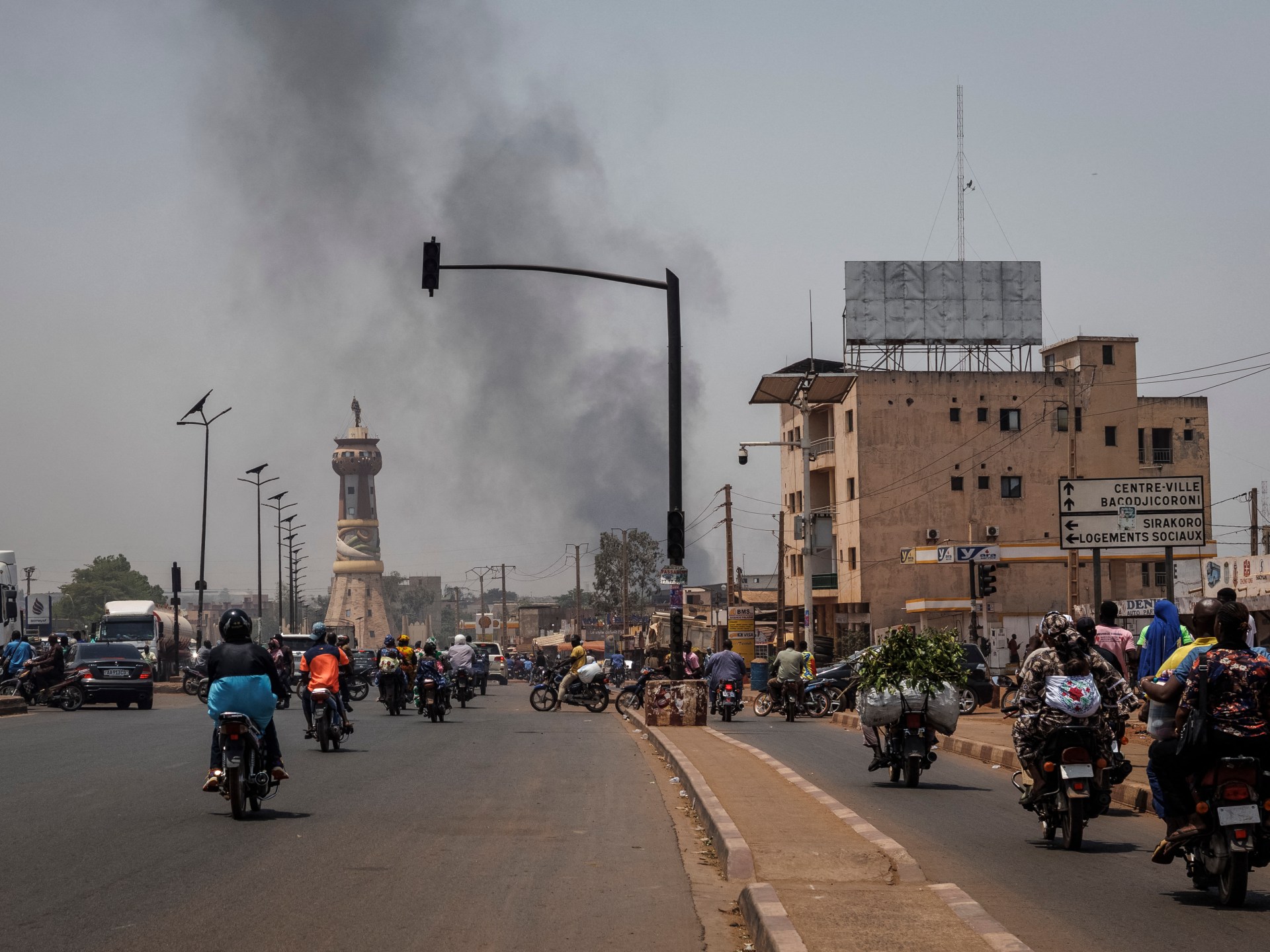

Armed violence has intensified in Mali since Saturday after an al-Qaeda-linked armed group working with separatists attacked several military bases across multiple cities, including areas where senior government officials live, and took control of the northern city of Kidal.
Malian Defence Minister Sadio Camara and his family were killed in their home in Kati, a military garrison close to the capital, Bamako, the government announced on Sunday. Armed groups have announced that they are laying siege to Bamako.
- list 1 of 4Armed group announces siege on Mali capital
- list 2 of 4What role has Russia played in Mali’s security and the Sahel region?
- list 3 of 4Mali’s Tuareg rebels say Russian fighters must withdraw from country
- list 4 of 4Video emerges of heavy firefight in Mali
end of list
Mali has been beset by security crises since at least 2012. Al-Qaeda-linked Jama’at Nusrat al-Islam wal-Muslimin (JNIM) controls swaths of rural territory, especially in the north and central regions, and has active cells around the capital. Similarly, the ISIL (ISIS) affiliate in Sahel Province (ISSP) controls areas in northeastern Menaka city.
At the same time, armed Tuareg separatists of the Liberation Front for Azawad (FLA) group, fighting for an independent nation called Azawad, also in the north, are clashing with the military and allied Russian mercenaries who have been deployed since 2021. They control Kidal now, along with the JNIM, but they also want Gao, the largest city in the north, Menaka and Timbuktu, to complete the self-declared state of Azawad.
These groups sometimes work together: they operate in the same areas and draw from the same pool of fighters from aggrieved communities. On Saturday, the JNIM worked with the FLA against the army.
But who are the faces behind them? Here is a breakdown of who is who in the Mali crisis:
Advertisement
Key figures in the Malian army
- Assimi Goita: Colonel Goita, 42, is the country’s head of state. He helped the military seize power in 2020, removing the civilian government and promising to end the crisis as security deteriorated. In May 2021, he again launched a coup, this time removing the civilian members of the cabinet and installing himself as president. Although Goita initially promised to hold elections, he has since gone quiet on that front. Under him, Mali’s foreign policy has been increasingly nationalist: his government has cut off ties with the regional bloc, ECOWAS, which pressured it to hold elections. It has also cut ties with former colonial power France and evicted French troops, as well as 15,000 United Nations peacekeepers. In their place, Mali has turned to Russian mercenaries for defence. Mali also restarted an on-and-off conflict with Tuareg separatists.

Assimi Goita visits wounded civilians and military personnel in Bamako, Mali [Handout/Mali Presidency via Reuters] - Sadio Camara: Killed on Saturday in the heavily fortified Kati, General Camara was the defence minister and a key official. He was 47. Camara actively took part in the 2020 coup. When he was sidelined by the civilian cabinet and replaced as defence minister, Goita launched a total coup in 2021 and reinstated him. Camara was the brain behind the Mali-Russia partnership and helped facilitate the arrival of Russian mercenaries from the Wagner Group, who were replaced by a Russian Defence Ministry unit called Africa Corps. Mali observed two days of mourning following his assassination.

Colonel Sadio Camara at an Alliance of Sahel States meeting in Ouagadougou, Burkina Faso, on February 15, 2024 [Fanny Naoro-Kabr/AFP] - Abdoulaye Maiga – Lieutenant-Colonel Maiga, 44, has served as prime minister since 2022. He did not take part in the coups, but is a close ally of Goita and reputed to be the main voice behind the scenes, pushing for a break with France. He studied in Algeria and France, where he earned a doctorate. Maiga formerly worked with the UN and ECOWAS, from which Mali has distanced itself.

Mali’s Prime Minister Abdoulaye Maiga addressed the 77th session of the UN General Assembly [File: Eduardo Munoz/Reuters]
Key figures in Africa Corps/Wagner
Russian mercenaries have been fighting alongside the Malian army since 2021. There are about 2,000 Russian fighters in the country at present, with another 400 or so others in neighbouring, military-led Niger and Burkina Faso.
They were initially deployed as members of the Wagner Group. In 2023, Wagner head Yevgeny Prigozhin died, and Russia integrated the group into its Defence Ministry as the Africa Corps, which is also present in the Central African Republic, Libya, and, reportedly, in Sudan. Field commanders are hardly known, with only small details emerging.

- Major-General Andrey Averyanov – The Russian senior intelligence officer is believed to be the Africa Corps commander on the continent. He was formerly the commander of a Russian intelligence unit linked to foreign assassinations. Unconfirmed reports in early April said Averyanov was killed by a Ukrainian drone strike on a Russian shadow fleet in the Mediterranean.
- Major-General Vladimir Selivyorstov – The 53-year-old is believed to be the Africa Corps commander in Mali. Formerly with the Russian air forces, he led operations of the 106th Airborne Division in Ukraine in 2022.
Advertisement
Key figures in the FLA
Tuareg separatists have been fighting for freedom even before Mali gained independence in 1960. There have been several waves of rebellions since – the 1960s, 90s and 2012. The FLA is the latest iteration of the separatist movements. It was formed in 2024 after previous movements merged.

- Alghabass Ag Intalla – A longtime separatist, the 54-year-old is the head of the FLA. He hails from a noble Tuareg clan in Kidal and is considered a traditional chief. Before the 2012 rebellion, Intalla was the city’s representative in parliament. Briefly, he joined the ideological al-Qaeda-linked Ansar Dine as the rebellion unfolded and separatists partnered with rebels. But he later left to rejoin the core separatist movement.
- Bilal Ag Cherif – The 49-year-old is considered another key leader. He was formerly the head of the National Movement for the Liberation of Azawad, the main grouping in the 2012 rebellion. At the time, he was reported to be seriously wounded in battle and transferred to Burkina Faso for treatment. He has been a key voice in past peace negotiations and the campaign for Malian refugees to return home. Cherif is from Kidal and studied in Libya in the 1990s, around the second rebellion.
Key figures in ideological armed movements
- Iyad Ag Ghaly – The 72-year-old is the leader of JNIM. He was also the founder of Ansar Dine, which merged with four others in 2017 to form JNIM, reputed to have up to 10,000 fighters. Ghaly had a moderate upbringing and was, at some point, a musician. He fought in the rebellion of the 1990s and was seen as the “father” of the movement, but signed a peace accord with Bamako. He was sent to Saudi Arabia in 2008 as a diplomatic staff member. However, Ghaly was expelled in 2010 on suspicion of developing links with al-Qaeda. He returned and tried to lead separatists again, but failed. He thereafter founded the ideological Ansar Dine. The group at first participated in the 2012 rebellion with the MNLA, but eventually hijacked the movement after both sides’ motives clashed.
- Amadou Khoufa – Born Amadou Diallo, the fighter and preacher is a JNIM deputy. He is of Fulani descent – a group that has long decried marginalisation in Mali. He founded Katiba Macina, a group that merged with others to form JNIM. He has long preached a strict version of Islam and pushed for an Islamic republic.
- Abu al-Bara al-Sahrawi – Not much is known about him, the wali or governor of ISSP. His father, Adnan Abu Walid al-Sahrawi, was a West Saharan who fought that region’s liberation movement before moving to northern Mali and joining the armed group, al-Mourabitoun, which is now part of JNIM. In 2015, he declared allegiance to ISIL. Al-Sahrawi was killed in Mali by French soldiers in 2021, after which his son took over leadership.
Related News
Mali’s Defence Minister Sadio Camara killed amid coordinated attacks
Pope Leo visits Cameroon with message of peace amid attacks from Trump
Two CIA agents reportedly killed in car crash in Mexican state of Chihuahua