‘Vengeance for all’: How Iran’s Lego videos won narrative war against Trump
 17 April 2026
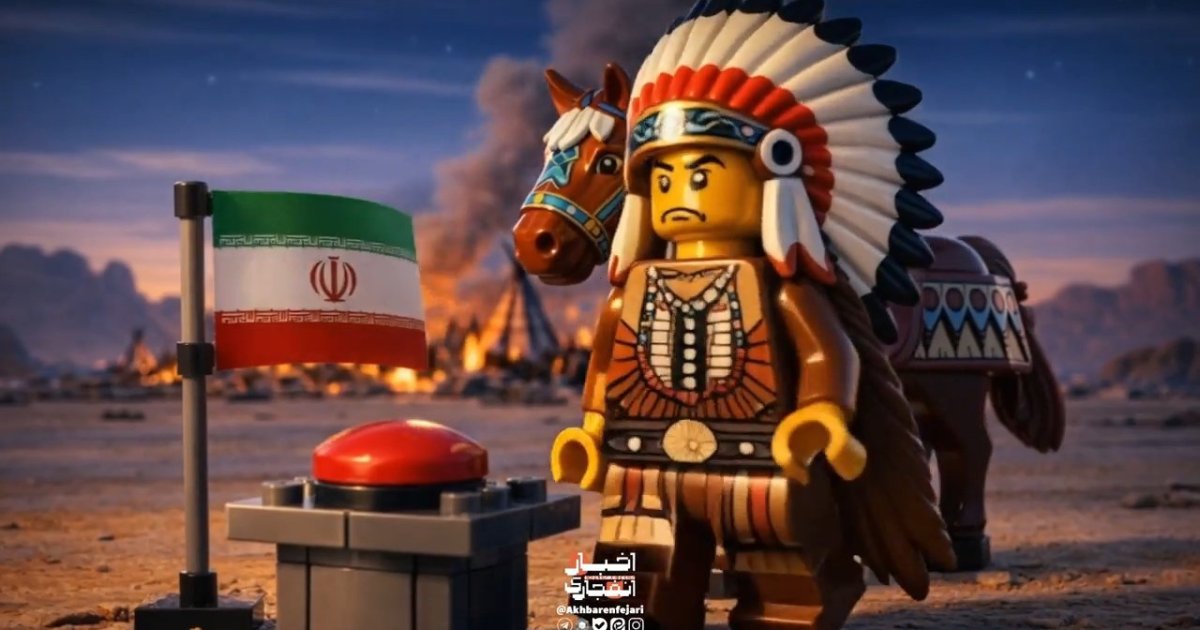

It’s a Lego set, with a difference.
A Native American chief rides on his horse onto a barren landscape, bathed in moonlight. The animated video rapidly shuttles between a range of people who’ve been victims of the United States government, from Black Americans in chains to survivors of Iraq’s notorious Abu Ghraib prison complex.
- list 1 of 3Iran slams YouTube ban on pro-Iranian group’s Lego-style AI videos
- list 2 of 3Iran war day 48: What’s happening in Lebanon, Tehran and Strait of Hormuz?
- list 3 of 3Why the Iran war did not go according to US plans
end of list
Then it pans to Iranian soldiers sticking large banners on missiles, as the tempo of the background music picks up. “For the stolen Blacks,” says the first one. “For the people of Hiroshima and Nagasaki,” comes up next.
“In memory of victims of Iran Air flight 655,” says another, referring to the passenger aircraft brought down by US missiles in 1988, killing all 290 people on board. “In memory of Rachel Corrie’s freedom struggle” follows, referring to the American activist who was killed by an Israeli bulldozer in Gaza in 2003. Victims of US war and abuses in Afghanistan, Vietnam and Iraq – and the “children of Epstein island” – all get similar messages, plastered on missiles that then fire off. The video ends with giant statues of US President Donald Trump and Israeli Prime Minister Benjamin Netanyahu collapsing, and a line in bold, white and all caps: ‘ONE VENGEANCE FOR ALL.’
The March 29 video is one of many released by Explosive Media, among several Iran-based groups that have used the Lego figures and blocks that households around the world are familiar with to script a viral social media trend, bolstering Tehran’s narrative amid the war against the US and Israel.
Advertisement
The video depicting the multiple victims of US aggression and domestic crimes has been viewed almost 150,000 times on X. Explosive Media’s YouTube account has more recently been deleted by the Google-owned video-sharing platform.
But the Tehran-based group, which uses bespoke lyrics and rap beats to mock Trump – often using the US president’s own words to accuse him of hypocrisy and of pandering to Israel’s interests rather than America’s – isn’t giving up.
An Explosive Media representative, who requested anonymity, told Al Jazeera that their YouTube channel was shut down on the grounds of promoting violence – and that they are convinced that Lego-like brick animations are not at all violent.
“There was frustration, but no surprise – this story is not new,” he said. “We know well how the West wraps truth in silence and tries to mute every voice that speaks it.”
Deep symbolism
The videos have ranged from sombre stories reflecting deeply on Shia-Muslim history to upbeat rap-style music videos, all set to motion in Lego-like brick figures and environments.
The Explosive Media spokesperson said the green and red featured in the animation are symbolic, as it interprets the traditions of green representing Hussain, the grandson of Prophet Mohammed and his fight for justice against oppression. Red symbolises the oppressor.
“That’s actually one of our team’s favourite animations. Especially that moment when war helmets are placed on missiles and drones – it was truly brilliant,” he said.
Other videos use phrases like “Epstein regime”, “Loser’’ and show the US president’s supporters wearing brick red hats with MAGA – Trump’s Make America Great Again movement – on them. They depict Trump’s promises to keep the US out of new wars and help ordinary working-class Americans, then use the president’s own words to accuse him of betraying his commitments and instead prioritising Israeli demands.
“LOSER is one of our best creations,” the group’s spokesperson said. It’s how Trump often refers to his opponents. “So we flipped it – and showed that, in the end, he’s the biggest loser of all.”
The Trumpesque figure is sometimes shown holding a little doll.
Another video was aimed at addressing the Lebanese people, stating that Iran’s Islamic Revolutionary Guards Corps (IRGC) will not leave them behind, released after the brutal pounding of the country, where more than 100 bombs were dropped in 10 minutes.
The team making these videos comprises 10 people, all between the ages of 19 and 25.
And they clearly have access to the internet – including US-owned social media platforms that Iran’s government has blocked access to for most Iranians since the start of the war.
Advertisement
In the interview with Al Jazeera, the Explosive Media spokesperson acknowledged that Iranian state media outlets are among their customers, but said the group itself was independent.
“We produce high-quality media content, so it’s natural that different local media outlets – including some state-affiliated ones – sometimes purchase our work for broadcast,” he said. “In practice, we create the content first, and if the quality is strong enough, media organisations choose to buy it from us. This way, our independence is fully preserved.”
Breaking through the noise
Explosive Media isn’t alone. Other creators, including PersiaBoi and Southern Punk, have made similar Lego-themed videos. The trend has also spread beyond Iran to Pakistan, where local creators like Nukta media in Pakistan made their own version ahead of the first round of Iran-US negotiations in Islamabad on April 11.
Fasi Zaka, an Islamabad-based social commentator, said that the brilliance in the Lego-style videos lies in how they tackle multiple subjects amid a global information narrative that for decades – courtesy of Western media – has been set against Iran.

“These videos are ways of breaking through what is an information highway stacked against them generally in times of war,” said Zaka.
Zaka said the videos, by focusing on faultlines within US domestic politics – such as on the Epstein files – had been really “smart”.
“They’re just calling it the ‘Epstein regime’, and that’s a domestic fissure that they’re choosing to bring forward again. They’re also using, like, the election MAGA tropes and being subordinate to Israeli interests, so in that the way they’re doing it, it seems like fun, but it’s really, really smart,” he said.
There’s also a deeper level of symbolism that Zaka spots. He referred to the bombing of the Minab girls’ school by the US on the opening day of the war, in which more than 160 Iranian school girls were killed.
“The war opened with an atrocity against Iranian children,” so the use of Lego – a brand and look that parents and children around the world recognise – means “it all comes together in this way”.
‘Owning smack-talk’
Marc Owen Jones, a professor at Northwestern University in Qatar, who researches media analytics, said Iran’s efforts to win the narrative war were a critical part of its strategy, because it knows that it can’t win militarily.
“Their best bet of success is to have public opinion on their side, pressuring the United States to stop,” he told Al Jazeera. “And the communications game in this day and age is one in which this kind of troll propaganda, this kind of ‘owning smack-talk type’ propaganda wins.”
He said that the carefully chosen themes in the Lego-style videos would have resonated even more with Western audiences if they weren’t coming out of Iran – a country they’ve been told, over decades, to distrust.
Advertisement
Zaka argued that in many ways the undiplomatic tone and ruthless messaging in the Iranian videos mirrored Donald Trump’s own communication style.
“Ultimately, the Iranian Lego videos are very good,” Jones said. “They’re actually well thought out. There’s a lot of details in them. There’s actually a narrative. Whereas US propaganda is just, you know, explosions with Hollywood films cut through them.”
Related News
Iran war live: Trump issues Hormuz deadline, search for US airman continues

US House votes to extend temporary protections for Haitians in Trump rebuke
What is Trump-backed SAVE America Act and what could it mean for US vote?