
So many stories in a dozen cells
 09 February 2026
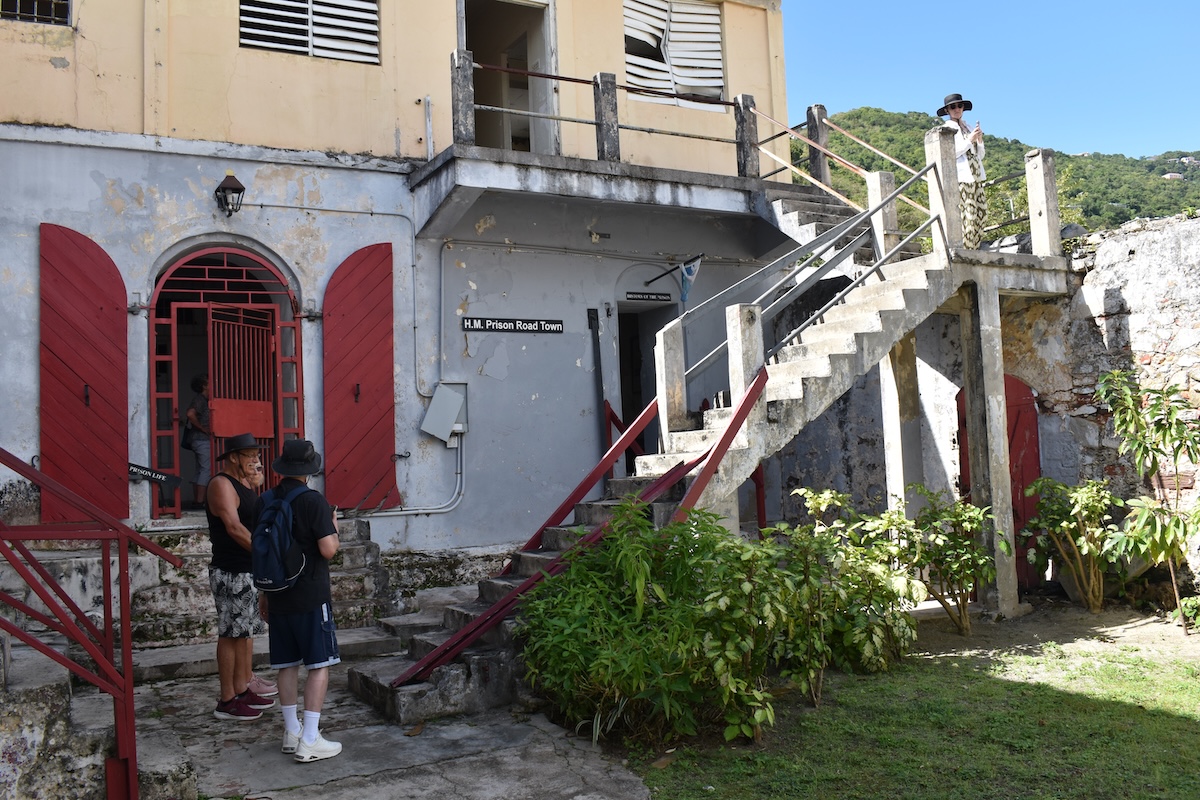

A radio with a plastic fork for a tuner played softly in the small room that serves as the lobby of the H.M. Prison Museum on Main Street.
Museum guide Rosie Smith was sitting in a corner between a filing cabinet and a table when she spotted visitors at the door.
“Some people have faces like in storybooks,” Ms. Smith said with a chuckle.
A few tourists filed in and sat down in plastic chairs that lined walls hung with paintings by Carol Vanterpool, a former museum guide who died in 2021.
Some of the paintings include unconventional materials, such as barbed wire from the prison’s original perimeter.
Ms. Smith has been a guide since the BVI Tourist Board opened the museum in 2016, and she continued in the role after the Wickhams Cay Development Authority assumed responsibility for its operations.
But her connection to the prison goes much further back.
When she was a girl walking by on her way home from school, she recalled, inmates who recognised her would often call out for cigarettes and snacks, which she would wrap in a paper and throw over the wall.
“And next thing, you would hear the door there open up, because the police officers would come to see who tossed something over there,” Ms. Smith said. “And you’d put your hand behind your back and walk and say, ‘Well, it wasn’t me.’”


Long history
Ms. Smith, a short woman with curly hair and glasses, asked her guests where they were from before setting the scene, providing the context for the facility’s long history.
His Majesty’s Prison was established in 1774, when King George III was on the throne, and it was officially recognised by the crown in 1778, Ms. Smith said.
It operated as a mixed-sex facility until 1995, and then it became a women’s-only prison until its permanent closure in 2008, according to the guide.
The original prison, which served all the territory’s islands, topped out at 12 cells in 1887, but Ms. Smith said it was big enough to accommodate the low crime rate back then.
“Maybe once every 20 years we would have a murder here,” she said.
When children misbehaved, she recalled, their parents sometimes brought them down to the prison to be scolded and spanked by the police.
She added that such discipline, combined with the territory’s closeknit community, helped discourage misbehaviour from a young age.
“I think it’s gone out of control, because it’s not what it used to be,” Ms. Smith said, adding, “There was once a time when the village raised a child and everybody used to look out for everybody. So if a prisoner escaped, somebody would see the prisoner, drag him back in here, or tell the police officer, ‘He’s right down there.’”
Before emancipation
Before slavery was abolished in the territory in 1834, the prison was also used as a place to hold enslaved people found walking the streets without documentation, Ms. Smith said.
Any who were not claimed would be auctioned off, with the proceeds going to the prison, according to the guide.
Some visitors were appalled by the stories of slavery and the brutal fashion in which the prison was run.
“I think it’s very interesting, and it’s a bit of the real island,” said Gloria Lankashear, who was visiting from Cornwall, England, with her husband John. “You come to an island like this and it’s all tourists, and this is actually what actually happened in the old days: the grimness of life and the horror of slavery and what they had to do. I just thought it was ghastly the way people were kept here, and the conditions were just barbaric.”
Long-time visitor John Piggin agreed but said modern correctional facilities can be too lenient at times.
“Compared to our prisons, well, this was pretty grim, but I think prisons are too soft now,” said Mr. Piggin, who is from the United Kingdom. “People get out of prison, let loose. They commit crimes, they go back. But clearly here there were horrible consequences.”


Prison life
To address overcrowding and create a more modernised facility, the current prison in Balsam Ghut was established in 1997 following a two-year transition as it was built, Ms. Smith said.
As a result, the Main Street prison finally closed after 234 years of operation.
Today, the Balsam Ghut facility provides adult basic education and vocational training as well as treatment for substance misuse and anger management.
Though its Main Street counterpart was not as progressive, many inmates were afforded a certain degree of freedom.
Ms. Smith told visitors that some skilled prisoners were able to continue practising their trades in the community while serving their sentence through a lenient system where an employer could sign out a prisoner for his services.
As in a library, she said, there was a physical ledger where the prisoners were checked out.
“One [prisoner] was a carpenter,” Ms. Smith recalled. “He got a job with a construction company, so he used to go to work from Monday to Friday, and he would sign himself out. He was a great carpenter, but he was very well behaved, and eventually when they went to the new jail, they had set him free.”
Other examples included a tailor who would take commissions from his cell, including sewing uniforms for his own jailers, and a mechanic who would get signed out to fix cars and even take them for test runs.
“You would be responsible for bringing them back,” Ms. Smith said.
Open for business
The museum averages about 60 visitors per week, Ms. Smith estimated, adding that it has hosted as many as 120 students and teachers at a time for field trips.
However, Ms. Smith would like to see greater efforts to get tourists and residents alike to come visit.
Though the museum is supposed to be closed on the weekends, she said she is often there if a ship arrives in port.
Most visitors who came in on Jan. 27 happened upon the museum by chance, stumbling in while wandering into town from their cruise ships.
“Well, we were just walking by,” said Jenny Robinson of the West Midlands of England. “We’ve been here before, and we’ve done tours and all of that, and we said we haven’t really done the town properly. So it was by chance we ended up seeing it.”
While visitors were moved by their experience on the tour, some felt that more could be done to get across the significance and history of the old prison.
“It was brilliant. Fascinating, absolutely fascinating,” Ms. Robinson said. “It’s definitely worth a trip. And the lady was very good. She’s working with a lot of information. It would be nice to have some investment in it, so you can have a film when you first come in.”
Related News

Senators Shelve Bryan’s Double Dipping and Leave of Absence Bills, Citing Preemption Rule
Op-Ed: Leadership in a Borrowed House and the Limits of Power in the Virgin Islands

Trump Faces Bipartisan Backlash After Racist Video Targeting Barack and Michelle Obama Pos...