
Flamingo reintroduction a success for VI
 13 January 2026
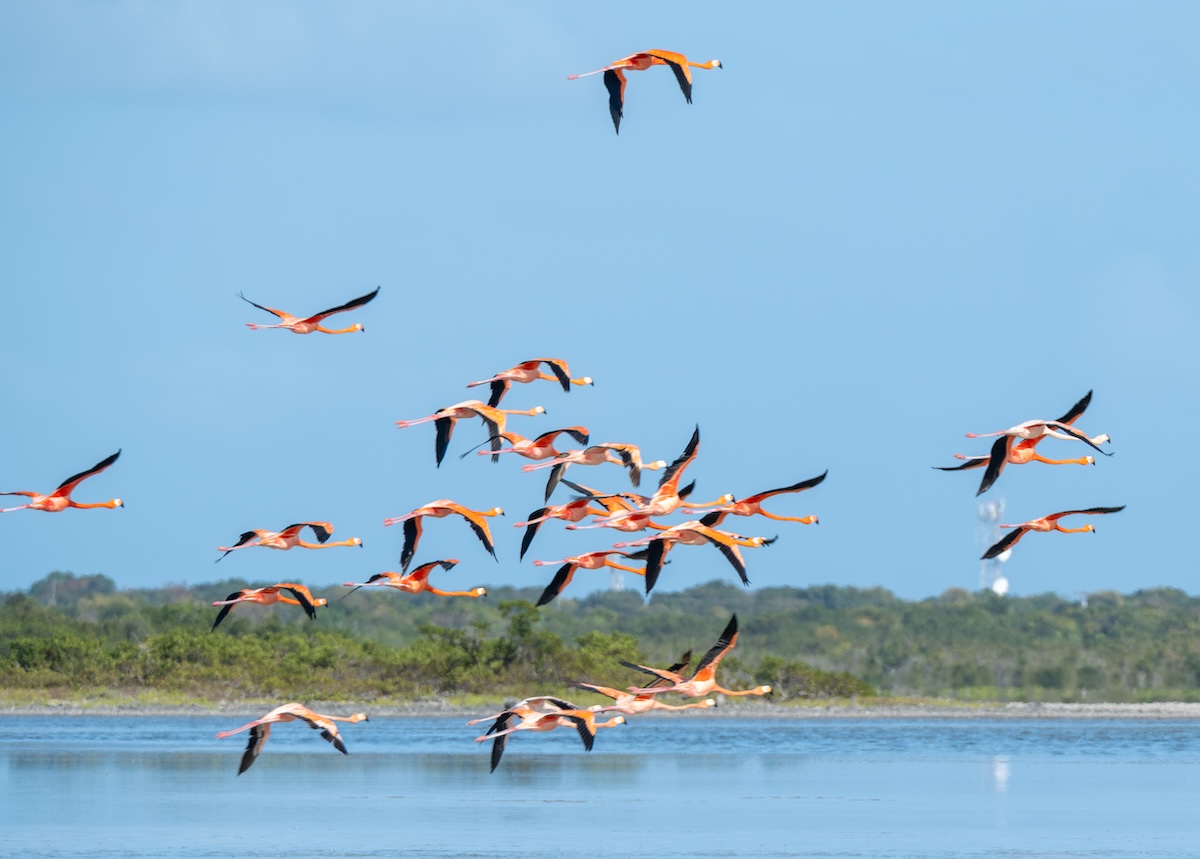

More than 100 flamingos meandered around the Josiahs Bay salt pond, dipping their heads in and out of the murky water to feed on brine shrimp and other tiny organisms.
Suddenly, about half a dozen of the biggest males lined up in a row, drawing the attention of other groups spread out across the pond.
In near-perfect sync, the males began cocking their heads back and forth as if to establish a common time. Then, they simultaneously spread their wings before bringing them back in close.
What followed was a complex dance routine — a type of mating display that helps females select their partners for the season.
“That is definitely flamingo courting,” biologist Lianna Jarecki told the Beacon after watching a video taken that February day at the Josiahs Bay pond. “Flamingos have several specific behaviours in courting. In [the] video, I can see head flagging, wing saluting and inverted wing saluting.”
According to Ms. Jarecki, such behaviour is a very good sign in the pond, where successful flamingo nesting was first observed in 2020.
The pink birds — a group of which is called a “flamboyance” — were once rare in the VI, but now they inhabit several of the territory’s salt ponds in breeding colonies.

They aren’t thriving by accident.
The VI’s 800-plus resident population is the result of decades of hard work and good luck that began in the 1980s with the birds’ initial reintroduction on Guana Island and continued with multiple nesting cycles since then.
Despite the success, however, experts warn that the resurgence shouldn’t be taken for granted.
As the population continues to grow, the species faces mounting threats.
Predators such as feral cats — along with human disturbances from tourism, low-flying aircrafts, and ongoing habitat destruction — have already proven deadly for nesting colonies and remain major concerns.
Flying away the first time
Flamingos are native to the Caribbean, but experts say they effectively vanished from the VI decades ago after being hunted to near extinction.
Records show that populations across the region were shrinking as far back as the 19th Century, according to a 2001 article by the late biologist James “Skip” Lazell, who for decades helped manage conservation programmes involving flamingos and other species on Guana Island.
In the article, which was published in the Journal of Caribbean Ornithology, Mr. Lazell wrote that German-born British explorer Sir Robert Hermann Schomburgk travelled to Anegada in 1830 and noticed the birds’ apparent decline.
“Schomburgk chronicled the vast numbers of greater flamingos (Phoenicopterus ruber) on Anegada, but noted they were even then declining and no longer nesting,” wrote Mr. Lazell, who was also the founder of a Rhode Island-based nonprofit called The Conservation Agency. “By mid-20th Century, no resident birds remained, although small groups of flamingos occasionally visited the island.”
VI biologist Clive Petrovic, an avid birder, remembers when the birds were a rare sight in the VI.
“Even in the 1980s, ’70s, ’60s, when there were no colonies on Anegada, flamingos would still, once in a while, fly by — because, you know, they’re nesting in the Dominican Republic and in the Bahamas,” Mr. Petrovic said. “And flamingos — like all the big egrets and herons, the young ones especially — they’ll wander great distances.”
Occasionally, smaller flocks break off from a large colony to roam further afield, Mr. Petrovic explained.
“If you’ve got a big colony of thousands and thousands of birds, it’s not unusual for a flock of a dozen of them or thereabouts to take off and fly hundreds of miles exploring, prospecting in new areas,” he said.


Reintroduction
The return of wild flamingo colonies to the VI began in 1987, when a small test group was introduced to Guana Island as part of a programme spearheaded by Mr. Lazell.
“My plan was initially vetted by [local authorities] and proposed to several prominent leaders on Anegada,” Mr. Lazell wrote in his 2001 article. “If I could find a suitable home for some Anegada rock iguanas, and capture and move them, I promised to obtain greater flamingos for re-establishment on Anegada. … I did not know how difficult and expensive this would be, or that it would take over a decade to accomplish.”
Throughout the early 1980s, Mr. Lazell wrote, he and the National Parks Trust worked with the government until seven greater flamingos were secured from the Bermuda Aquarium, Museum and Zoo.
“These birds came with the stipulation that they had to survive on Guana without being poached prior to placing any on Anegada,” Mr. Lazell wrote. “I published my plans in a local newspaper.”


Jet-setting flamingos
In 1987, the flamingos were finally transported to the VI on board a jet owned by Guana Island owner Henry Jarecki, according to Ms. Jarecki, his niece.
“My uncle at that point had a small jet that could get [to Bermuda],” Ms. Jarecki told the Beacon. “They tried [reintroducing flamingos in the VI] by taking these seven or eight flamingos on the jet and then released them at the salt pond on Guana. … They did really well, but it was too small a flock to breed.”
The Conservation Agency continued working with the government and the NPT, and in 1992 an additional 18 birds were brought to Anegada from Bermuda, according to Mr. Lazell’s article.
“There was a great ceremony on that occasion involving the BVI’s then-governor Peter Penfold, then-deputy chief minister Ralph O’Neal, then-education minister Louis Walters, Guana’s owners Dr. Henry and Gloria Jarecki, the prominent citizens of Anegada, then-director of NPT Rosmond DeRavariere, TCA’s vice-president Dr. Numi Goodyear (Mitchell), and many government officials,” Mr. Lazell wrote.
Ms. Jarecki, who grew up watching the Guana Island flamingos and later helped oversee the island’s science programmes, told the Beacon that the reintroduction should be considered successful.
“Any effort to bring back a species where they’re able to breed and feed on their own is a success,” she said.
Past the fledgling stage
Three years after the second group of flamingos arrived in the territory, the first nesting mounds appeared on Anegada in 1995, according to Mr. Lazell’s 2001 article.
At the time, he wrote, NPT warden Rondell Smith was responsible for monitoring the island’s growing flock in collaboration with The Conservation Agency.
By 2001, the Anegada colony had grown to 63, including 11 young of the year, according to Mr. Lazell’s article.
In the mid-2000s, flamingos were also introduced to Sir Richard Branson’s Necker Island, which operates a breeding programme.
Both populations thrived, and today hundreds of the birds nest on Anegada and Necker alike. “The [Virgin Islands] population is now re-establishing flamingos in our region,” Mr. Petrovic said. “They fly back and forth. … I do regular counts [in Josiahs Bay], and it’s rare nowadays that there’s less than a hundred. Often there’s 200 or thereabouts.”
Today, the VI’s total flamingo population is nearing 1,000 individuals, according to NPT Deputy Director Nancy Woodfield-Pascoe.
As part of a project supported by a grant from the United Kingdom’s Darwin Plus programme, 897 were counted in a single day in November 2023 across Anegada, Necker, Guana and other islands.
“We were monitoring the flamingo population all around the BVI,” Ms. Woodfield-Pascoe told the Beacon. “That was our record — over 800 in one day spread across the territory.”


Mounting threats
If the territory’s flamingo population continues its current growth, Mr. Petrovic said it could hit 1,500 within five years.
But the birds must first navigate the VI’s many hazards. Feral cats, for example, can threaten entire generations of a colony — as occurred on Anegada in 2022, when game cameras recorded a single cat eating chicks from about 60 nests night after night.
The predators are not the only threat. Human development and habitat removal can also pressure a colony, Ms. Jarecki said.
The Coxheath dumpsite on Tortola, she added, used to have a salt pond called Flamingo Pond, but it was filled in years ago — like many other salt ponds on the island.
Mr. Petrovic said flamingos prefer quiet, low-traffic zones for nesting, and disruptions from tourists or low-flying aircraft can prompt colonies to abandon nesting sites altogether.
“I’ve seen [flamingos] flying low over the runway,” he said of the Beef Island airport, which is adjacent to a salt pond often frequented by the birds, adding, “Two or three years ago, there was a strike: An airplane, a small twin-engine airplane, hit a flamingo.”
To help ensure the birds are protected, efforts to track them more closely are in the works.
Ms. Woodfield-Pascoe said her team has purchased leg bands and tracking tags to identify individual birds and log their locations.
“We want to band them so we can track where they’re going,” she said, adding that this effort is not easy. “Basically, you have to get the juvenile flamingos before they can fly.”

Young photographer
Last July near the Anegada ferry dock, wildlife photographer Rondel Smith Jr. — the son of the NPT warden who helped reintroduce flamingos to the island more than 30 years ago — sat on an outdoor patio sharing some of his video footage with the Beacon.
Whenever he can, he said, he rises before the sun, dons his camouflage ghillie suit, and sets up in the bush to wait for some colourful subjects to make their appearance.
Mr. Smith was born six years after the original 18 flamingos were reintroduced to his home island in 1992.
But thanks to conservationists like his father, he has been documenting the birds since he was a young teenager as their population has continued to grow throughout the first part of the new millennium.
“I remember one morning I went out to the Fisherman’s Wharf at like 6 a.m., just after the sun rose,” he said. “There was one single flamingo there — probably the first good photo I took of a flamingo.”
Creeping closer, the budding wildlife photographer paused, giving the bird its space.
“At that point, I realised [the flamingo] maybe can’t fly away — like I could be harassing him,” he said. “I just think about that distance. It was pretty cool.”
Upon returning home later that morning, the teenager showed his sister what he’d captured.
“I was like, ‘Is this the camera you said can’t take good photos?’” he recalled with a chuckle. “Kind of went from there. I think after that photo, it was brought to my attention that, like, people don’t see these kind of things every day.”
Related News

Man Hospitalized After New Year’s Day Shooting in Estate Contant

VIPD Arrests St. Thomas Man Following Alleged Strangulation in Domestic Incident
19-Year-Old Woman Killed in Estate Rattan Shooting; Suspect Arrested Within Hours, Charged...