Why are some African countries banning US citizens from entry?
 01 January 2026
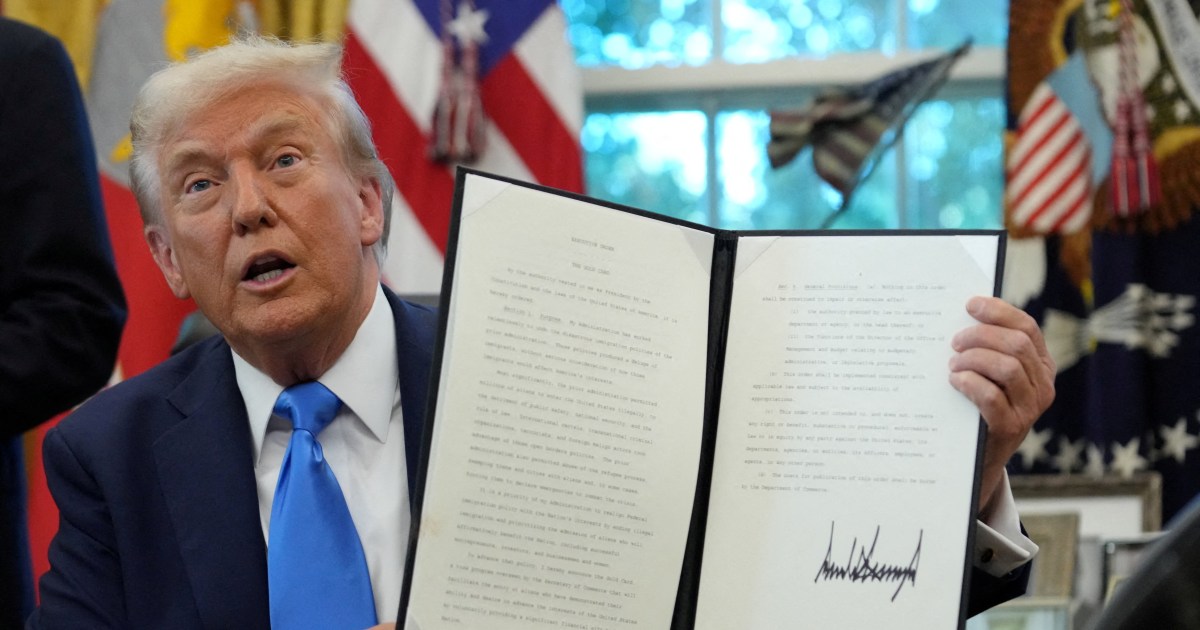

Mali and Burkina Faso have announced they are imposing full visa bans on United States citizens in retaliation for US President Donald Trump’s ban on US visas for their citizens this month.
The two West African countries, which are both governed by the military, on Tuesday became the latest African nations to issue “tit-for-tat” visa bans on the US. These follow Trump’s new visa restrictions, which now apply to 39 countries in Africa, Asia, the Middle East and Latin America. The White House said they were imposed on “national security” grounds.
- list 1 of 4Mali, Burkina Faso ban US citizens in response to Trump travel bans
- list 2 of 4Trump’s anti-immigrant policies clash with promised World Cup ‘unity’
- list 3 of 4Faced with Trump’s deportation push, US teachers fear leaving the classroom
- list 4 of 4US bars five Europeans over alleged efforts to ‘censor American viewpoints’
end of list
“In accordance with the principle of reciprocity, the Ministry of Foreign Affairs and International Cooperation informs the national and international community that, with immediate effect, the Government of the Republic of Mali will apply the same conditions and requirements to US nationals as those imposed on Malian citizens,” the Malian ministry said in a statement.
Burkina Faso’s foreign minister, Karamoko Jean-Marie Traore, in a separate statement similarly cited a reciprocity rule for his country’s visa ban.
Which countries have issued bans on visas for US citizens?
The US directive issued on December 16 expanded full US visa bans to citizens of five nations other than Mali and Burkina Faso: Laos, Niger, Sierra Leone, South Sudan and Syria.
Travellers holding travel documents issued by the Palestinian Authority were also banned from entering the US under the order.
The US cited the countries’ poor screening and vetting capabilities, information-sharing policies, visa overstay rates and refusal to take back their deported nationals for the ban.
Advertisement
Trump’s order also noted countries were additionally assessed based on whether they had a “significant terrorist presence”.
The US ban takes effect on Thursday.
Mali, Burkina Faso and neighbouring Niger have been plagued by violence from armed groups linked to al-Qaeda and ISIL (ISIS) for years. The violence in those countries has displaced millions of civilians.
On Friday, Niger banned entry for US citizens, also citing the US ban on its citizens. The country is also military-led like its neighbours Mali and Burkina Faso. All three formed the Alliance of Sahel States in July 2024 to tackle security problems and improve trade relations.
In its own reciprocal move, Chad stopped issuing visas to US citizens on June 6 with an exception for US officials. Only US citizens who were issued visas before June 9 are now allowed entry into Chad.
The country was on an initial list of 12 nations whose citizens the Trump administration issued a full visa ban on from June 9.

Which countries are affected by the US visa bans?
Citizens of 39 countries are now under full or partial entry restrictions to the US, according to the US-based Council on Foreign Relations think tank.
Those fully banned are:
- Afghanistan
- Burkina Faso
- Chad
- Equatorial Guinea
- Eritrea
- Haiti
- Iran
- Laos
- Libya
- Mali
- Myanmar
- Niger
- Republic of Congo
- Sierra Leone
- Somalia
- South Sudan
- Sudan
- Syria
- Yemen
- Holders of travel documents issued by the Palestinian Authority are also fully banned.
Those partially restricted are:
- Angola
- Antigua and Barbuda
- Benin
- Burundi
- Cuba
- Dominica
- Gabon
- The Gambia
- Ivory Coast
- Malawi
- Mauritania
- Nigeria
- Senegal
- Tanzania
- Togo
- Tonga
- Turkmenistan
- Venezuela
- Zambia
- Zimbabwe
Is Trump specifically targeting African countries with visa bans?
Trump’s approach to Africa regarding visa entries in his second term as US president is similar to that of his first administration when he issued a “Muslim ban”, which included citizens of three African nations – Somalia, Sudan and Libya – as well as Yemen, Syria, Iraq and Iran.
In later updates to the ban, Sudan was removed while Chad was added.
Most countries under US entry restrictions since Trump took office on January 20 are in Africa. Of the 39 affected countries, 26 are African nations.
How have US-Africa trade relations fared under Trump?
Tradewise, the US has shifted away from its preferential African Growth and Opportunity Act (AGOA) trade programme to a tariff-based regime that has also been applied to most other countries around the world under Trump’s tariffs policy.
Advertisement
From 2000, AGOA provided African nations with duty-free access to US markets, bolstering African exports to the US of a wide range of goods, from wine to cars.
AGOA created an estimated 300,000 jobs in African countries and indirectly sustained another 1.2 million jobs, according to the US-based Center for Strategic International Studies.
However, AGOA expired in September after the US Congress failed to renew it. Although the Trump administration said it supported a one-year extension, no steps have been announced to revive the programme.
Instead, African countries now face often steep tariffs as the US sometimes justifies them on political grounds.
South Africa, Africa’s richest country, for example, was slapped with a 30 percent tariff after Trump made debunked allegations of a “genocide” on the country’s white Afrikaner minority. The US government has since prioritised resettling Afrikaners as refugees in the US.
South African President Cyril Ramaphosa met with Trump at the White House in May and explained that crime in the country targets the population at large – not just its white citizens – but was unable to persuade Trump.
Trump’s administration is also prioritising its access to critical rare earth minerals, used to develop high-tech devices, in a bid to remain competitive with China, which mines about 60 percent of the world’s rare earth metals and processes 90 percent of them.
Trump took up a mediator role in the conflict between the Democratic Republic of the Congo (DRC) and neighbouring Rwanda this year after the DRC government proposed a minerals deal with the US. The US and United Nations accuse Rwanda of backing a rebellion by the M23 armed group in the eastern DRC.
Trump did not commit to US military intervention in the DRC but successfully secured a peace pact between the two countries on December 4 after applying diplomatic pressure on Rwanda.
Attacks on civilians by M23 have nonetheless continued despite the peace deal.
A clause in the pact granted US firms priority access to both the DRC’s and Rwanda’s mineral reserves, which include cobalt, copper, lithium and gold.

In early 2025, the Trump administration shut down the US Agency for International Development and cut billions of dollars of US foreign aid, affecting many African countries that greatly depended on the world’s largest funder of health and humanitarian aid.
Aid groups have since reported rising hunger in northern Nigeria, Somalia and northeastern Kenya.
Health observers and analysts have also raised the alarm about the risk of undoing work to prevent and contain the spread of HIV in Lesotho and South Africa.
In northern Cameroon, officials have reported a spike in malaria deaths as drug supplies fall. This month, the US unilaterally pledged $400m in health funding to the country over the next five years on the condition that Cameroon raises its own annual health spending from $22m to $450m.
Advertisement
African nations were also most affected when Trump recalled 30 career diplomats appointed by former President Joe Biden from 29 countries last week.
Fifteen of them had been stationed in African nations: Algeria, Burundi, Cameroon, Cape Verde, Gabon, Ivory Coast, Egypt, Madagascar, Mauritius, Niger, Nigeria, Rwanda, Senegal, Somalia and Uganda.
Meanwhile, the US has continued to intensify strikes against armed groups linked to ISIL and al-Qaeda, similar to those during Trump’s first term as president from 2017 to 2021.
In Somalia, the US launched strikes in September targeting al-Shabab and the ISIL affiliate in Somalia Province, according to the US-based New America Foundation think tank.
The US also targeted ISIL- and al-Qaeda-linked groups in northwestern Nigeria for the first time on Thursday.
While those strikes were carried out in collaboration with the Nigerian government, a war of narratives prevailed between the two countries.
The US claims to be “saving” Nigerian Christians, who it alleges are experiencing a genocide.
Nigerian authorities, on the other hand, deny claims of genocide and say people of all religions have been badly affected by armed groups operating in the country.
Related News
New Year’s Eve celebrations as the world welcomes 2026

Suicide bomber kills at least one police officer in Syria’s Aleppo
Israel becomes first country to recognise Somaliland