Climate fund finds friends at COP30
 21 November 2025

The Virgin Islands’ long-delayed climate fund didn’t launch internationally this month as previously planned, but a VI delegation has been laying the groundwork to roll it out next year instead.
In May, the government said the territory’s Climate Change Trust Fund — which was established by a 2015 law but not funded until this year — would be introduced to the world this month at the 30th United Nations Climate Change Conference in Belem, Brazil.
But VI delegates at the conference told the Beacon this week that more preliminary work is needed first, including hiring a CEO and establishing a secretariat.
In the meantime, the delegates have been using the Brazil conference — which is known as COP30 — to spread the word about their plans for the CCTF now that it has been seeded with an initial outlay of about $5.5 million raised from the $10 environmental levy the government has been collecting since 2017 from each overnight visitor.
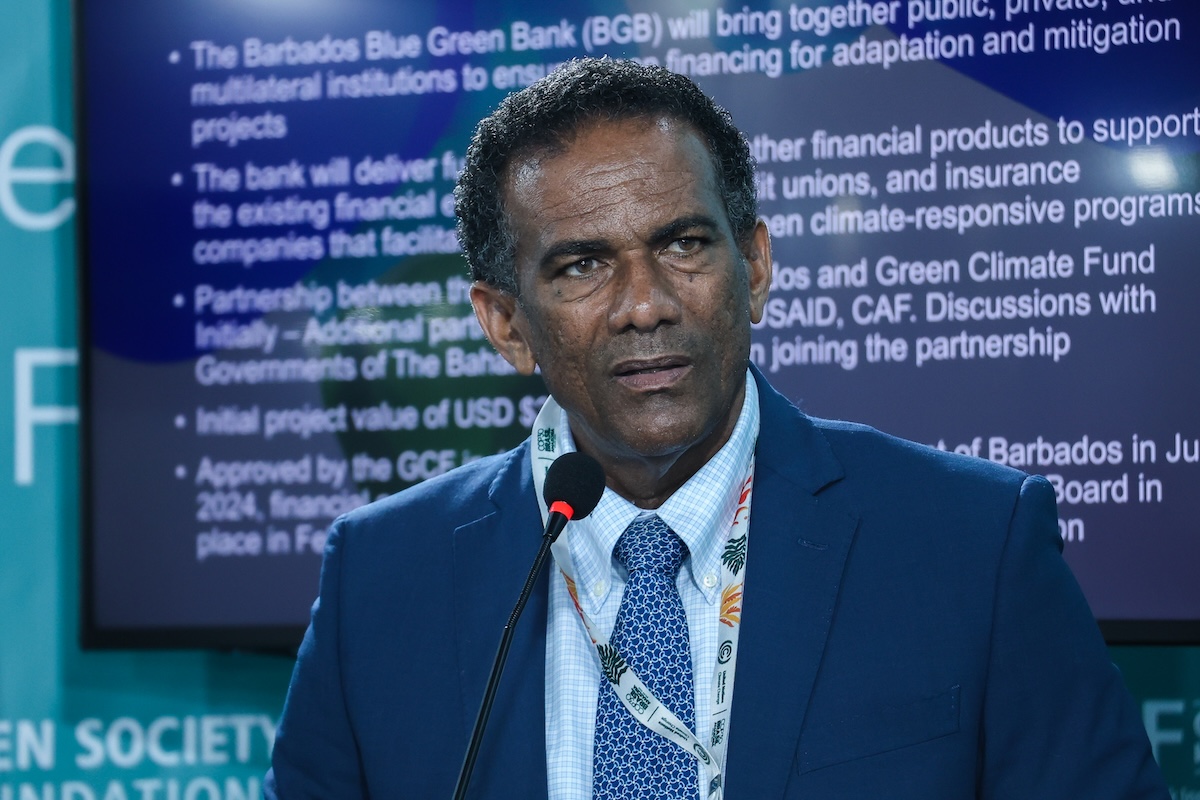
To that end, they hosted a series of climate-finance events on the sidelines of COP30 in partnership with the Caribbean Community Climate Change Centre last Thursday and Friday.
Climate envoy
At one of the events, former deputy premier Dr. Kedrick Pickering, who has been appointed as climate envoy for Premier Natalio “Sowande” Wheatley, provided a history of the fund and stressed the importance of cross-party collaboration.
“We have sought to protect our environment in a way that is sustainable,” said Dr. Pickering, who was the minister of natural resources when the CCTF’s enabling legislation passed in 2015. “We’re not just talking about climate change as a technical issue: We’re talking about climate change as it pertains to our very livelihood, because our environment is us.”
Mr. Childs also spoke, telling attendees that the fund is an independent and nationally owned financial mechanism guided by international standards and aligned with global frameworks including the 2015 Paris Agreement and the 2030 Agenda for Sustainable Development, according to government.
The VI delegation also included Ronald Smith-Berkeley, permanent secretary in the Ministry of Environment, Natural Resources and Climate Change, as well as Angela Burnett Penn, the ministry’s director of climate change.
Future priorities
Looking to the future, Mr. Childs and Ms. Burnett Penn told the Beacon this week that current priorities include hiring a CEO, establishing a secretariat and developing a business plan to drive an investment strategy and organise funding for planned projects.
These steps, they said, signal to investors that there is a framework in place for responsible management of the fund.
Though overseas territories like the VI are not currently eligible for financing from many global agencies like the Green Climate Fund — a roadblock the premier is seeking to lift — Mr. Childs told the Beacon that funding can still be sourced from donors and other mechanisms in the meantime.
To that end, he added, the plan to seed the CCTF with local money collected through the environmental levy is key.
“This is the government putting some skin in the game if you like, and that’s something that donors like to see,” Mr. Childs said. “So if you’re looking at how you’re going to tackle climate change within a small island state like the Virgin Islands, then it’s really a case of how do you operationalise yourself, how do you make sure that you can deliver on the mandate that we’ve been given by government as a trust fund.”
Showing up
Ms. Burnett Penn also stressed the importance of attendance at the Brazil event.
“COP is the global forum where real players in the climate change space meet and exchange, and so we thought it important that we be at this table,” she said, adding that the delegation was able to secure endorsements from organisations such as the Caribbean Community Climate Change Centre, the Caribbean Development Bank, and the Organisation of Eastern Caribbean States Commission.
The delegates said stakeholders at COP30 expressed strong interest in the CCTF.
“It’s important to recognise the reception that we’ve had down here from these regional and international attendees,” Mr. Childs said. “They’ve been really impressed by the structures that have gone into creating what we’ve got compared to other destinations or other territories and islands and so on.”
The series of side events in Brazil also led to measures to help operationalise the CCTF, including an agreement in principle to partner with the Caribbean Development Bank and the UN Resident Coordinator’s Office in Barbados and the Eastern Caribbean to develop and implement a capacity-building strategy for the fund, according to government.
Troubled history
The CCTF was the first of its kind in the region when it was established in 2015 with the passage of the VI Climate Change Trust Fund Act.
Board members were first appointed in July of 2017, the same year the government began collecting a $10 levy from most noncruise-ship visitors under the 2017 Environmental Protection and Tourism Improvement Fund Act.
The act requires this money to be used to combat climate change, protect the environment, and boost the tourist industry, and 40 percent of the take is earmarked for the CCTF.
But the funds collected from the eco-levy — which today amount to more than $14 million in total — were not disbursed as planned because of legislative roadblocks.
Disbanded, re-formed
Meanwhile, the board itself was also subject to political whims. Shortly after the CCTF board members were appointed in 2017, they got to work with the help of donations from their own pockets.
But in the wake of the 2019 general election, the board’s membership was suddenly revoked by then-premier Andrew Fahie — a move the 2022 Commission of Inquiry report later found to be unlawful.
Mr. Fahie’s successor, Mr. Wheatley, reappointed the board in June 2023, but the fund was still empty.
Recently, it was finally funded with about $5.5 million from the eco-levy money, according to Mr. Childs.
Freeman Rogers contributed to this story, which Mr. Contreras reported from New York.