3,500 acres added to Maya Forest Corridor
 11 November 2026
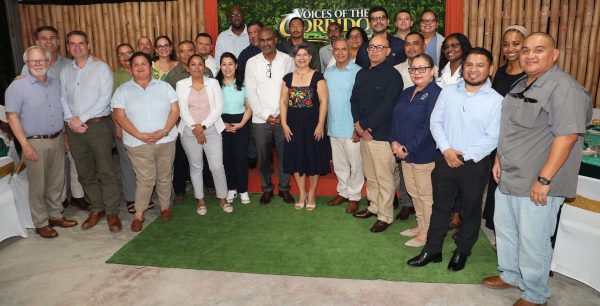

Conservation partners, landowners and communities committed to work together… in partnership with… Government… to protect Belize’s natural heritage
By William Ysaguirre
(Freelance Writer)
BELIZE CITY, Mon. Nov. 9, 2026
Belize’s protection of wildlife habitat grew by 3,500 acres which the Maya Forest Corridor Trust has added to its protected areas, with the help of conservation partners. The Trust is already steward of 236,000 acres of forest, and celebrated this milestone in partnership with the Ministry of Natural Resources, Petroleum and Mining, and the Ministry of Sustainable Development Climate Change and Solid Waste Management, in a short ceremony at the Belize Zoo on Friday, November 6.
The recently acquired 3,500 acres connects the protected lands between Labouring Creek, the Jaguar Corridor Wildlife Sanctuary, Monkey Bay National Park, and the Manatee Forest Reserve, extending the protected habitat for jaguars to connect with the Selva Maya protected area, which Belize shares with Mexico and Guatemala. The conservation partners, landowners and communities committed to work together to achieve this shared vision in partnership with the Government of Belize, to protect Belize’s natural heritage
Acting Prime Minister Hon. Cordel Hyde, as Minister of Natural Resources, expressed his delight to be a part of this initiative to finally connect this corridor and make it complete and perpetual. “This place, where our Mayan ancestors performed their religious ceremonies and secret rituals, will forever be kept intact, cradled like a baby, undisturbed by the ravages of development and exploitation. This is not a sale; this is a vesting for conservation purposes, for and on behalf of the people of Belize; so that no future government or minister will ever be able to alienate this land, that’s happened in this part in the past.”
He commended the Trust’s executive director Elma Kay PhD, of the Environmental Research Institute at the University of Belize, and chief executive officer Paul Thompson, who fine-tuned the agreement to acquire 3,500 acres of government land, which the Cabinet would easily and quickly approve. He also acknowledged executive director Kent Womack of the Liz Claiborne Art Ortenberg Foundation, which funded UB’s Environmental Research Institute in 2019, and helped to purchase the first and biggest parcel. He also gave kudos to Esteban Mora of Re:Wild, who also partnered in the land acquisition.
He thanked all the other international partners who supported a land purchase for protection efforts, and the local partners who already protect their vulnerable land. He also thanked the U.S. Embassy, Ambassador Andre Bauer, British High Commissioner Alistair White and the U.K. government for supporting the management of corridor properties through grants.
Minister of Sustainable Development, Climate Change and Solid Waste Management, Hon. Orlando Habet noted that the “National biodiversity Strategy and Action Plan 2025 to 2035 and the National Protected Area Policy recognize biological corridors as essential to the effectiveness and long-term integrity of our protected areas system. This initiative also advances Belize’s commitments under the Kunming-Montreal Global Biodiversity Framework on ecosystem restoration, and conserving at least 30 percent of our lands and waters through ecologically representative, well-connected, and effectively managed protected areas, and other effective area-based conservation measures.”
Habet further stated, “By linking the Maya Mountain Massif with northern Selva Maya, we help safeguard the great Maya forest and its shared heritage. Forests do not recognize political boundaries; their protection requires cooperation beyond our borders, a shared vision and sustained collective action. The Maya Forest Corridor demonstrates that conservation and sustainable development can advance together. Healthy ecosystems and thriving communities are interconnected. The corridor must therefore work not only for wildlife, but also for the people who live in and around it. The communities must be recognized as partners, with meaningful opportunities to participate in decisions and benefit from its conservation. We must promote tangible livelihood opportunities through sustainable tourism, local enterprises restoration, and other compatible economic activities, alongside regenerative agriculture, climate resilient livelihoods, and responsible land management. Our conservation efforts must respect and integrate community, cultural and traditional practices, while creating meaningful opportunities for women and young people,” Habet affirmed.
Elma Kay thanked her many partners who supported her efforts over the past 7 years “to bring the vision alive of an integrated landscape that’s managed to ensure that we have thriving wildlife, that is such a part of our natural heritage and livelihoods. Protecting forest is also protecting our cultural heritage in the form of so many archaeological sites that go back thousands of years to our Maya ancestors; our historical sites for our Creole culture, because the first to free themselves from the shackles of slavery were those who actually found refuge in the coastal hills and caves of the corridor. Today we celebrate the corridor’s incredible biodiversity, from our iconic jaguars who are endangered, white-lipped peccaries, monkeys and tapirs; the special seasonally inundated forest and savannahs that act as flood retention zones to protect our communities; amazing lagoons and riverine systems that harbor globally critically endangered species, like our beloved hickatee,” Kay enthused.
Related News
Man Accused of Beating St. Croix Resident and Setting His Home on Fire After Police Complaint

Amandala #3970 Friday , October 70, 2026
Government of Belize protests GAF aggression on the Sarstoon River